


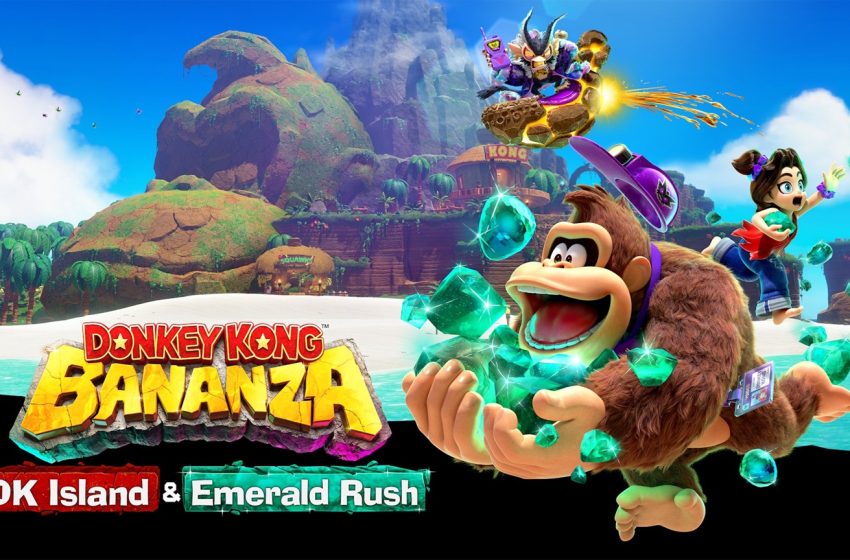
Donkey Kong Bananza’s Emerald Rush is one of Nintendo’s best and most underrated DLCs
In this day and age, there are plenty of controversies surrounding video games – and it feels like there’s a new Nintendo-adjacent controversy every other day. To be fair, though, many of those controversies are valid – some recent ones that come to mind are Xenoblade Chronicles X: Definitive Edition’s poor upscaling on Nintendo Switch 2 and the sky-high prices for amiibo.
One Nintendo controversy that wasn’t justified in my opinion, however, was Donkey Kong Bananza’s DLC. When I reviewed Emerald Rush a few months ago, I had played the new mode for somewhere around 15 hours and wasn’t quite hooked. Nearly six months later, however, and that’s changed – I find myself going back to Donkey Kong Bananza every month or so to play the new in-game events. Super Mario Odyssey had a somewhat similar system with Luigi’s Balloon World, but that doesn’t compare to Emerald Rush at all – I remember a ton of balloons in Luigi’s Balloon World being placed out-of-bounds, so the mode wound up more like a showcase of game knowledge (including technical strategies and especially glitches). Emerald Rush, however, is where the bulk of Donkey Kong Bananza’s challenge lies. And it’s a very rare case of a 3D platformer that’s kept me coming back six months later without replaying the story from the beginning.
It’s no secret that Donkey Kong Bananza, save for the final boss fight, is generally very easy. Standard bosses often go down in just a few seconds if you know what you’re doing, and you can smash your way through each layer skipping every Banandium Gem if that’s how you want to play (it’s good to have freedom, though!). One thing I’ve noticed is that Nintendo games have been getting easier – that is, the ones designed to have mass appeal. You’ve got easy mode in Kirby and the Forgotten Land, Assist Mode in Super Mario Galaxy, Super Mario Galaxy 2, and Super Mario Odyssey, and invincible characters like Nabbit in New Super Mario Bros. U Deluxe and Super Mario Bros. Wonder. Though this lack of difficulty can be frustrating, it’s clearly meant to ensure that players new to video games will be able to ease themselves into these titles. Another component of this approach is to put the tough challenges exclusively in the postgame, and this is the case for Donkey Kong Bananza as well. Emerald Rush can be played on several different difficulties, and you can eventually unlock the ability to play the mode on every layer except for a few, which we’ll discuss later. For full 100 percent completion of the DLC, you’ll have to clear all seven difficulties of Emerald Rush on every available layer. The first difficulty, as you might expect, is easy – but that last difficulty level will challenge you in a way that the rest of Donkey Kong Bananza cannot.
Here’s the general gist of how Emerald Rush works: all gold in layers turns into emeralds, and you try to collect as many as possible. You earn perks that increase the emeralds you get – for example, one perk increases the number of emeralds proportionate to the amount of times you perform spin jumps, and another increases emeralds the more you use consecutive water-bounce jumps (which is an obscure move Donkey Kong can use when he’s right next to a body of water). In the base game itself, these moves are never required. But in Emerald Rush, every single one of DK’s moves can potentially make or break your run. At the beginning of each Emerald Rush run, DK’s skills are also reset, and you can earn them back with Banandium Chips. This creates an incredibly fun system where you’re managing your resources, hurrying around finishing one task after another to earn emeralds, and showcasing your knowledge of each layer and its fossil and enemy locations to really stack on the emeralds. There’s a lot of knowledge required to ace Emerald Rush, and though it takes a while to learn where exactly every fossil is, the payoff is incredibly satisfying. And, if you become good at Emerald Rush, you’ll also be one step closer to being able to pull off better speedrun strategies, too.
You can play Emerald Rush on every stage, with the following exceptions: Ingot Isle, The Divide, The Junction, the Racing Layer, the Groove Layer, and the final two layers as well. The reason these aren’t playable is because Emerald Rush wouldn’t really work here – for example, the Racing Layer has very little in terms of actual resources, and there’s not enough space for Donkey Kong to run around and finish up Void Goals to earn emeralds. The same logic applies to the other unplayable layers – they’re too small to be viable for Emerald Rush. That still leaves plenty of levels to experience, though, and you unlock more and more of them as you play the mode. There are also plenty of rewards in the form of new equipment. That’s another thing – a lot of times, equipment like the Soggy Cravat (which makes DK immune to lava) and the Treasure Tie (which increases the appearance rate of treasure chests) can make or break a run as well. There’s a lot to consider with Emerald Rush – we’re talking many multiple layers of strategy.
And none of this is even mentioning the limited-time events, which likely will be re-run at some point in the future. The most recent one at the time of writing took place in the Forest Layer, and during these events, only a hand-selected spread of perks will ever appear. For this event, the perks that appeared were all based around the Ostrich Bananza. To win this event, you had to stay in Ostrich form as often as possible, fly around as often as possible, and drop as many egg bombs as possible while finishing Void Goals, collecting fossils, and defeating enemies. Each event has its own intended solution, and it’s up to you to figure out how to get the 1,000,000 emeralds you need to unlock both statue rewards. Emerald Rush is a true test of skill, which is something Donkey Kong Bananza really needed.
With all of this being said, Bananza’s DLC received backlash on launch for its $20 price point. Generally, Nintendo games are complete for several months before they release – bug testing and such takes a long time, and even outside of that, it’s rumored that games like Metroid Prime Remastered and Fire Emblem Engage were fully complete for months before being launched later. With that in mind, it’s easier to understand why the DLC was released just three months after Bananza’s initial launch. But at the same time, much of the controversy was directed to its content – I saw countless social media posts complaining that $20 for a hub world was too much, even though that’s not what this DLC is. DK Island is included as a nice little bonus, but is by no means a big part of the DLC in practice. Nintendo’s marketing made DK Island seem like the focus of the DLC, when the focus is actually the roguelike mode that easily adds over 50 hours of playtime. I don’t think anyone would complain at spending $20 for 50 hours of playtime, to be honest, so I do agree the marketing should have been different and less focused on DK Island.
At the end of the day, though, Emerald Rush remains one of Nintendo’s best DLC packages. It’s definitely a step below Xenoblade Chronicles 3: Future Redeemed and Splatoon’s Octo Expansion, for example, but it’s still a good value that opens up dozens of hours of play time and true challenges for those interested. Most of the time, the only replay value a 3D platformer will have is restarting the game from the beginning and doing a challenge run or something of the sort. But Emerald Rush lets you keep your save file while challenging yourself to the toughest tasks the game has to offer. Plus, there’s a Chunky Kong statue you can get as a reward. That’s probably important too.
What are your thoughts on Emerald Rush? Did it manage to hook you? Let us know in the comments down below.
Related
First Appeared on
Source link






