


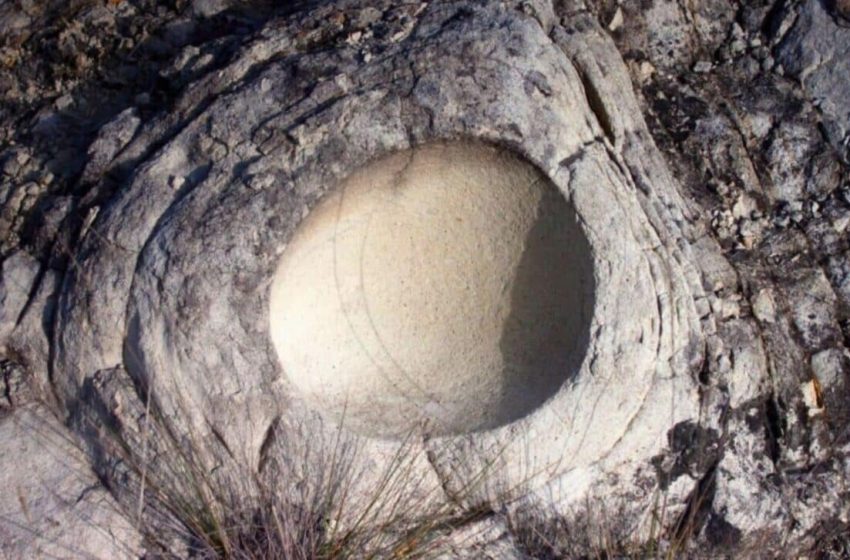
Scientists Uncover a 68-Million-Year-Old Dinosaur Egg Inside Another Egg
On a 2017 field survey in central India, a team of researchers documented a cluster of 11 fossilized eggs arranged in a shallow depression within the Lameta Formation. The region had produced dinosaur material before, but this clutch stood out because each egg measured roughly 15 centimeters across and shared an unusually consistent shape. The team recorded the position of each specimen, removed surrounding sediment, and prepared them for laboratory study.
During the initial inspection, nothing appeared unusual. The eggshell texture suggested they belonged to titanosaurs, large herbivorous dinosaurs common across the Late Cretaceous landscapes of the Indian subcontinent. But one specimen showed a subtle curved shadow beneath its outer shell, barely visible until proper lighting revealed its outline. That faint curve prompted the team to flag the egg for deeper imaging.
When the eggs reached the lab, specialists began CT scanning the specimens. The scans showed a second arc-shaped structure inside the unusual egg. At first, the researchers considered the possibility of a collapsed shell, a common deformation seen in buried fossils. But the inner curvature held a smooth, uninterrupted arc rather than the jagged fold expected in compression damage. The team increased scan resolution to determine whether this internal shape represented a biological layer.
The Layer Hidden Inside the Fossil
High-resolution imaging confirmed two separate curves divided by a thin strip of sediment. This separation suggested that the internal form was not a sediment fold. The research team compared the images with collapse patterns known from other titanosaur eggs. None of those examples matched the geometry captured inside this specimen. The distinct layering pointed toward ovum-in-ovo, a condition previously recorded only in birds.
At this point, Dr. Guntupalli Prasad of the University of Delhi began leading the analysis. He and his colleagues referenced earlier studies published in Scientific Reports, which documented titanosaur nesting traits from nearby regions. Those papers provided baseline measurements for eggshell thickness and curvature, helping the team evaluate whether the inner arc represented a second developing shell. The structure matched those ranges closely, reinforcing the interpretation.
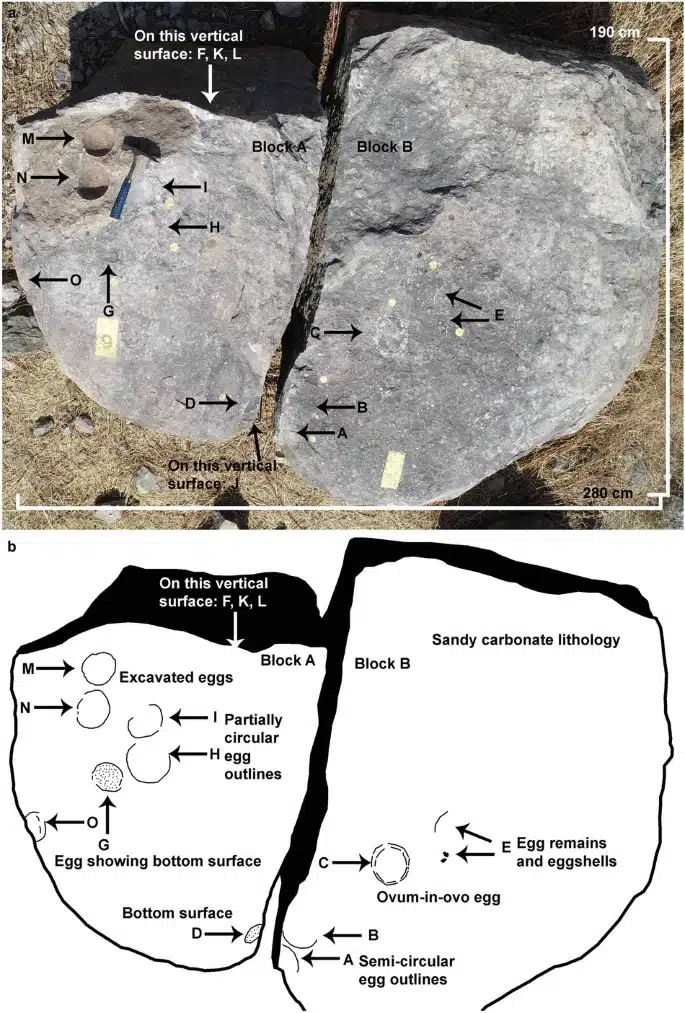
The outer eggshell measured 2.6 millimeters, and the inner form measured about 2 millimeters. Both fit within known titanosaur eggshell parameters. The team also examined mineral orientation across the two layers. They found consistent biological growth patterns on both curves, indicating that each had once developed independently inside the reproductive tract.
Why the Double-Shelled Egg Matters
A true ovum-in-ovo structure means a second layer formed around an already-developing egg after it reversed direction internally. Modern reptiles do not form such structures. Birds do. Before this discovery, no confirmed non-avian dinosaur egg had ever shown this pattern. The specimen therefore provided rare evidence that titanosaur reproductive biology may have resembled avian systems more closely than previously thought.
The researchers examined the rest of the clutch for comparison. None of the other 10 eggs showed any sign of secondary layering. All displayed single-shell architecture and typical mineral deposition. The isolated nature of the double-shell structure supported the idea that it resulted from an internal reproductive event rather than external pressure or deformation. The curvature ratio of the inner layer also differed from collapse artifacts and matched biological layering far more closely.
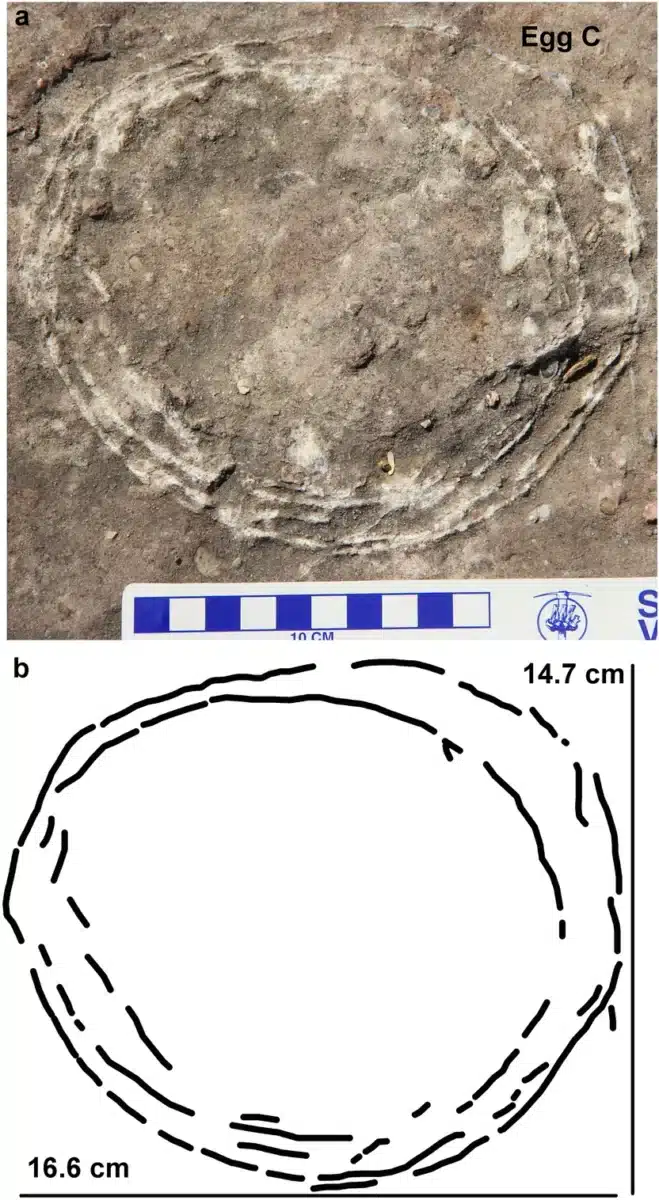
Another clue came from the incomplete circumference of the inner shell. It did not extend across the full diameter of the egg. Instead, it stopped partway, a pattern consistent with avian ovum-in-ovo, where the redirected egg receives only partial encapsulation before laying. These details encouraged the team to continue microstructural analysis to map how the layers formed.
How Researchers Reconstructed the Egg’s Development
Dr. Prasad’s team studied shell microtextures using scanning electron microscopy. The images revealed two sets of columnar calcite growth, separated by a thin mineral gap. That gap was significant because compression would have crushed or smeared such boundaries. Instead, the gap preserved a sharp separation, indicating that the two shells formed at different times inside the oviduct.
The sediment trapped in the gap provided another piece of information. The grains were finer than those surrounding the rest of the clutch, implying the separation occurred before the egg was completely buried. This detail helped estimate the timing of the internal reversal event. The team concluded that the inner egg reversed direction shortly before being encapsulated by the second shell.
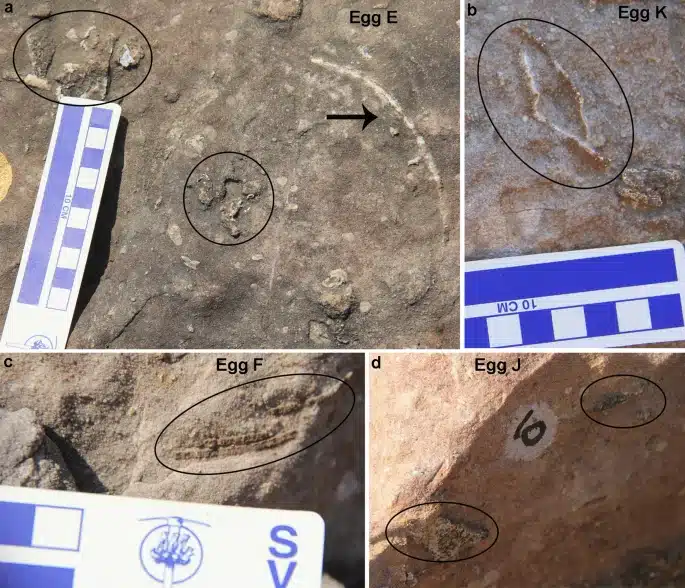
Crystal alignment offered additional support. Both shells showed outward radial growth, suggesting similar physiological conditions during deposition. These findings aligned with avian reproductive mechanics, where segmented oviducts allow secondary shell formation following irregular movements inside the tract.
What the Study Suggests About Titanosaur Reproduction
The structure provided evidence that titanosaurs may have possessed a reproductive system with segmented oviducts, similar to birds. Reptiles lack this organization and cannot form dual shells. This detail supported growing hypotheses that some dinosaur lineages used reproductive strategies closer to birds than reptiles. The finding also aligned with earlier evidence of group nesting, in which titanosaurs laid eggs in large clusters across wide regions.
The research team cited Guntupalli Prasad when explaining how the fossil differed from deformation patterns. Dr. Prasad said the preserved structure “showed clear separation between the two shell layers,” emphasizing that the observed shape was not the result of geological pressure. That separation also helped the researchers confirm that the inner shell represented an independent biological event.
Measurements of pore density added another supporting detail. The outer shell displayed normal titanosaur porosity, suggesting it had fully developed before forming around the redirected inner egg. This sequence matched avian ovum-in-ovo timing, where the secondary shell forms only after initial development is complete.
A Rare Window Into Ancient Physiology
When the team compared the specimen with more than 250 titanosaur eggs catalogued from the region, none displayed similar internal layering. The absence of comparable examples underscored the rarity of the condition but kept it within the boundaries of documented reproductive biology. High-resolution scans of the fossil are now archived for further comparative work at additional institutions.
The preserved dual-shell architecture offers a rare glimpse into a reproductive process seldom captured in the fossil record. After 68 million years, the specimen remains one of the clearest examples of sequential eggshell deposition in a non-avian dinosaur.
First Appeared on
Source link






