



In a First, Private Investors Will Fund a Telescope Bigger Than Hubble for $500 Million
A new private space observatory, the Lazuli Space Telescope, is on track to surpass Hubble with its larger mirror and cutting-edge technology. Funded by former Google CEO Eric Schmidt and his wife Wendy, the project is already turning heads in the space community.
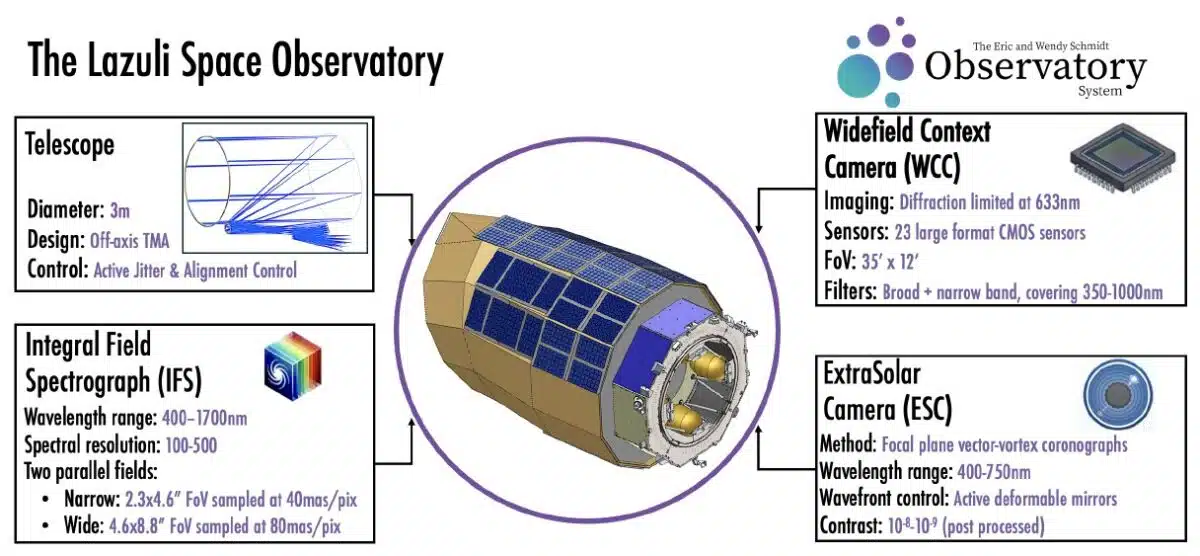
At its core, Lazuli’s three-meter mirror will make it one of the largest space telescopes ever built, capable of observing both optical and infrared light. While other telescopes, like Hubble, have paved the way for modern astronomy, Lazuli promises to build upon their legacy with better speed and efficiency, thanks to its private funding and quick-turnaround development. If everything goes as planned, this ambitious project could reshape our understanding of the universe in just a few short years.
How a $500 Million Telescope Is Ushering in a New Era
The Lazuli is a bold leap into a new era of space exploration. Gone are the days when NASA or ESA were the primary forces driving scientific missions. Instead, the Schmidt family’s willingness to pour millions into the Lazuli project represents a growing trend: private sector involvement in space science. It’s a game changer, particularly because the funding allows for quicker, more flexible timelines.
As noted in a recent report avaliable on arXiv, private ventures like Lazuli are not bound by the slow-moving bureaucracies that often plague government agencies. According to the team, this means they can take on more risk, experiment with untested technologies, and adapt faster to challenges as they arise. Most space missions take decades to develop, however, Lazuli could launch in as little as three to five years.
Revolutionary Observations
What really sets Lazuli apart from its predecessors is its speed. While Hubble and other space telescopes need days to reposition and respond to cosmic events, according to the team behind the telescope:
“Operating from a lunar-resonant orbit, the observatory will be able to respond to external targets of opportunity within four hours of trigger receipt, with a goal of 90 minutes, and will support continuous observations of individual targets for up to ~12 hours.”
That’s a remarkable feat, especially considering the fast-paced nature of some astronomical phenomena, like supernovae or gamma-ray bursts.
This ability to rapidly respond to alerts could make Lazuli a game-changer for astronomers. It could allow them to capture more data on fleeting events, helping to fill in the gaps of our understanding of everything from exploding stars to the formation of black holes.
Pushing the Boundaries of Exoplanet Discovery
Another exciting aspect of the Lazuli mission is its coronagraph, a tool that will help astronomers detect exoplanets orbiting nearby stars. It works by blocking out the bright light from stars, allowing the telescope to spot planets in their orbit.
While other telescopes like the Roman Space Telescope are set to look for exoplanets, Lazuli’s slightly larger mirror, and innovative design, could give it the edge it needs to find planets faster and more effectively. As the team explained in a statement published by Schmidt Sciences:
“The mission adopts an open data philosophy, with science-ready data products released to the global community following quality assurance and calibration, typically within days.”
First Appeared on
Source link






