


Cue the allergies and time change, the flu vaccine process is starting, WH’s impact on Tylenol, and good news
Anyone else dragging this week? Daylight saving time has arrived, along with the coffee dependency and the annual chorus of “why do we still do this?” But the time change also has real health effects. More on that below.
Also, the respiratory season is finally winding down, but spring viruses are already stepping in to fill the void. The flu vaccine process for next season has begun, and it’s already getting complicated. New data reveal just how much harm a single White House briefing caused for pregnant patients in emergency departments last fall.
Here’s what it all means to you and your health.
The winter respiratory season is finally easing. After six weeks stuck at high levels, influenza-like illness is starting to decline. Good riddance.
That said, RSV and common cold viruses are still climbing. Some outlets are dramatically overhyping a rise in one in particular: HMPV (black in the chart below). But… this virus isn’t showing anything unusual. A rise is normal, starting in March and peaking in April and May.
What is HMPV? It’s a virus related to RSV, and causes similar symptoms (cough, fever, congestion, shortness of breath). For healthy kids and adults, HMPV is typically a miserable cold. But for infants, older adults, and the immunocompromised, it can be as serious as RSV. Like many viruses, HMPV has no vaccine or treatment, and care focuses on symptom relief.
What this means for you: Expect more snotty noses and cranky kids, but nothing unusual so far this spring season. Full viral reprieve will come in another month or two.
And, did anyone catch the measles plot on The Pitt? I addressed it on social media.

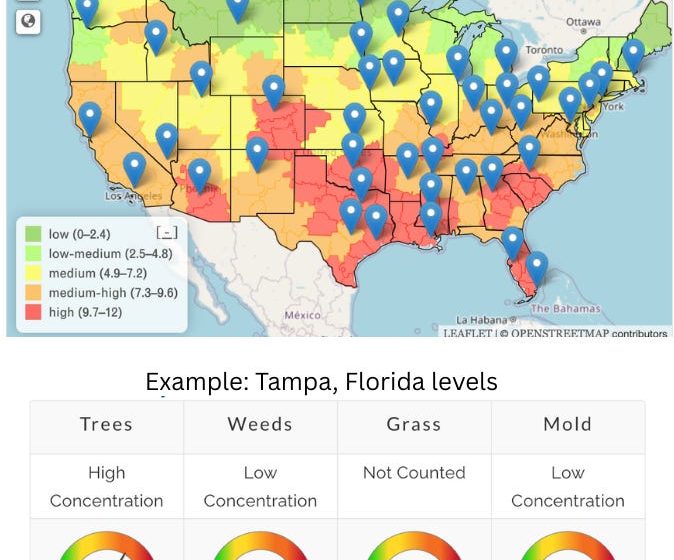
My husband is downstairs sneezing up a storm. And I know it’s not just him: Google Trends shows an enormous spike in googling allergies. If we look at pollen data, the Southern portion of the country has high levels, specifically from trees.
Allergy season is becoming longer—plants are releasing pollen earlier in the year (about 40 days earlier) and stopping pollination later in the year (about 2 weeks later)—due to rising temperatures. There’s also more pollen because of the increased amount of CO2 in the atmosphere.
What this means for you: You’re getting exposed to more “pollen grains,” and your immune system may be irritated by them. Dr. Zach Rubin, an allergy doctor, joined us on our podcast America Dissected last year and gave great tips on managing allergies:
-
Rinse your nose regularly with saline water (just like you brush your teeth)
-
Go with second-generation antihistamines, like Zyrtec, instead of Benadryl. Benadryl was made in the 1940s as one of the first antihistamine drugs, but it has a lot of side effects. Always chat with your doctor for more information.
The U.S. annual flu vaccine rollout is a six-month process with many moving parts, refined over more than half a century. It feels early (flu is just now receding), but the sequence has to start now so vaccines are ready for you in the fall.
Last year’s process was a mess: pieces missing, timelines wobbling, disrupted by federal disarray and ideological interference.
Will this year be any different? Too soon to say.
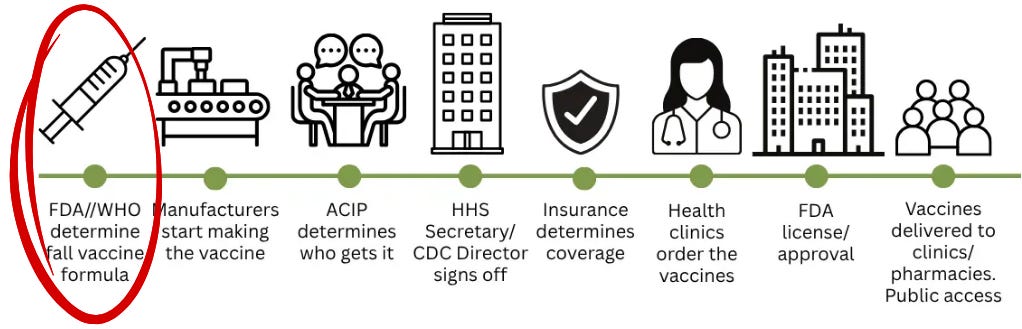
Where things stand: Last week, WHO made its official vaccine formula recommendation: a three-strain (trivalent) formula with one newcomer. Subclade K is a subvariant of flu that mutated enough to behave differently from its parent strain. It only emerged last August and has already driven record-breaking hospitalizations in several states.
Although the U.S. formally withdrew from WHO earlier this year, CDC flu experts were granted an exception to attend the meeting virtually. That’s good news because global data sharing is essential regardless of politics. Two of the three recommended strains came from viral samples collected right here in Missouri and Pennsylvania.
The U.S. doesn’t automatically follow WHO’s recommendation. We run our own process through an FDA advisory committee called VRBPAC, which rarely diverges from WHO. But this year it might.
The uncertainty: The data clearly support an updated vaccine. Whether Americans get one is another question, for two reasons:
-
Formula in flux. RFK Jr.’s political leadership signaled a new framework that would require randomized controlled trials (RCTs) for fall vaccine approval. This is a serious problem: flu mutates fast, production must begin months before the season starts, and there’s simply no room for the long timelines RCTs require. This is also not necessary. Flu isn’t a brand new vaccine. Rather, we tweak it like editing a word or two in a Word document—we don’t create a whole new document.
-
Leadership chaos. Vinay Prasad, the official overseeing this process, is stepping down after an extraordinarily turbulent tenure.
What this means for you: You will almost certainly have a flu vaccine this fall. The open question is whether it’ll be an updated formula (matching this season’s strains, like the rest of the world will get) or last year’s formula held over due to impossible approval standards. The latter isn’t catastrophic, but it’s a poor strategy against a fast-mutating virus.
What’s next: VRBPAC meets this week. You can submit a public comment here.
On September 22, 2025, President Trump held a White House briefing in which he claimed that acetaminophen, the active ingredient in Tylenol, was linked to a “very increased risk of autism” in children when used during pregnancy. This claim was not backed by new data or new scientific evidence. Read more in our response here. At the same briefing, the White House promoted leucovorin (folinic acid) as a treatment for autism.
New data is showing just how much words matter. Researchers at Brigham and Women’s Hospital and Harvard tracked prescription orders at a hospital before and after the White House announcement. What did they find?
-
Orders for acetaminophen for pregnant women at emergency departments dropped 20%. There was no corresponding change in orders for non-pregnant patients. Prescribing rates gradually crept back toward baseline.
-
Prescriptions of leucovorin for children ages 5–17 jumped 71%. This translates to roughly 25 additional children per 100,000.
On acetaminophen: This is just devastating. For pregnant patients in pain or with a fever, the ED is often the last resort. These are people who are already suffering. Acetaminophen is one of the very few tools available to treat them safely, and because of a baseless claim made at a press briefing, even that was being withheld. Untreated fever in pregnancy is associated with miscarriage, birth defects, and premature birth.
On leucovorin: A small body of research suggests that leucovorin may help a subset of autistic children, particularly those with cerebral folate deficiency. But the largest supporting study included just 77 children, and it was retracted in January due to data errors. This means in the hospital prescriptions study, given the rarity of this disease, the president’s claim has likely replaced clinical judgment.
What this means for you: Acetaminophen remains the safest available pain and fever reducer during pregnancy. If you are pregnant and have a fever or pain, talk to a clinician and take acetaminophen.
With the spring forward change, we lose an hour of sleep. Research has consistently linked the springtime change to a temporary increase in heart attacks, strokes, and fatal car crashes in the days following the shift. The disruption to your circadian rhythm—your body’s internal clock—is the driver. Even a small decrease in sleep can spike stress hormones and affect blood pressure, metabolism, and alertness.
What this means for you:
-
Prioritize morning light. Get outside in the morning during this first week. Sunlight is the strongest signal to reset your circadian clock.
-
Go easy on evening screens. That extra evening light from the time change already delays melatonin. Screens make it worse.
-
Florida’s rollback of school vaccine requirements is stalled. Despite Surgeon General Joseph Ladapo’s dramatic announcement last fall that Florida would eliminate all school vaccine requirements, the Florida Legislature did not take up the proposal. House Speaker Daniel Perez confirmed this week that the House version of the bill was never heard in committee and won’t be brought to the floor.
-
Shift in vaccine communications. CDC Acting Director Jay Bhattacharya posted a video last week simply saying the measles vaccine works and that vaccination is the most effective protection against measles. When you’ve been banging your head against a wall, stopping, even briefly, feels worth noting. We’ll take it. (Read our recent piece on Bhattacharya here.)
Every week, 230 million people turn to chatbots like ChatGPT with health-related questions. These tools are fast, flexible, and available anytime, but are they actually giving sound advice? How do these models work? How do we get better as end users? How do we talk to our communities about their strengths and limitations?
Join me, Alex Byrnes (Dewey), and Brian Anderson (Coalition for Health AI) for a webinar on March 17 at 3pm PT.
This webinar is exclusively for paid YLE subscribers. There’s a 500-person limit for this one, so get your seats! Here’s how to register…
First Appeared on
Source link






