


‘Easter comet’ could be visible in daytime skies this April — if it survives a fiery dive past the sun
A newly discovered comet could put on a dazzling show in the coming weeks and if it survives a fiery brush with the sun, it might even become an ‘Easter comet’ visible in early April.
Comet C/2026 A1 (MAPS) was discovered photographically on Jan. 13 at the AMACS1 observatory in San Pedro de Atacama, Chile, by four French astronomers. The group runs a dedicated near- Earth asteroid search program called MAPS, an acronym based on their last names — Alain Maury, Georges Attard, Daniel Parrott, and Florian Signoret.
Article continues below
Since then, the comet has brightened some 600-fold to magnitude 11, bright enough to be readily detected in amateur telescopes of 8 to 10-inch aperture. It will likely ramp up in brightness in the coming days and weeks as it races toward an extreme rendezvous with the sun on April 4.
Why it’s exciting
What makes this potentially exciting is that Comet MAPS has been identified as a Kreutz sungrazer. Some of the brightest comets in history were members of the Kreutz group. Examples include the Great Comets of 1843 and 1882, and Comet Ikeya-Seki of 1965. The most recent Kreutz comet that put on a fine showing was Comet Lovejoy in December 2011.
Comet MAPS will arrive at its perihelion — its closest approach to our star — at around 10 a.m. EDT (1400 GMT) on April 4.
At that moment, the comet will pass just 99,000 miles (159,300 km) from the solar photosphere. Since it will be passing through the sun’s intensely hot corona, where temperatures can reach about 2 million degrees Fahrenheit (1.1 million degrees Celsius), there is a possibility that the comet may not survive, likely being either completely consumed by the extreme heat or torn apart by the sun’s massive gravitational tidal forces.
But Lovejoy’s predicted path does not take it directly into the sun. To escape such a fate, the comet must move incredibly fast. Around the time of its closest approach, the comet will whip around the sun on a hairpin-like curve at a speed of over 1 million miles per hour.
Daytime visibility?
On his Visual Comets in the Future webpage, Seiichi Yoshida of Japan has Comet MAPS peaking near magnitude -5 at perihelion, which would make it about as bright as Venus.
Around that time, the comet will be passing just to the immediate left of the sun, possibly tempting some to try and see it as a speck of light by blocking out the dazzling disk of the sun with their thumb or outstretched hand.
However, as in the case of watching a partial solar eclipse, there are inherent dangers in attempting to sight a comet so close to the sun. Viewing the comet itself poses no danger, but potential danger lies in staring at the sun, whose infrared rays can burn the retina of the eye and cause irreparable damage, all without causing any pain. It should be emphasized that neither sunglasses, telescopes, nor binoculars will protect against the type of eye damage that could ultimately result in blindness when a person, however briefly, looks directly into the sun’s rays.

The safest way to watch
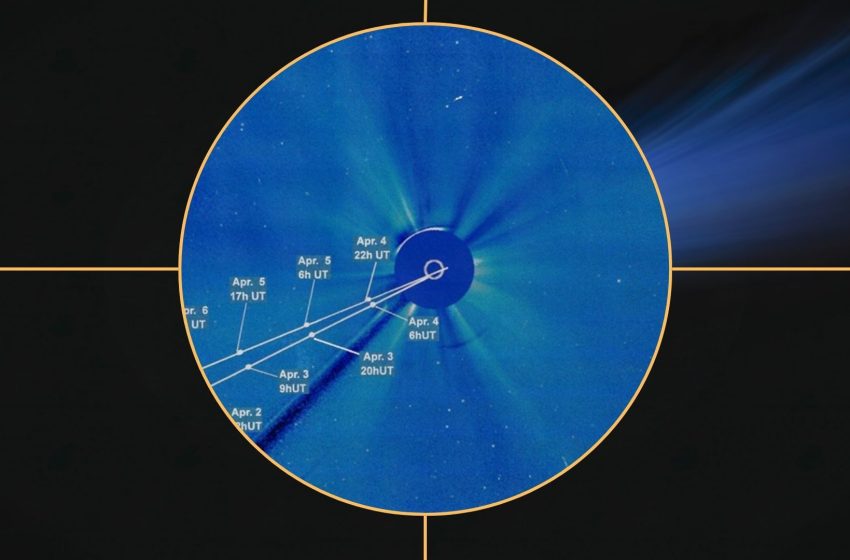
By far the safest way to watch the comet’s close brush with the sun is to view it on your computer screen courtesy of the Solar and Heliospheric Observatory (“SOHO”). Astronomers hope to get spectacular views of the comet by utilizing SOHO’s LASCO (Large Angle and Spectrometric Coronagraph Experiment) C3 camera and accessing either near-live images or videos that span the past 24 hours.

Back in October 2024, the public was captivated when SOHO captured Comet Tsuchinshan-ATLAS sweeping closely past the sun. Since it was launched in 1995, literally thousands of otherwise unknown comets have been first detected in SOHO imagery, generating competition among a handful of armchair astronomers. To date, SOHO officials have reported more than 5,000 comet discoveries using that spacecraft’s LASCO C3 imagery.
Comet MAPS will be within range of the LASCO C3 imagery from April 2 at 8:00 a.m. EDT (12:00 GMT) through April 6 at 1:00 a.m. EDT (05:00 UTC). During a roughly four-hour timespan centered on the time of perihelion, the comet will appear to pass behind the sun as seen from our earthly perspective, then rapidly swing around and cross in front of the sun.
First Appeared on
Source link






