


Humans Could Live Up to 200 Years If Scientists Harness a Protein That Repairs DNA Damage
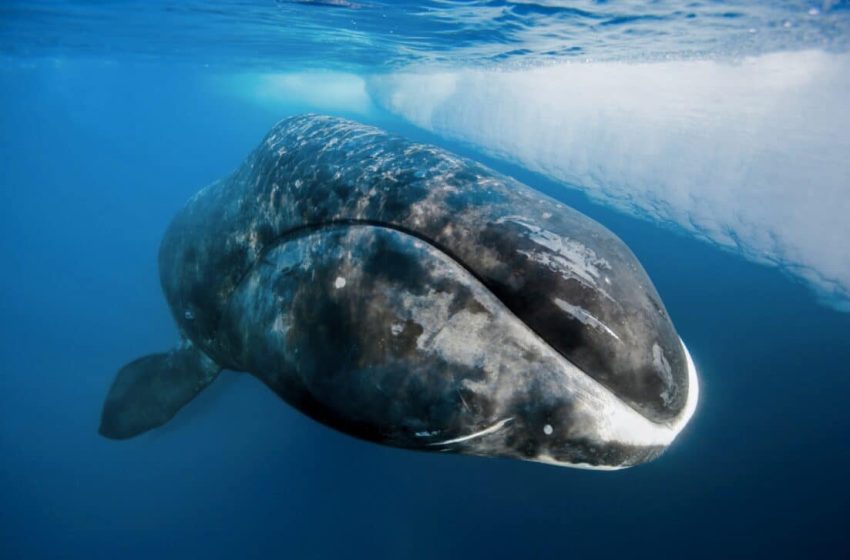
Deep beneath the shifting sea ice of the Arctic Ocean, a massive marine mammal moves slowly through waters that remain near freezing for most of the year. The animal, known as the Bowhead Whale, can weigh more than 100 tons and measure up to 18 meters in length, making it one of the largest mammals on Earth. Yet what most fascinates scientists is not its size but its extraordinary lifespan. Researchers have long suspected that the Bowhead Whale possesses biological mechanisms that allow it to remain healthy far longer than most other mammals.
For decades, scientists studying the Bowhead Whale have documented evidence suggesting these animals can survive well beyond 100 years, with some estimates exceeding 200 years. One striking clue emerged when hunters recovered a Victorian-era harpoon tip from a living whale in Arctic waters.
Records showed the weapon had been manufactured around 1890, indicating the animal had survived with the harpoon lodged in its body for more than a century. Later analysis of eye lens proteins, a technique used to estimate age in whales, suggested that some Bowhead Whale individuals may live up to 211 years in the wild, according to findings discussed in research on whale longevity published in PubMed.
A Biological Puzzle Hidden Inside Giant Bodies
The extreme longevity of the Bowhead Whale presents a major challenge to conventional biological expectations. Large animals contain trillions of cells, and each cell carries DNA that can accumulate damage over time. In theory, organisms with more cells should face a much higher risk of developing cancer or other diseases linked to genetic mutations.
Yet whales do not show dramatically higher cancer rates compared with smaller animals. This contradiction is known as Peto’s paradox, a concept that describes why large species do not experience the levels of cancer predicted by simple statistical models. The paradox suggests that animals like the Bowhead Whale must possess particularly efficient systems for maintaining genetic stability over long periods of time.
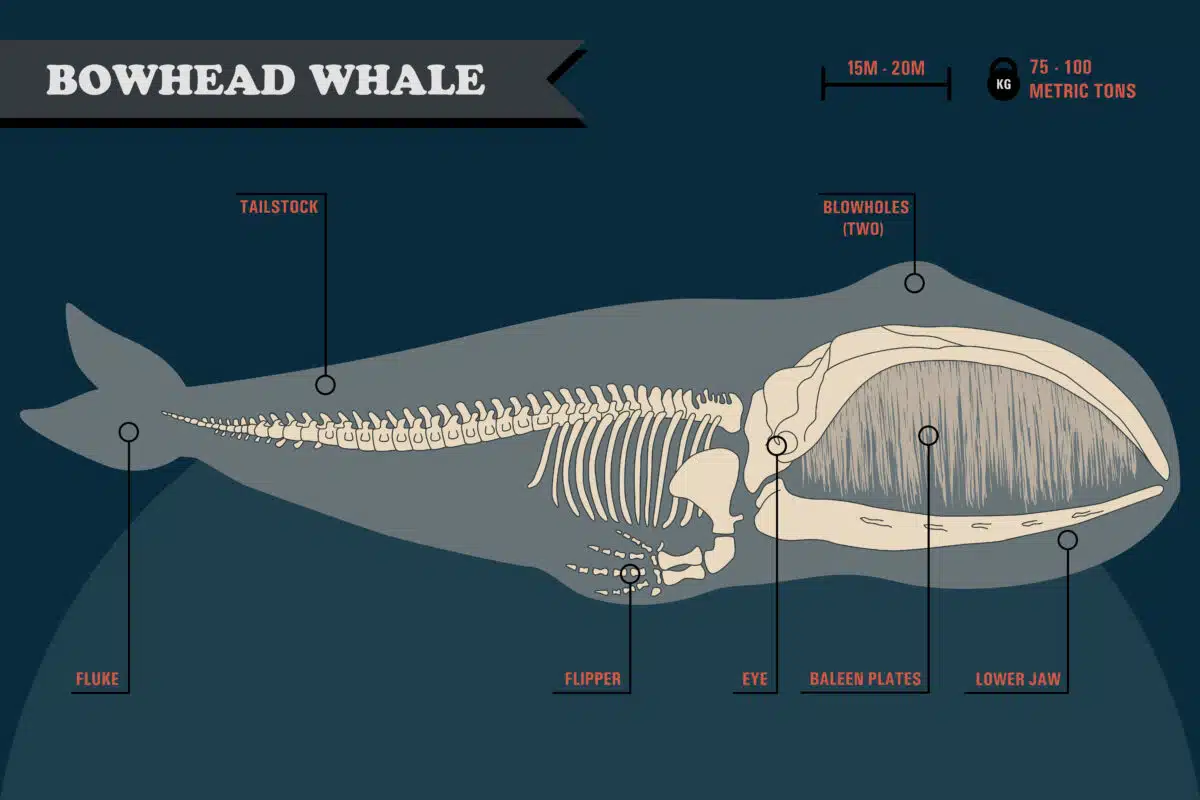
To investigate how these systems might work, scientists began examining the biology of long-lived mammals and comparing them with species that have much shorter lifespans. Researchers wanted to identify molecular mechanisms that could help protect cells from accumulating damage during decades or even centuries of life. One group studying this question was led by Vera Gorbunova and Andrei Seluanov at the University of Rochester, whose laboratory focuses on aging and cancer resistance in mammals.
Searching the Genome of the Bowhead Whale
The research team analyzed patterns of genetic activity in the Bowhead Whale and compared them with those observed in other mammals. Their goal was to identify genes that might enhance the body’s ability to monitor and repair damage to DNA. Among thousands of genes examined, the scientists noticed unusually high activity associated with a protein called CIRBP, short for cold-inducible RNA-binding protein.
Most mammals, including humans, produce CIRBP as part of the body’s response to environmental stress. The protein helps stabilize RNA molecules, which carry genetic instructions used to produce other proteins inside cells. By protecting RNA and interacting with cellular repair systems, CIRBP supports processes that help maintain the integrity of genetic material.
In the Bowhead Whale, however, the activity of CIRBP appeared far stronger than what scientists typically observe in other mammals. According to the research published in the journal Nature, the elevated presence of this protein suggested that it might play a key role in protecting the whale’s cells from the types of damage that accumulate during long lifespans.
What the CIRBP Protein Does Inside Cells
Further experiments revealed that CIRBP plays an important role in maintaining the stability of DNA. When DNA strands break or experience chemical damage, the protein helps activate cellular pathways responsible for DNA repair. These pathways detect damaged regions of genetic material and coordinate the molecular machinery that restores the original sequence.
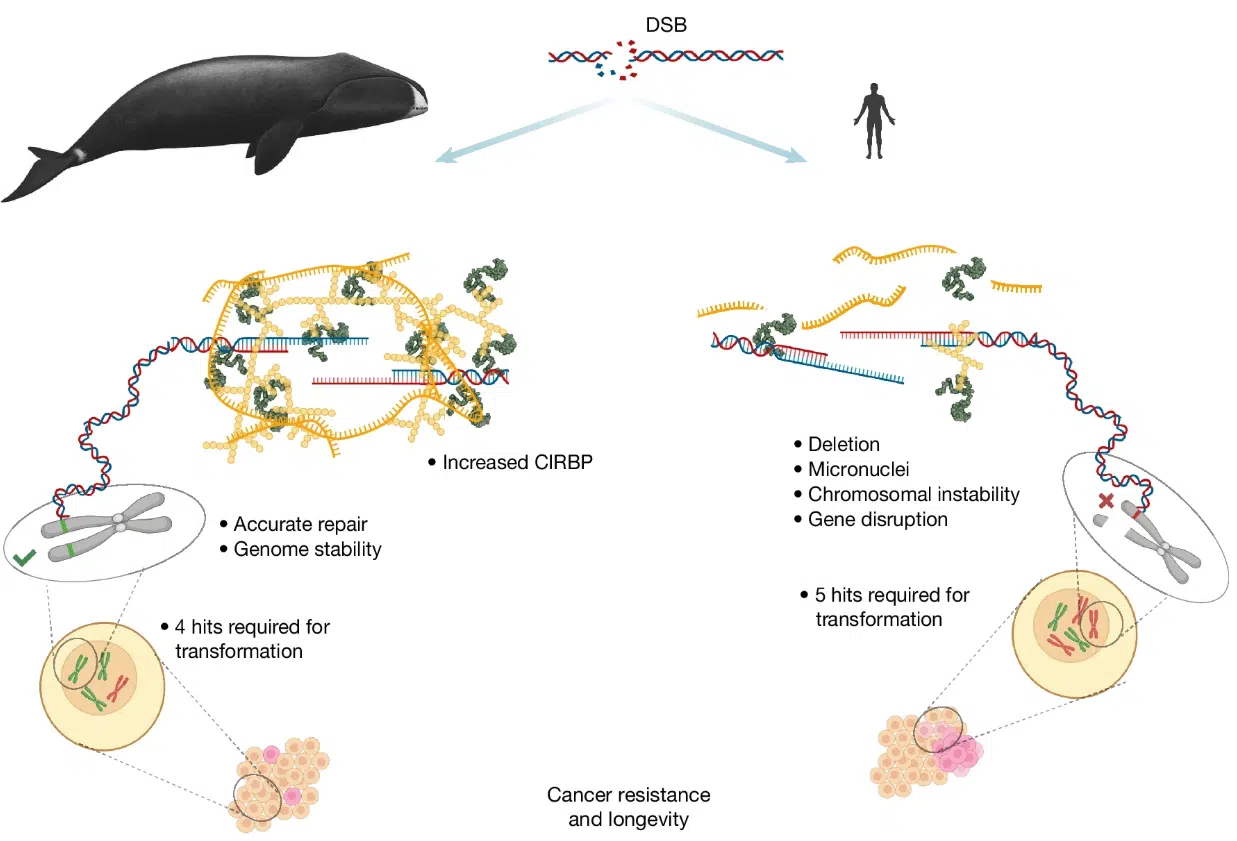
Efficient DNA repair is essential for preventing the gradual accumulation of mutations that can disrupt cell function. Over long periods of time, even small genetic errors can lead to malfunctioning tissues, organ decline, or the development of cancer. By strengthening repair mechanisms, CIRBP appears to help cells maintain accurate genetic information during repeated cycles of growth and division.
Researchers also observed that the protein influences inflammatory signaling within tissues. Chronic inflammation is widely associated with aging and many age-related diseases in mammals. By regulating these inflammatory processes, CIRBP may contribute to preserving healthy cellular environments for much longer periods.
Testing the Whale Mechanism in Laboratory Organisms
To explore the biological impact of the protein, researchers tested the whale-related CIRBP mechanism in Drosophila melanogaster, a species of fruit fly widely used in genetics research. Fruit flies are particularly useful for lifespan experiments because they reproduce quickly and complete their life cycles within a few weeks. This allows scientists to observe how genetic changes affect aging across many generations in a relatively short period of time.
When researchers increased the activity of CIRBP in these flies, the insects demonstrated longer survival compared with normal fruit flies. The modified flies also showed improved resistance to cellular stress and accumulated fewer signs of DNA damage over time. These results suggested that strengthening DNA repair pathways can influence lifespan in certain organisms.
Although fruit flies are very different from whales or humans, the experiments provided valuable insight into how the CIRBP protein functions across species. By examining these mechanisms in simple organisms, scientists can better understand how similar molecular systems might operate in larger animals.
First Appeared on
Source link






