


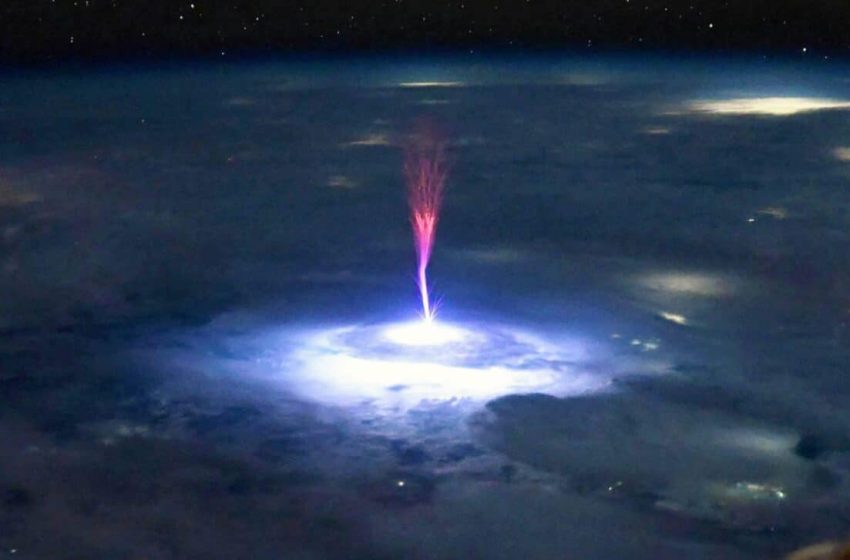
A NASA Astronaut Photographs a Rare Red Flash 55 Miles Above a Storm and It Lasts Only Milliseconds
From orbit, astronauts aboard the International Space Station have captured striking images of rare luminous flashes appearing high above Earth’s storms. These glowing structures known as red sprites and other transient luminous events occur far above thunderclouds and last only milliseconds, making them difficult to observe from the ground.
For most observers on Earth, a storm’s electrical activity ends with lightning bolts striking between clouds or toward the ground. Yet some of the most dramatic electrical events occur much higher, in the thin layers of the atmosphere above the weather itself.
Strange Lightning in the Sky
High above powerful thunderstorms, electrical discharges can appear in unexpected shapes and colors. These phenomena are known collectively as Transient Luminous Events (TLEs) and include red sprites, blue jets, violet halos and ultraviolet rings called ELVES.
According to NASA, these flashes can occur as high as 55 miles, about 90 kilometers, above the planet’s surface. Red sprites in particular appear briefly in the mesosphere and often resemble upside-down jellyfish. One photograph taken from the ISS shows a large sprite above a storm system near the Texas-Mexico border.
ISS Sensors Track Atmospheric Lightning
Much of the research relies on the Atmosphere-Space Interactions Monitor (ASIM), a scientific instrument installed on the ISS by the European Space Agency in 2018.
The instrument continuously watches Earth using high-speed cameras and photometers capable of detecting extremely brief flashes. Earth.com explained that ASIM is designed to detect electrical events lasting only fractions of a second, often appearing smaller than a fingernail from space.
Its observations have already revealed how lightning at the tops of storm clouds can release electromagnetic energy into the ionosphere, creating ELVES. These rings can spread across hundreds of miles and alter the electrical charge of the upper atmosphere, a process that scientists are still trying to fully understand.
Just. Wow. As we went over Mexico and the U.S. this morning, I caught this sprite.
Sprites are TLEs or Transient Luminous Events, that happen above the clouds and are triggered by intense electrical activity in the thunderstorms below. We have a great view above the clouds, so… pic.twitter.com/dCqIrn3vrA
— Nichole “Vapor” Ayers (@Astro_Ayers) July 3, 2025
Lightning Observed From The ISS
Using the station’s Cupola observation module, crew members aboard the ISS film distant thunderstorms with specialized cameras as part of the Thor-Davis experiment.
These cameras record lightning at speeds reaching 100,000 frames per second, allowing researchers to examine the fine structure of electrical discharges in slow motion. As reported by the same source, the resulting footage reveals lightning branches and filaments forming in ways that earlier models had not predicted.
Researchers are also investigating another unusual phenomenon linked to storms, terrestrial gamma-ray flashes, bursts of radiation associated with lightning. To detect them, the Japan Aerospace Exploration Agency (JAXA) launched a small satellite called Light-1 from the ISS. Despite its compact size, the CubeSat carries detectors capable of identifying high-energy photons produced during these events.
Scientists hope that combining observations from the ISS, orbiting satellites and ground-based lightning networks will gradually build a detailed map of where these rare atmospheric flashes occur and how they influence the delicate electrical balance of the upper atmosphere.
First Appeared on
Source link






