


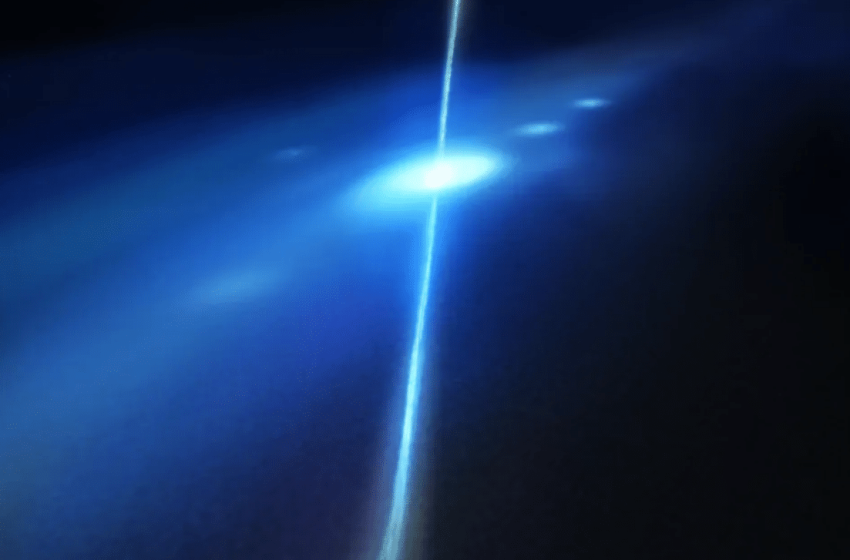
NASA Discovers Extreme Star Collision in Unexpected Part of the Universe
Astronomers have detected a neutron star collision in an unexpected place, deep within a tiny, faint galaxy. Located about 4.7 billion light-years away, this collision occurred within a vast gas stream stretching an incredible 600,000 light-years across the cosmos. This finding, part of a new study led by Simone Dichiara from Penn State University, challenges everything we thought we knew about where such extreme cosmic events could happen.
The Discovery: A Collision That Challenges Expectations
Astronomers have long known that neutron stars, the remnants of massive stars that have undergone a supernova explosion, are some of the most extreme and dense objects in the universe. These stars are only a few dozen miles across yet have masses greater than the sun. However, until recently, these objects were primarily observed colliding within moderate to large-sized galaxies. The recent discovery of a neutron star collision in a small galaxy, approximately 4.7 billion light-years away, completely upends the previous understanding of where such events can occur.
“Finding a neutron star collision where we did is game changing,” said Simone Dichiara, the lead scientist of the study. “It may be the key to unlocking not one, but two important questions in astrophysics.”
The collision in question was spotted within a faint and small galaxy, located inside a massive gas stream created by the collision of several galaxies hundreds of millions of years ago. This stream stretches a staggering 600,000 light-years across, much larger than the Milky Way, and holds within it the origins of this cosmic explosion.
The discovery is not only significant because of its unexpected location but also because it could help solve two major mysteries. The first of these is related to gamma-ray bursts (GRBs), high-energy explosions thought to result from neutron star collisions. Astronomers have noticed that sometimes GRBs appear to be without a host galaxy, or even located in regions far from the galactic core. This finding could explain why some GRBs do not seem to have a visible host galaxy, sometimes the galaxies are too small and faint to be detected by optical telescopes. The findings, described in a paper soon to be published in The Astrophysical Journal Letters are currently available on the arXiv preprint server.
The Mystery of GRBs and Their Host Galaxies
Gamma-ray bursts have been a source of intrigue for astronomers for decades. These intense flashes of gamma radiation are believed to occur when two neutron stars collide or when a massive star collapses. These bursts can release more energy in a few seconds than the sun will emit throughout its entire lifetime. However, one of the perplexing aspects of GRBs is the fact that some of them seem to occur in places where no galaxy or faint galaxy can be observed. The discovery of GRB 230906A, located in a small, faint galaxy, may finally provide an explanation.
“We found a collision within a collision,” said Eleonora Troja, co-author of the study from the University of Rome. “The galaxy collision triggered a wave of star formation that, over hundreds of millions of years, led to the birth and eventual collision of these neutron stars.”
The violent galaxy merger, which took place hundreds of millions of years ago, ignited a wave of star formation that ultimately produced the two neutron stars that would collide, producing a gamma-ray burst detectable by NASA’s Fermi Gamma-ray Space Telescope.
This breakthrough shows that even in tiny, faint galaxies, the extreme cosmic events that lead to gamma-ray bursts can occur. It also highlights the possibility that some GRBs observed in the future could originate from similarly undetectable galaxies, if the host galaxy is small enough to elude detection by conventional optical telescopes.
The Role of NASA’s Telescopes in the Discovery
The discovery of the neutron star collision was only possible because of the collaboration between multiple NASA telescopes. Fermi Gamma-ray Space Telescope was the first to detect the burst of gamma radiation that signaled the event. After that, a series of observations using NASA’s Chandra X-ray Observatory, Swift, and Hubble Space Telescope pinpointed the exact location of the burst, leading astronomers to the small galaxy in which the collision took place.
“Chandra’s pinpoint X-ray localization made this study possible,” said Brendan O’Connor, co-author of the study and McWilliams Postdoctoral Fellow at Carnegie Mellon University. “Without it, we couldn’t have tied the burst to any specific source. And once Chandra told us exactly where to look, Hubble’s extraordinary sensitivity revealed the tiny, extremely faint galaxy at that position. We were only able to make this discovery after we put all the pieces together.”
The use of these telescopes together was crucial in accurately determining the location of the event, further illustrating the importance of combined observational efforts in modern astronomy.
This discovery not only sheds light on the mystery of GRBs and their origins but also suggests that such events could be more common in the universe than previously thought. By understanding how such collisions occur, astronomers can gain insights into the birth of heavy elements, such as gold and platinum, which are produced during the neutron star collision process.
A Cosmic Puzzle: Explaining the Presence of Heavy Elements
Neutron star collisions are known to be one of the primary sources of heavy elements in the universe, including precious metals like gold and platinum. These elements are created in the extreme conditions of the collision, where high-energy nuclear processes take place. In 2017, astronomers witnessed one of these events, confirming that neutron star collisions are responsible for generating these heavy elements.
The location of the current collision in a tiny, faint galaxy could also help explain the presence of heavy elements like gold and platinum in distant stars. These stars are typically much older and are believed to have formed from gas that had less time to be enriched by the products of supernova explosions. As these neutron stars collide, they release their heavy elements into the surrounding environment, which could eventually be incorporated into new stars forming in distant parts of galaxies.
First Appeared on
Source link






