


Scientists Have Just Uncovered That Plants Scream in Pain, Find Out What They Really ‘Say’ When They’re Hurt
It turns out that plants may not be as silent as we once thought. While the idea that plants might “scream” or produce sound has long been relegated to the realm of myth, recent findings suggest otherwise. When stressed, plants emit ultrasonic sounds, beyond the range of human hearing.
However, the possibility that they could produce sound had remained largely unexplored. A 2023 study has now confirmed that stressed plants do indeed produce noise, signaling their discomfort in a way we never noticed before.
Thirsty Plants Aren’t as Quiet as You Think
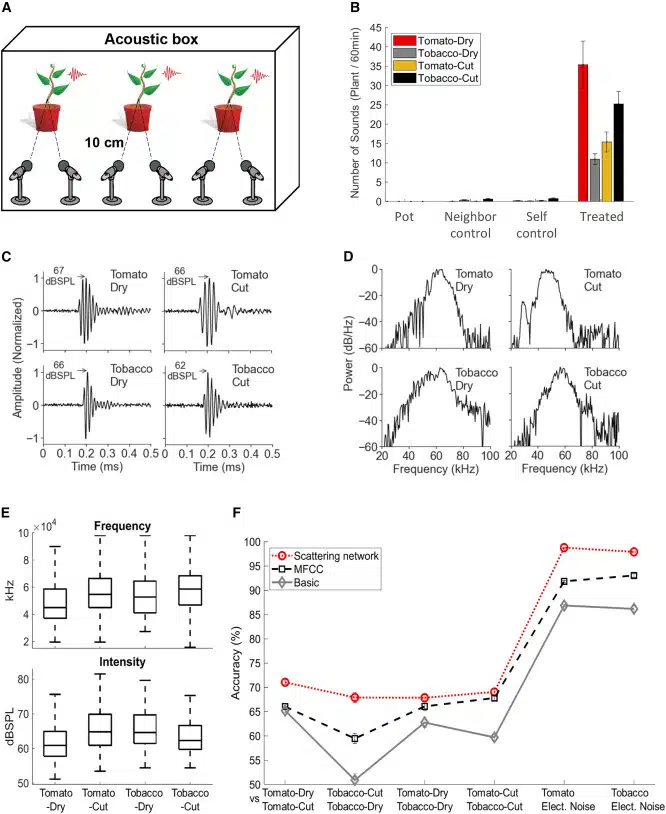
Published in Cell, a study led by Lilach Hadany and her team at Tel Aviv University focused on understanding how plants react under stress. They recorded sounds produced by plants under various conditions: healthy, dehydrated, and damaged.
The researchers found that stressed ones emitted clicking or popping noises at ultrasonic frequencies, which are inaudible to humans. For instance, tomato and tobacco released an average of 40 clicks per hour when dehydrated, with the sound intensity increasing as they became more stressed.
These sounds were detectable over a meter away, suggesting that animals and insects nearby might hear them.
“Even in a quiet field, there are actually sounds that we don’t hear, and those sounds carry information. There are animals that can hear these sounds, so there is the possibility that a lot of acoustic interaction is occurring,” noted evolutionary biologist Lilach Hadany.
A Sound-Based Method of Plant Communication?
Typically, when a plant is threatened, whether by herbivores or environmental stress, it produces chemical signals. These signals might trigger defensive responses in neighboring plants, prompting them to enhance their resistance.
Beyond signaling their own stress, these sounds might influence the behavior of nearby organisms. As Hadany explained:
“For example, a moth that intends to lay eggs on a plant or an animal that intends to eat a plant could use the sounds to help guide their decision,”
The study hints that the interaction between plants and animals might be far more complex than we’ve recognized, with sound playing a crucial part in these relationships.
What’s Next for Nature’s Noises?
But, one of the biggest mysteries is how exactly plants produce these sounds. Earlier research has pointed to cavitation, the formation and collapse of air bubbles in the vegetation’s stem, as a likely source of the popping noises.
However, it is unclear if this is the only mechanism or if others are involved. Scientists are now exploring whether other stressors can also cause the botanical specimens to produce noise.
“We are currently investigating the responses of other organisms, both animals and plants, to these sounds, and we’re also exploring our ability to identify and interpret the sounds in completely natural environments,” she added.
First Appeared on
Source link






