


Colon cancer now leading cause of cancer deaths under 50 in US | US news
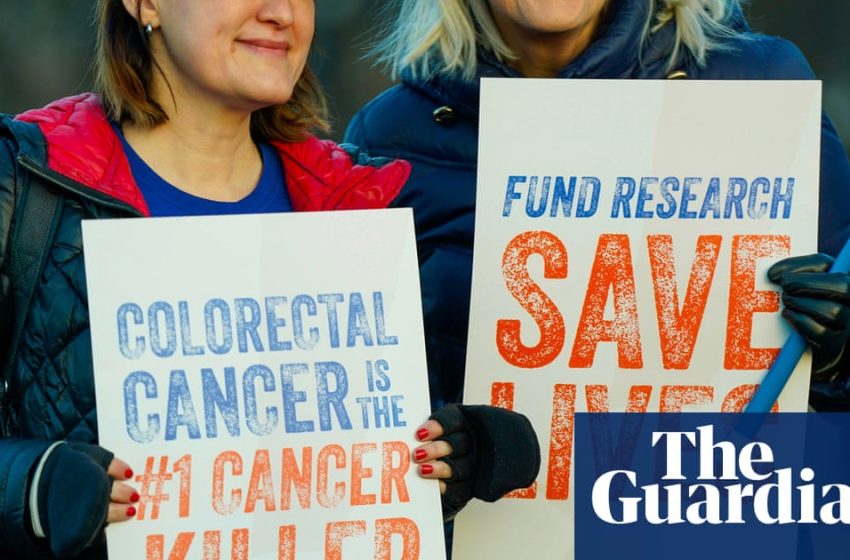
Colorectal cancer is now the leading cause of cancer death in the US for people under 50, according to a new analysis from the American Cancer Society, prompting both experts and those in that age group with the disease to warn others to take certain symptoms seriously.
Becca Lynch, who works in cyber security in Denver, Colorado, was diagnosed with advanced colon cancer last year, when she was just 29. At first, she assumed her symptoms couldn’t be anything serious: “I chalked it up to stress,” she said.
Now, she is careful to describe her symptoms in great detail, not because they’re fun to talk about, but because she doesn’t want other people to miss the signs.
Initially, she was experiencing “pencil thin” bowel movements and having to “go number two much more frequently,” as much as five or six times a day. Eventually, she started seeing thick, dark blood with each movement.
She decided to see a doctor after seeing an Instagram video by Cass Costley, where she talked about how similar symptoms turned out to be colon cancer. Still, Lynch put off a colonoscopy for several months; when she did get it, she was diagnosed with stage 3B colon cancer.
Lynch’s is a “very common story”, says Rebecca Siegel, an epidemiologist and senior director of cancer surveillance research at the American Cancer Society and lead author of the analysis.
Around 3/4 of people under 50 already have advanced colorectal cancer when they’re diagnosed, “because they haven’t been screened through regular colonoscopies, and they don’t take their symptoms seriously, because they think they’re too young”, Siegel said.
Many people assume they have haemorrhoids, because that’s the first search result that comes up when you look up blood in stool. Costley, the woman who inspired Lynch to get checked out and has since passed away from the cancer, told Today that she too thought she probably had haemorrhoids and “ignored it”.
Siegel urges anyone who is experiencing rectal bleeding for more than a couple weeks to see their doctor immediately. Stool tests like Cologuard and the FIT test are a good way to rule out potential cancer for people who don’t want to get a colonoscopy right away, she said.
For people over age 65 colorectal cancer is “continuing to decline rapidly by more than two percent a year”, Siegel said, whereas for younger people, it’s jumped from the fifth to the first leading cause of cancer death since the 1990s.
This also means that doctors who treat colorectal cancer need to learn how to address the needs of a younger population.
“Doctors are used to treating people in their 70s who aren’t concerned about fertility. They’re not as concerned about sexual dysfunction,” Siegel explained. “There are so many surveys that report that young survivors find out that they can’t have children after their treatment is already finished.”
Siegel also emphasized that doctors should discuss what options might be possible to preserve fertility and sexual function before treatment begins.
Experts aren’t yet sure why colorectal cancer has risen in younger people, but Siegel said it’s an example of the “birth cohort effect”. That people born after the 1950s face heightened risk “tells us that there was some exposure, some risk factor that was introduced in the middle of the 20th century that’s increasing our risk of this disease”, Siegel said, “and it’s increasing the risk more and more with every subsequent generation.”
Many are looking to changes in the food supply for answers. Increased consumption of processed foods, processed meats and foods packaged in plastic are all possible, not proven, contributors.
“We now know microplastics can cross the blood–brain barrier, so the colon is clearly being exposed,” Siegel said.
Some populations are more at risk than others. Alaska Natives have the highest documented colorectal cancer mortality in the world, but Siegel said that, because the total number of Alaska Natives is so small, it’s hard to get funding to study why.
“Their rates are so extraordinarily high … if there could just be some funding dedicated to that topic, I think it would be pretty easy to figure that one out,” Siegel said, adding that understanding why Alaska Natives are more at risk might also help unlock the reason why young people’s general risk is increasing.
Known lifestyle factors, like inactivity, obesity and alcohol consumption do not fully explain the spike in diagnoses among young people.
Prosanta Chakrabarty, an evolutionary biologist based in Baton Rouge, Louisiana, now 47, said he “was living a pretty clean, healthy life” and even getting annual colonoscopies, but was still diagnosed with advanced colon cancer in 2024. After going through 24 total rounds of chemotherapy over two different courses, he still has a floating tumor.
“There are so many things I didn’t realize were options,” Chakrabarty said, including “doing chemo forever.”
Both Chakrabarty and Lynch are public about their cancer to help get people past the “embarrassment” that hinders diagnosis. Lynch posted an AMA on Reddit about her cancer. Chakrabarty posted a video of himself walking through a giant, inflatable colon on Bluesky.
Lynch, who has been free of symptoms since receiving surgery but is still being closely monitored, said after Costley’s Instagram video helped her get her diagnosis, she feels obligated to do the same for others: “That’s part of why I agreed to an interview about my poop.”
First Appeared on
Source link






