



This Pink Bug Is Not A “Rare Freak Mutant” After All
On March 27, 2025, somewhere in the Panamanian rainforest, the evolutionary biologist Zeke Rowe was looking for a snack. While walking outside the research station’s cafeteria, Rowe noticed a strange insect summoned by a floodlight. The insect was a katydid, a close relative of crickets famous for their mimicry of leaves. Katydids have veined bodies that are often bright green like a new leaf or stippled brown like a fallen leaf. But this particular katydid was a seemingly unnatural neon pink. Rowe, who studies leaf mimicry in moths, brought the pink katydid to the office of his colleague Benito Wainwright, an evolutionary biologist at the University of St Andrews in Scotland.
“I was extremely excited,” Wainwright wrote in an email. For the last two years, Wainwright has exclusively studied such katydids and how they evolved their leafy masquerade. But he’d never seen a pink katydid before. When he dug into the literature, he saw that pink katydids had been previously documented in scientific literature, albeit not in this particular species, Arota festae. But most of these papers were more than a century old and made no mention that the pink coloration could offer any advantage to the insects. Instead, “these individuals had been regarded as rare freak mutants that are disadvantaged by their conspicuous appearance,” Wainright said.
Wainwright plopped the pink katydid, an adult female, into a cage with other katydids he had been collecting, all of whom were green. Here, the insects feasted on green vegetation, apples, and water. He’d rounded up these katydids to study their behavior, wing shape, and genetics, and he figured he could do the same with the pink one. Wainwright “had no intention of specifically studying its crazy coloration at the time,” he said. In fact, he did not look closely at her until four days later, when he realized she was changing color. He and colleagues describe the bug’s color change in a paper recently published in Ecology, titled “Pink Cricket Club.“

The katydid’s body had faded slightly, from intense fuchsia to a paler bubblegum. “I’m still slightly annoyed at myself for not spotting that it was changing color sooner,” Wainwright said. He began photographing the katydid every 24 hours to track her changes.
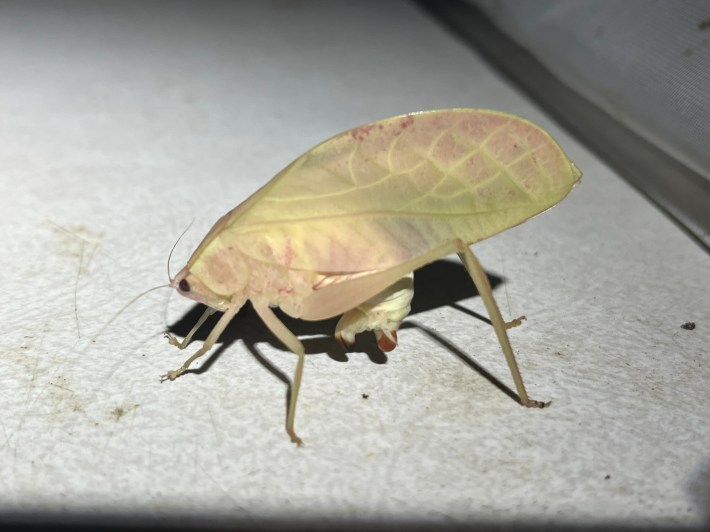
After seven days, she had become entirely green, indistinguishable from her vegetal brethren in the cage. On the 10 day, the researchers found she’d mated with a male A. festae katydid. The proof was in the spermatophylax, a tasty sort of goo that a male dollops on a female, along with his sperm, for her to snack on post-coitus.
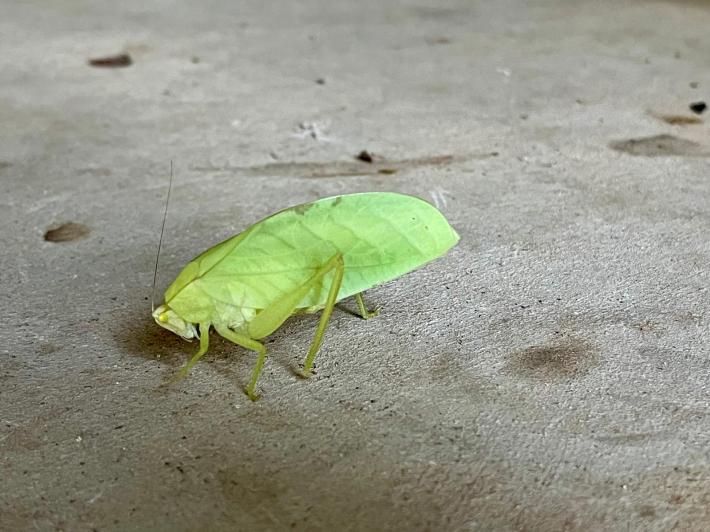
All insects molt over the course of their lives, slipping out of old exoskeletons and into new ones, which offers them unlimited potential for drastic color change—just look at the difference between baby and adult brown marmorated stink bugs. But Wainwright was “absolutely gobsmacked,” he said, by the revelation that a katydid could change color within a single life stage. “I had never heard of an insect doing anything like this before,” he said.
Then Patrick Cannon and Matthew Greenwall, also authors on the new paper, pointed out the ubiquity of red, white, and pink leaves in the jungle. These leaves, also described as “red flushing” or “delayed greening,” occur with reduced chlorophyll content. Flushing is a defense strategy; the pale or pink leaves offer less nutritional value and are therefore less likely to be eaten. It’s a popular strategy in the tropics, and as the researchers looked around in the rainforest of Barro Colorado Island, they saw an abundance of leaves that seemed exact color-matches to the katydid’s gradient of pink hues. Blending in with these pink, unpalatable leaves could offer protection from predators.

Past explanations of the occasional pink katydid always considered the color rare and disadvantageous. Surely a pink body would make any insect more conspicuous in a green forest. But the researchers now hypothesize that the bug’s pink hue, and capacity for color-change, could be an adaptive trait in katydids. “Could it be that these katydids are not just mimicking green leaves, but also pink leaves at a specific stage of development, and are also able to transition between these forms?” Wainwright asked. “We have no experimental evidence to support this, but it has been extremely exciting to think about and if true, would beautifully exemplify the interconnectedness of tropical ecosystems.”
The researchers aren’t quite sure what mechanisms triggered the katydid’s color change. Perhaps it was in response to being surrounded by green katydids, or green vegetation. After all, a pink katydid receives none of the privileges of camouflage if it’s living on an entirely green tree. “Changing color may enable these animals to match the most abundant colors in their immediate surroundings,” Wainwright said. Or perhaps it’s more specific, and a pink katydid’s color normally fades along with the greening of flushing leaves. Or maybe the pink coloration is the result of recessive genes. As of now, scientists just don’t know enough about how color-changing works for pink katydids. Wainwright hopes he can test some of these hypothesizes in the future, whenever he finds the time and money.
In the meantime, Wainwright continues to study how katydids evolved their close resemblances to leaves. He is in Panama now, snooping around the floodlights, especially under the new moon, to scoop up any katydids drawn to the light. He also found some katydids that resemble dead leaves, with brown splotches marring the bright green of their back. Although the once-fuchsia female died of natural causes in late April, other pink katydids still roam the rainforest, little mysteries waiting to come into the light.
First Appeared on
Source link






