


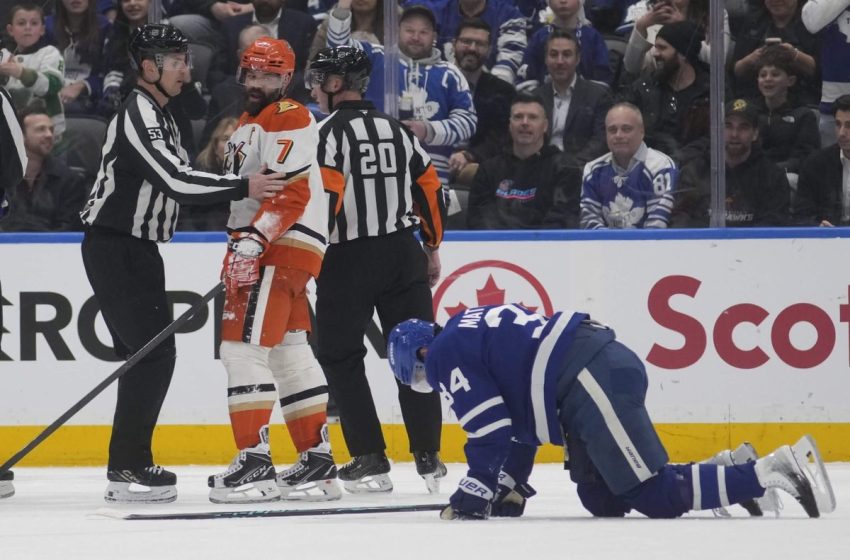
Why the NHL needs to suspend Radko Gudas for his dirty hit on Auston Matthews
It’s been a while, but Radko Gudas is back in hot water with the NHL’s Department of Player Safety.
No one should be particularly surprised.
The Anaheim Ducks’ captain took out the left leg of Toronto Maple Leafs captain Auston Matthews with a knee-on-knee hit during the second period Thursday night, one of the uglier hits of the 2025-26 season.
“That’s a dirty play,” Leafs coach Craig Berube said. “The league’s going to obviously look at it and see what the suspension will be or whatever happens.”
Matthews left the game immediately, without putting any weight on the leg, and wasn’t able to return. Gudas received a five-minute major penalty and a game misconduct, a penalty that broke the game open as the Leafs scored twice on the power play as part of a 6-4 win.
Gudas is well-known as a tough customer and one of the hardest-hitting players in the league, including when he crumpled Canadian captain Sidney Crosby at the Olympics only a few weeks ago. While that hit was within the rules, his collision with Matthews wasn’t even close.
Gudas’ history is likely to become a factor for the league, as he’s been suspended four times, including twice for illegal hits to the head. His longest suspension came in 2017 when he was banned for 10 games for slashing Mathieu Perreault in the neck.
In all, Gudas has missed 21 games in his career due to suspensions.
The NHL considers four key factors when deciding how long to suspend a player, and the first three are all working against Gudas on this play:
1. “The type of conduct involved: conduct in violation of League Playing Rules, and whether the conduct is intentional or reckless, and involves the use of excessive and unnecessary force. Players are responsible for the consequences of their actions.”
2. “Injury to the opposing Player(s) involved in the incident.”
3. “The status of the offender and, specifically, whether the Player has a history of being subject to Supplementary Discipline for On-Ice Conduct. Players who repeatedly violate League Playing Rules will be more severely punished for each new violation.”
4. “The situation of the game in which the incident occurred, for example: late in the game, lopsided score, prior events in the game.”
There’s no question Gudas’ play was reckless, as he hangs his leg out to catch a piece of Matthews when it becomes evident the Leafs’ best player is about to sidestep him for a direct lane to the net for a scoring chance. There was also an injury, and it remains to be seen how much time Matthews will miss, which will likely be the biggest factor in elevating this from a short suspension into something with more heft. (Matthews’ status is currently unknown as his knee will require imaging to determine the extent of the damage.)
Most importantly, as mentioned, Gudas has one of the longer rap sheets in the league, albeit all from earlier in his career (between 2015 and 2019), when these reckless plays were fairly routine for him.
“It’s a garbage hit from a player who has a reputation for doing these kinds of things,” TSN analyst Frankie Corrado said on the broadcast following the game. “It’s been something that has followed Radko Gudas around. He has a tendency to stick his knee out or put himself in a position where he can hurt a player in a vulnerable position. … That’s no way to play defense.”
While long suspensions for kneeing are less common than for other plays in the NHL, there is precedent for players missing considerable time in these situations, especially when involving repeat offenders.
In 1998, Bryan Marchment was suspended for eight games for a knee-on-knee hit on Carolina’s Kevin Dineen. More recently, Matt Cooke was suspended for seven games during the 2014 playoffs for kneeing Tyson Barrie and causing an injury.
Both Marchment and Cooke had been suspended regularly at the time, piling up more than a half dozen suspensions.
While Gudas’ history isn’t as extensive, it’s still going to be enough to warrant a significant punishment, which will hurt the Anaheim Ducks’ push to try to win the Pacific Division title and get back to the playoffs for the first time in eight years.
First Appeared on
Source link






