



By Director Mr. Sakurai, Kirby Air Riders: Development Insights — Part 2 – News
Join Kirby Air Riders director Masahiro Sakurai as he shares insights into the development and details behind some of the game’s modes and features.
Check out the rest of the interview
Part 2: Cramming everything into Skyah
So during the design planning phase for City Trial, we actually considered bringing back the old map as one of our options.
But, we just couldn’t pull it off… Things don’t work like they did in the past. It would take tremendous cost and effort.
It took everything we could just to create the base for Skyah, and it wasn’t simply a matter of porting it over.
Unlike the previous game, we can have up to 16 players* this time, and the balance for both machine power-ups and acquisition frequency differs from back then. We had to figure it all out as we were creating the machines: how big the gameplay field should be, how often attacks should land for offense-defense balance, the ratio of surface level, underground, and building areas, and how to achieve high jumps. Previously, I was the only one setting the machine parameters, so I only needed to satisfy myself. This time, however, a lot of people were deeply involved in making balance adjustments.
As an example, if the average speed of a machine is increased even just a little, the width and height appropriate for the field then changes.
The composition is so delicate that even slight changes can significantly alter the balance and feel. Coming up with a coherent design and layout within a gameplay field with that sort of limitation was incredibly challenging.
Moreover, it was impossible to have variations of the fields.
We had to condense all of the various elements of Skyah into the one setting, which makes it a fun map to play even when changing up battle strategies.
No one correct way to play
In City Trial, I think it’s important to change the game state and scenery through graphics and progression. Not through elements that change every time, like terrain or weather changes.
Some areas are extremely wide and flat, while others are more complicated. At first glance this may seem obvious, but the kinds of strategies that can emerge from them are quite different.
In spacious areas, visibility is good, making it easier to collect a variety of items, but you are also more likely to be attacked from behind or from the side. Underground areas, by contrast, tend to have straighter paths, making you harder to target, but there may be fewer items to acquire compared to other areas. I feel as though the key point is that players can try out whatever they like in the moment, and actually see the results.
If you want each play session to feel different, you can’t have too many strategies that are considered the ideal way to play.
Being able to reach the floating island in the distance would obviously be advantageous, but we’ve made sure that it almost never becomes the single best course of action. Maybe an opponent has already landed there. Or you might be outmaneuvered by someone who anticipated that and focused on strengthening their land machine. Or your flying machine might get destroyed, and so on.
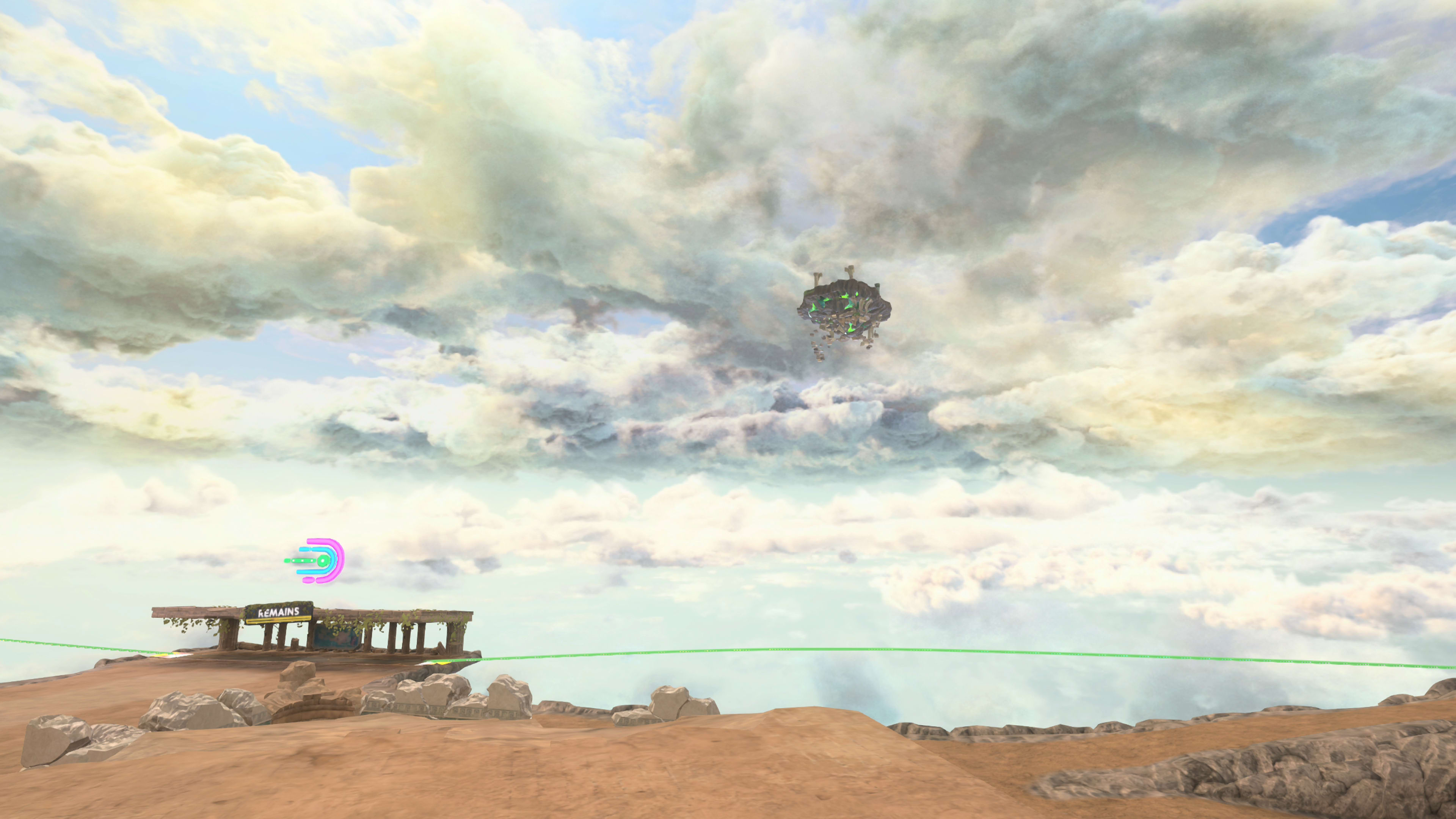
Players find themselves in a different situation each time, and play by figuring out what they can do then and there.
We consider that sense of improvised play a focal point of City Trial, and made a lot of design choices to support that.
Creating events that can delight in a short amount of time
The field events that occur during City Trial in the previous game were created under a very tight deadline. For example, the “dense fog” event was just a fog effect. It was an easy solution, but even something that simple could create unexpected accidents, which is a good thing.
This time around we had a dedicated team for creating events, so we were able to develop them a little more. There are still limits on what we can do, but things have significantly improved.
The best examples are in Dustup Derby and Short Race.
These were already in our design documents from the start, placing them as special events specific to certain areas.
Something happens within a specific area, and once it’s resolved, the event ends. This was a type of event we hadn’t had before.
Leaving open multiple ways to win
I think Stadium having four options was quite an astute design choice.
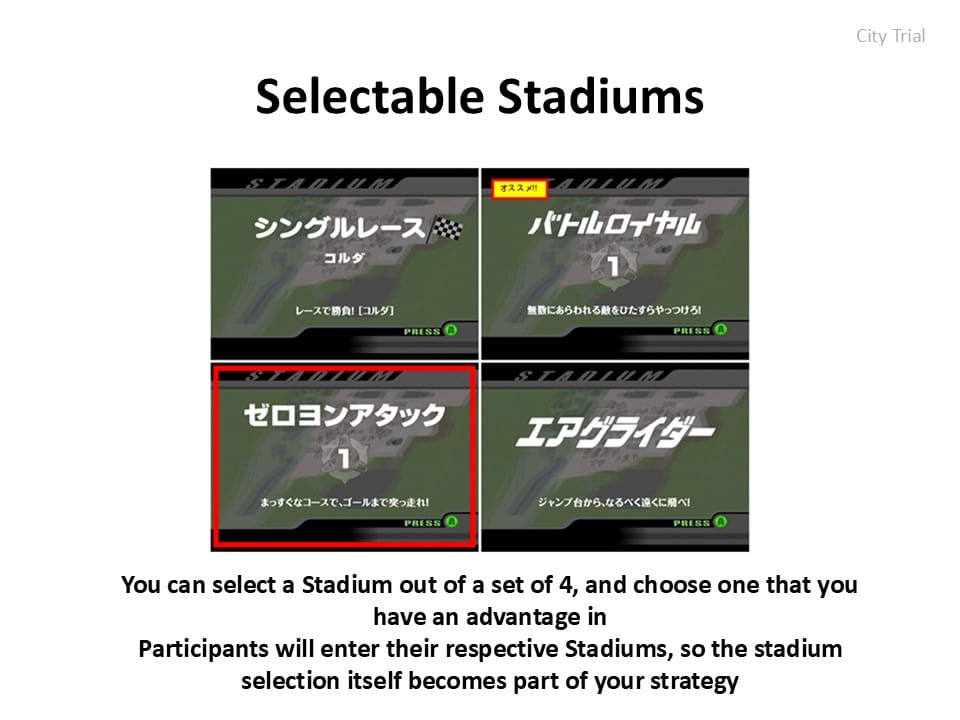
It means that the machines you’ve powered up won’t go to waste and there’s always a chance you could get first place. Playing the same type of competition with 16 other people can be a bit much, and having the player who had the most power-ups win doesn’t seem like great design for a game. It’s important that each player has a range of possibilities they can choose from depending on how they play, and the Stadium selection system is designed to hone that aspect of gameplay.
I think those who have played the game understand the purpose of this, and I feel that it’s become such a crucial feature that City Trial just wouldn’t be itself without it.
It’s precisely because of this that there’s such surprise and joy when Stadium choices match up. When you’re building the ultimate machine for racing and combat, you play Target Flight, laugh at the silliness of it all, wrap it up quickly before it gets stale and move onto the next match. I think that’s part of what makes this game so much fun.
Online games are tough. It’s easy to get discouraged when you’re no match for hardcore players, but I think this approach still allows players to progress without needing perfection.
First Appeared on
Source link






