


Deadly virus outbreak at Bay Area state park spreads to nearby beaches
The avian flu outbreak that killed 30 elephant seals at Año Nuevo State Park last month, resulting in its partial closure and canceling tours for the season, has spread to at least two other marine mammal species. At a Thursday press briefing, wildlife experts confirmed that the virus is also continuing to expand to nearby public beaches.
Samples collected from sick and stranded animals revealed nine additional elephant seals have tested positive for the virus, along with one California sea lion and one southern sea otter, said Christine Johnson, director of the Institute for Pandemic Insights at UC Davis. That brings the total of infected live elephant seals up to 16, though she noted the count only reflects animals that have gone through testing, and more will likely be reported in the coming weeks.
Though the outbreak is currently limited to San Mateo County, Johnson said experts have detected additional cases along the coastline just north and south of Año Nuevo State Park. The risk to the general public is very low, but the likelihood of contracting the virus is higher for people who have been directly exposed to infected animals. She urged people and their pets to “stay back” and “avoid all contact” with stranded, sick and dead marine mammals and birds.
“We are starting to see some carcasses on public beaches,” she said. People are asked to contact the National Oceanic and Atmospheric Administration’s stranding hotline at 866-767-6114 to report any sightings. If you think you have been exposed to a sick animal on the beach and experience symptoms like a cough, runny nose, fever or shortness of breath, call your doctor and seek medical attention.
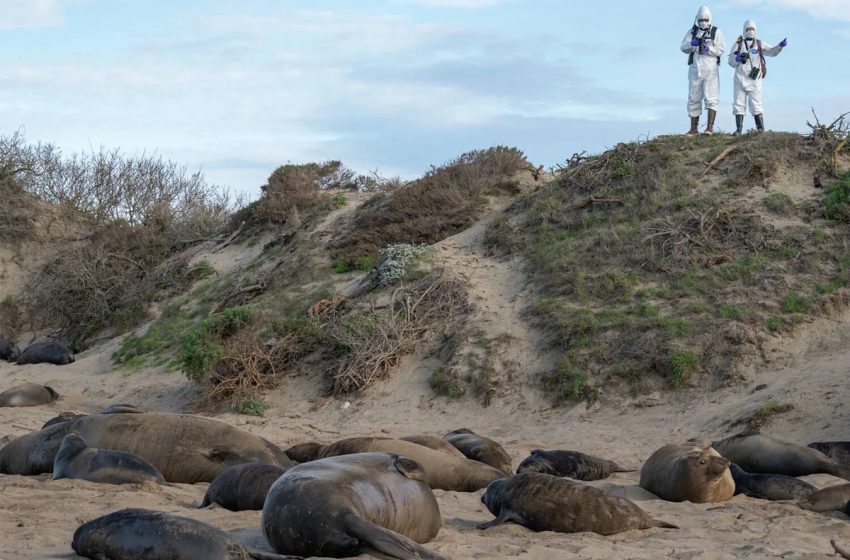
Elephant seals at Año Nuevo State Park, with the remains of the Año Nuevo Island Light Station in the background. (Getty Images/iStockphoto)
Though Johnson described the outbreak as “especially tragic” in species like the southern sea otter, which is listed as threatened under the Endangered Species Act, she said it’s not unusual to see it spread because the virus is “very opportunistic” and can infect a wide range of animals. The virus has also been confirmed in a number of seabirds including western gulls, common murres and Brandt’s cormorants. A population of peregrine falcons has also been plummeting due to the same strain of the virus for years, a new study out of UC Santa Cruz found.
Experts are continuing to monitor for new cases.
The virus, known as HPAI H5N1, has been identified as the A3 genotype, which was first detected in Eurasia in 2022 and is found in birds along the Pacific Flyway. It killed 3,500 northern fur seals and one Steller sea lion during a mass mortality event in Russia in 2023, but this is the first detection of the strain on the Pacific coast of the U.S. to date, according to Johnson.
“We obviously have a lot more to learn about this, and sort of the genetic history of this virus in the coming weeks,” she said.
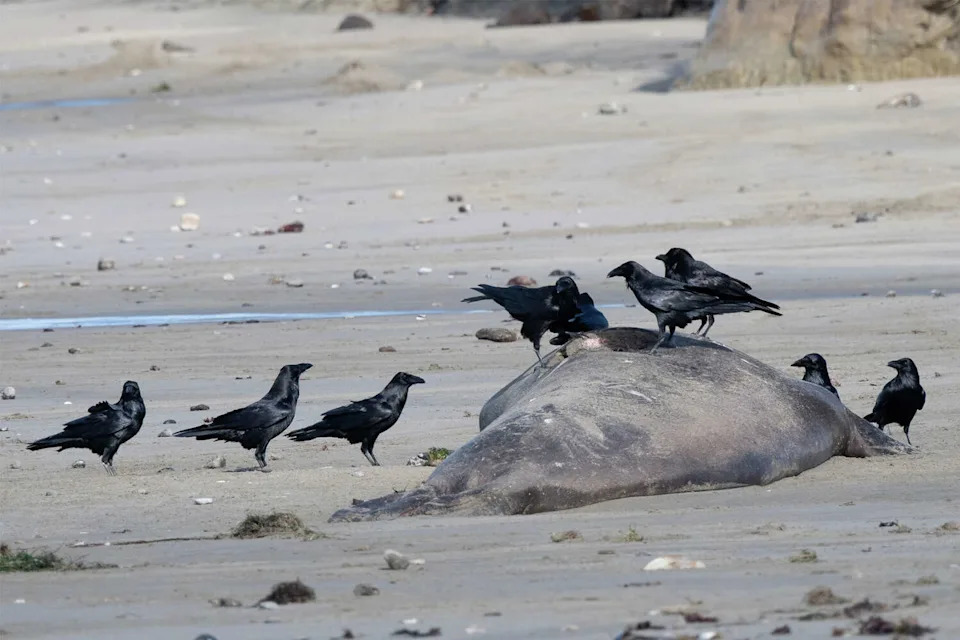
Ravens scavenge a recently deceased elephant seal carcass at Año Nuevo State Park. (Frans Lanting for the Beltran Lab/UC Santa Cruz under NMFS Permit 28742)
Año Nuevo State Park hosts one of the most intensively studied elephant seal colonies in the world, led by professor Roxanne Beltran of UC Santa Cruz. Her colleague Patrick Robinson, Año Nuevo reserve director, said the research program has been recording an average of two dead animals and two infected animals every day, and that the tally of dead seals has climbed to 47 since the start of the outbreak. Affected individuals include weaned pups as well as large adult males.
“This year’s mortality rate has been about four times higher compared to last year’s,” Robinson said.
While he was out with other experts conducting a survey of Año Nuevo last week, he said they were “certainly not expecting to see a sea otter.” On average, they find five to 10 dead sea otters per year in the park, almost always due to a suspected shark bite.
“This one, I was quite sad when we first looked at it, because it didn’t have any of those shark bite symptoms, so we kind of suspected that it might be influenza,” he said. “So we collected it, swabbed it right away, and sent those samples off.”
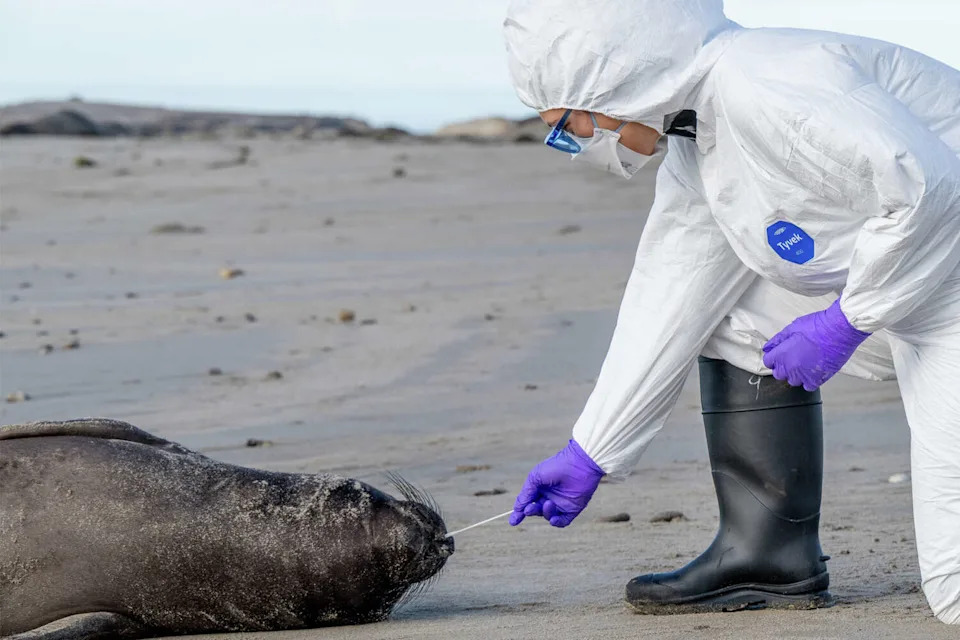
A researcher collects a nasal swab sample from a symptomatic elephant seal weaned pup for avian influenza testing. (Frans Lanting for the Beltran Lab/UC Santa Cruz under NMFS Permit 28742)
The good news, however, is that the outbreak occurred when 80% of the adult females in the elephant seal population had already left for their foraging migration, lessening the impact of the virus. Robinson said he has also observed a few elephant seal pups – including one dubbed by researchers as 007 – that appeared to be symptomatic, but later seemed to have recovered. Thousands of other seals remain healthy, and the sea otter and sea lion are anomalies among their own species.
“Of course the outbreak is not over, and we’re not really sure what’s going to happen in the future, but I remain hopeful about this thing,” he said.
Dominic Travis, chief programs officer of the Marine Mammal Center, which responds to live animals washed up along 600 miles of the California coastline, said it is temporarily halting rescue operations for elephant seals “out of an abundance of caution.” Behind the scenes, the center’s experts are working to understand the risks to its staff and updating safety protocols. All incoming animals are being tested for the virus, and so far, none have shown positive results.
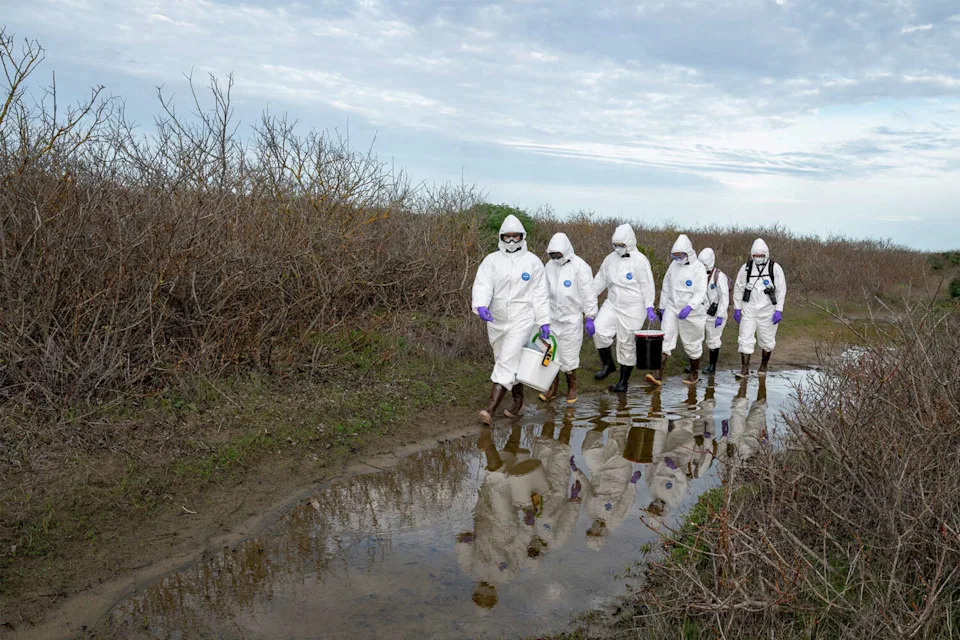
A team of researchers wearing personal protective equipment walk out to monitor and sample the elephant seals at Año Nuevo State Park. (Frans Lanting for the Beltran Lab/UC Santa Cruz under NMFS Permit 28742)
The specifics of how the virus is spreading from one host to another remain unclear as experts continue their research, but Travis explained that “sometimes when viruses burn hot and they kill quickly, they don’t spread as well.” That said, he’s concerned about other species, such as fur seals, which the virus has already impacted, and land-dwelling animals like coyotes that are known to scavenge for birds and seals along the beaches. Robinson added that Frankie Gerraty, a UC Santa Cruz graduate student who has been studying this phenomenon using trail cameras, is continuing to use them to monitor for carcasses of animals infected with the virus.
People are encouraged to check for weekly updates on UC Davis’ website.
More Local
– Barnes and Noble to close one of last Bay Area stores after over 20 years
– How wild turkeys ended up everywhere in the Bay Area
– Berkeley Bowl dishes up meat banned in red states
– Hundreds of Bay Area properties are heading to auction. Bids start at just $455.
Get SFGATE’s top stories sent to your inbox by signing up for The Daily newsletter here.
This article originally published at Deadly virus outbreak at Bay Area state park spreads to nearby beaches.
First Appeared on
Source link






