


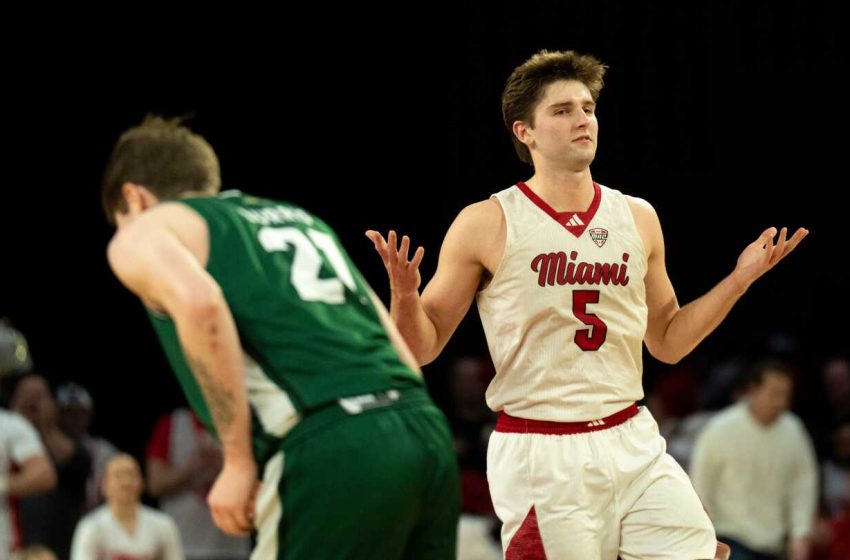
Miami (Ohio) should be celebrated in the NCAA Tournament, not left out in the cold
College basketball is typically a sport that embraces — and celebrates — the little guy. Cinderella stories are synonymous with March. They’re what we remember most vividly year after year, from Florida Gulf Coast’s Dunk City and Butler to UMBC and Saint Peter’s. We salute the Davids even though we eventually crown Goliath the champion.
And that’s why it’s so strange that Miami (Ohio) has become something of a lightning rod. The RedHawks went unbeaten in the regular season before suffering their first loss of the year in a stunning upset in their first game of the Mid-American Conference tournament on Thursday. No. 8 seed UMass beat Miami, 87-83, to make Selection Sunday a bit more stressful than the RedHawks had hoped it’d be.
But here’s the thing: It shouldn’t be close. Miami should safely be in the 68-team NCAA Tournament field, despite playing a schedule that looks quite different from other bubble teams. Considering a historically weak collection of bubble teams — most of whom lost their final regular-season games and/or have already exited their respective conference tournaments — most bracketologists agree with me that Miami should be just fine. They do differ in whether they think the RedHawks will be sent to Dayton for a First Four game or directly into the main 64-team draw, but that’s really the only major discrepancy at this point.
The important thing is that Miami gets in, which is what the 31-1 RedHawks deserve.
Vocal critics, such as former Auburn coach Bruce Pearl, don’t believe Miami is one of the best at-large teams in the country. Pearl would (quite obviously) prefer to see his son’s Auburn team — which has 15 more losses to its name than Miami does — in the NCAA Tournament. Yes, the Tigers have played one of the nation’s toughest schedules. But the selection committee cannot reflexively reward mediocrity in megaconferences; a team that finished 12th out of 16 teams in its own league should not automatically deserve a chance to play for a national championship. Teams like Auburn, Cincinnati and Indiana do not merit a ton of sympathy from me when they have so many opportunities for resume-boosting Quad 1 wins … and whiff on so many of them.
Teams like Miami don’t get those chances.
High-major teams simply don’t want to play good mid-major teams. They view those matchups as lose-lose situations; you either beat a team you’re supposed to and get little credit for it, or you lose a buy game, which is embarrassing and potentially very damaging to your resume. Miami didn’t play a single Power 4 (or Big East) team. It played zero Quad 1 games and had just two Quad 2 wins. Because of a strength of schedule ranked 296th (out of 365 Division I teams) and eight games won by one possession or in overtime, the RedHawks rank 93rd in KenPom and 64th in NET.
But it’s not that Miami didn’t try. According to Matt Brown of Extra Points, The RedHawks tried to schedule at least 16 Power 4/Big East schools this season. None said yes.
This is a college basketball issue far bigger than one school and one NCAA Tournament bid. Excluding a team like Miami would end up being taken as a referendum on mid-major basketball itself. If a team that goes undefeated over the course of an entire regular season — just the fifth time this has happened since the turn of the century — is left out of March Madness, what is the point of playing? If you’ve got to be perfect and still win your conference’s automatic bid to go dancing, what’s the point of the regular season? If you’ve got to be perfect and win, say, four Quad 1 games (even though nobody that good will schedule you), is that bar too high to ever clear?
These are questions I don’t think the sport wants to answer, and, hopefully, the selection committee will not force them to. It is hard to go undefeated over 31 games, even against a schedule that ranks in the bottom quarter of Division I. If it were that easy to win every game against weak opponents, we would see a lot more undefeated teams every year.
I am hoping the Miami bubble case ends up being debated far longer on social media than it does in the actual committee room. That should be the case, assuming the committee relies heavily on one metric it says it relies heavily upon: Wins Above Bubble (WAB). WAB measures a team’s total number of wins compared to how many victories the average bubble team would be expected to have against the same schedule. According to media members who attended a mock selection committee exercise last month, NCAA vice president of basketball Dan Gavitt went out of his way to bring up WAB and its importance “especially when it comes to selecting teams.” He said that the bubble teams that made the cut last year were more correlated to WAB than they were to any other metrics.
Miami’s WAB is 1.7, 37th in the country. For context, Auburn’s is 0.35 (44th), SMU’s is 0.07 (45th) and Indiana’s is -0.49 (53rd). That metric strips away the uneven schedule strength and tells us something simple: Miami is performing better against its schedule than the average bubble team would. And teams like Auburn, SMU and Indiana wouldn’t have performed as well against Miami’s schedule as the RedHawks have. Essentially, even though those Power 4 bubble teams had tougher schedules, they should have won more games to avoid their current predicaments.
Miami also ranks 28th in the nation in strength of record. These are metrics that can and should carry the RedHawks into the NCAA Tournament, regardless of their relative schedule strength.
And so, Selection Sunday should be special for these RedHawks, who did their very best against the schedule they had to play. They should be dancing, and they should be darlings in a tournament — and sport — that usually celebrates them.
First Appeared on
Source link






