


Forget Kegels—a Pilates instructor shares four simple moves to strengthen your pelvic floor
Kegel exercises—moves that involve squeezing, lifting and relaxing the pelvic area—are an incredibly effective way to strengthen your pelvic floor, but it’s not the most engaging option. Thankfully, Pilates is also effective.
Jill Drummond, Pilates instructor and vice president of fitness at BODYBAR Pilates says the combination of breath, deep core engagement and controlled movement in Pilates is an effective way to strengthen your pelvic floor too.
“The benefits of a stronger pelvic floor are wide ranging,” she says. “It’s a key part of your core, supporting the spine, pelvis, and internal organs while helping your body move with strength and control.”
Article continues below
Drummond highlights four Pilates exercises that are particularly helpful for building pelvic floor strength.
Aim for 15 to 20 repetitions of each move, and repeat the sequence two to three times to turn it into a workout for best results.
1. Bridge
- Lie on your back with your knees bent and heels on the floor or on an elevated surface.
- Press your heels into the floor and lift your hips.
- Squeeze your glutes and inner thighs to activate your pelvic floor.
- Hold at the top for two to three breaths.
- Lower your hips to the floor with control.
Make it harder: place a resistance band above your knees to further engage your outer thighs and glutes.
How it helps: By strengthening your glutes and engaging your deep core, this move helps to support and activate the pelvic floor muscles.
2. Double-leg stretch
- Lie on your back with both knees close to your chest and hands on your shins.
- Curl your chin toward your chest to lift your shoulders off the floor.
- Extend your legs in front of you at a 45° to the floor as you sweep your arms behind your head.
- Engage your deep abdominal muscles and activate your inner thighs.
- Return your arms to hug your knees.
How it helps: This move challenges your deep core while coordinating breath and control, helping the pelvic floor work with your abdominal muscles to stabilize your spine.
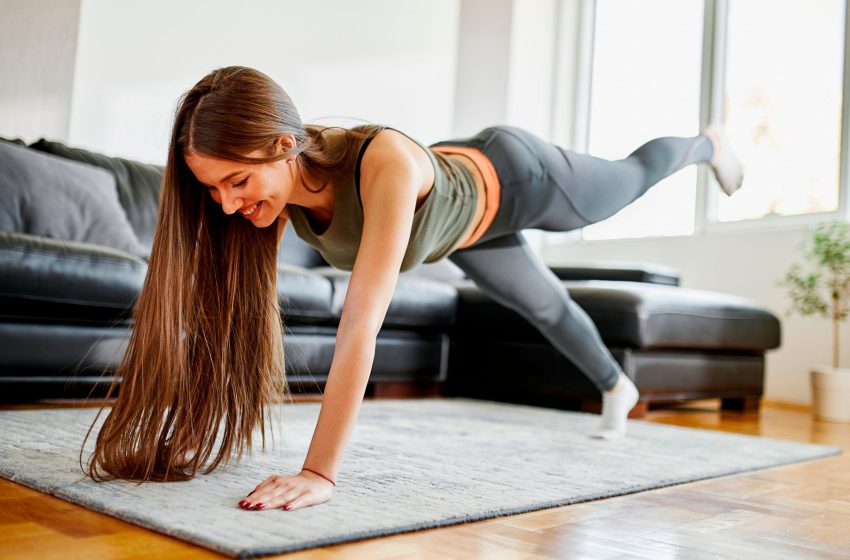
3. Plank variations
- Start in a high-plank position with your hands directly under your shoulders and legs extended behind you, with your body forming a straight line from your feet to your shoulders.
- Draw your belly into your spine, and squeeze your glutes and inner thighs to start.
- Sideways jump: jump your feet outward and back in again.
- Up-down: lower your elbows to the floor, coming into a low plank on your forearms. Reverse the movement back to a high plank.
- Single-leg raise and pulse: lift one leg at a time to above hip height, pulse in the air for three repetitions.
How it helps: “By focusing on activating your inner thighs, glutes and deep abdominals, planks can support pelvic floor stability and strength,” Drummond says.
4. Squat
- Stand with your feet hip-width apart.
- Bend your knees and send your hips back as you lower toward the floor.
- Drive through your heels to return to your standing position.
Trainer tip: As you return to standing, imagine you’re zipping up your body from your heels to your head, pulling everything in.
How it helps: “The pressure changes during a squat naturally activate the pelvic floor, helping to strengthen the muscles over time,” Drummond says.
First Appeared on
Source link






