


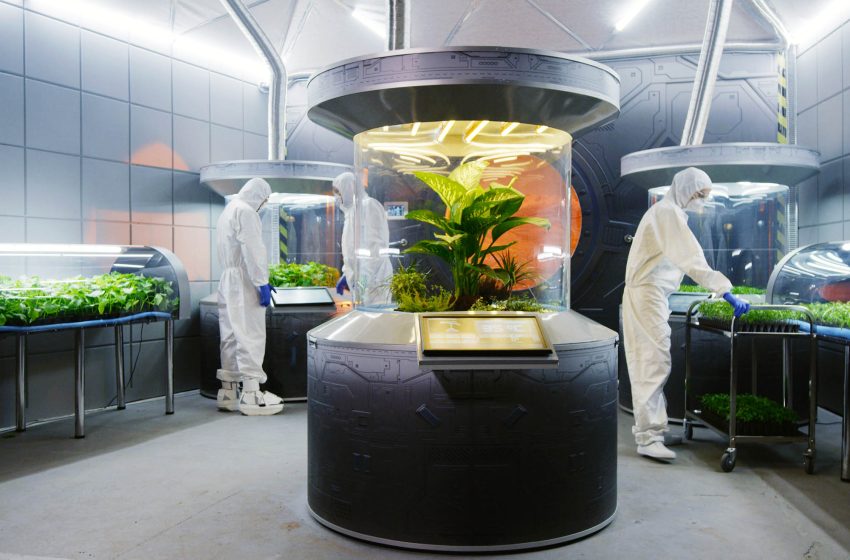
Recycled wastewater could help astronauts grow food on the Moon
Future missions to the Moon and Mars will depend on more than rockets and life-support systems – they will depend on food. But beyond Earth, there is no living soil.
Astronauts will have to grow crops in lifeless, mineral-heavy dust that lacks the organic matter and nutrients plants need to survive.
Now, researchers at Texas A&M University (TAMU) report that an unlikely resource could help solve that problem: recycled human waste.
In laboratory experiments, treated sewage pulled essential nutrients out of Moon- and Mars-like dust, chemically transforming barren mineral grains into a potential fertilizer source for future space farming.
The findings suggest that future space habitats could rely on tightly closed recycling systems, where wastewater not only feeds plants directly but also unlocks nutrients trapped inside extraterrestrial soil.
Rather than treating waste as something to discard, the research points toward a future in which it becomes a cornerstone of sustainable farming beyond Earth.
Lab soil is not Mars
Instead of recreating real lunar or Martian soil, the experiments relied on manufactured stand-ins designed to approximate their mineral chemistry.
Moon tests relied on NASA’s JSC-1A, a volcanic ash material engineered to resemble basalt-rich lunar regolith.
Mars tests used MGS-1, a blend of minerals modeled on rover data from Gale Crater but lacking the full chemical complexity of Martian soil.
“By weathering simulant soils from the Moon and Mars with organic waste streams, it was revealed that many essential plant nutrients can be harvested from surface minerals,” said study co-author Harrison Coker of TAMU’s Department of Soil and Crop Sciences.
Sewage feeds space farming
NASA’s Organic Processor Assembly broke down simulated human waste and produced a filtered liquid that supported pak choi growth. Inside its bioreactor tanks, microbes digested solids and converted them into dissolved nutrients and salts.
Even so, that recycled wastewater lacked some of the minerals plants need. When researchers mixed it with Moon- and Mars-like dust, the chemistry shifted.
As the treated liquid soaked into the mineral grains, it pulled sulfur, calcium, and magnesium into solution – nutrients crops rely on every day.
The minerals dissolved and released additional salts, and the mixture also drew out trace metals that can either help or harm plants, depending on their levels.
Notably, the local dust released nutrients even in plain water, revealing that the rock itself holds a hidden fertilizer reserve. Such enrichment could fortify recycled water used for plant feeding, especially when crews cannot count on regular resupply flights.
“In lunar and Martian outposts, organic wastes will be key to generating healthy, productive soils,” said Coker.
Surface changes alter nutrients
Under a microscope, the Moon-like dust developed tiny pits, while the Mars-like dust picked up a coating of ultra-fine particles.
Scientists call this process weathering – chemical and physical wear that gradually breaks minerals into smoother pieces.
That surface change could carry practical benefits. Sharper grains can scratch equipment and irritate lungs, so rounding their edges may make dust safer to handle inside habitats and easier to work with when planting crops.
Mineral reactions and nutrient availability
Still, the experiment lasted only 24 hours, and long-term wear could behave differently under real habitat conditions.
The same mineral reactions that reshaped the grains also affected nutrient availability. Not every element released into the liquid stayed there.
Some nutrients stuck to dust surfaces instead of remaining dissolved for plant uptake. Phosphorus showed the clearest binding pattern, and the Mars dust retained more of it than the Moon dust.
When minerals lock nutrients onto their surfaces, crops cannot access them until roots or microbes free them later.
Any real growing system will need to monitor these losses carefully, or the recycled solution could slowly drift away from what plants actually need.
Managing waste on Mars
Mars did not respond like the Moon. When the treated wastewater met the Martian dust simulant, minerals dissolved more aggressively, and the liquid quickly grew saltier.
Extra soluble salts in the Mars mix rushed into the water, shifting the chemistry and raising sodium levels along with other dissolved elements. The planet’s distinct mineral makeup shaped which metals appeared and how strongly they moved.
That difference matters. While some dissolved nutrients can help crops grow, too much salt can stress roots, limit water uptake, and reduce yields.
Any plan for farming on Mars will have to manage salinity from the start, balancing nutrient release without tipping the system toward salt overload.
What future crews must manage
Turning waste into fertilizer sounds elegant on paper, but inside a sealed habitat the chemistry cannot run unchecked.
A waste-to-fertilizer loop would require crews to control odors, monitor microbial activity, and prevent filters from clogging in tight living quarters.
As minerals dissolve from dust, they can also leave behind hard scale deposits that damage pipes and equipment, demanding regular cleaning and replacement parts.
Plant support systems must remove pathogens and carefully balance acidity, because a nutrient mix that works one week could drift out of range the next. In space, small chemical shifts can cascade into larger problems.
Any misstep could threaten both food production and water safety. Engineers will need robust monitoring systems, simple controls, and clear warning signs to keep future off-world farms running smoothly.
Toward farming on Mars and beyond
Next experiments will need to grow real crops in these treated dust mixes and measure exactly which nutrients plants absorb.
Longer trials can reveal whether the dust continues releasing helpful elements over time or if the initial nutrient burst quickly fades.
At the same time, field-scale systems must capture gases, recycle water, and prevent fine dust from drifting through habitats.
The research outlines a practical chemistry: treated wastewater could both nourish crops and soften harsh mineral dust by gradually wearing down its surfaces.
With careful tuning, habitat designers may be able to turn wastewater into a resource rather than a disposal problem that builds up over time.
Before anyone starts farming on another world like Mars, engineers must demonstrate that this approach remains safe, stable, and reliable for years under real operating conditions.
The study is published in the journal ACS Earth and Space Chemistry.
—–
Like what you read? Subscribe to our newsletter for engaging articles, exclusive content, and the latest updates.
Check us out on EarthSnap, a free app brought to you by Eric Ralls and Earth.com.
—–
First Appeared on
Source link






