


Woman Told Stomach Pain Is from Ovarian Cyst, Then Official Diagnosis at 24 Leaves Her ‘Stunned’ (Exclusive)
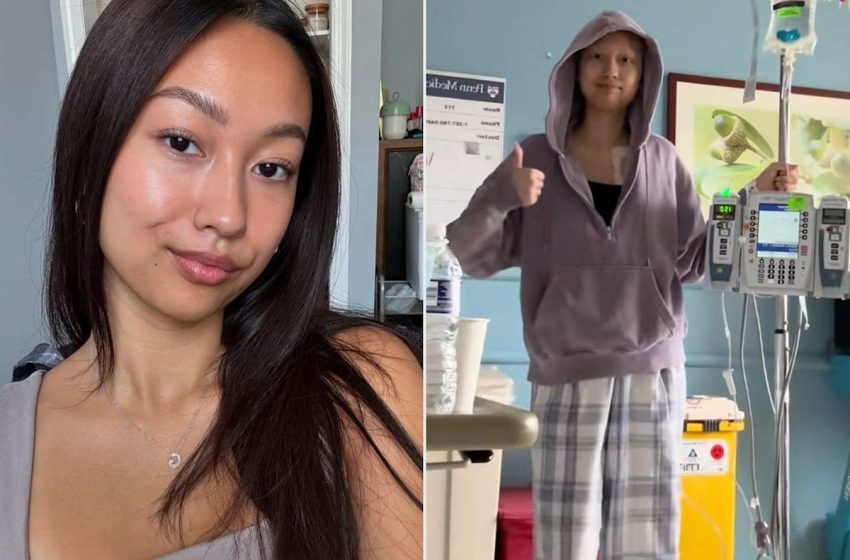
Giahan Tang before and after cancer diagnosis
Credit: Giahan Tang
NEED TO KNOW
-
Giahan Tang thought she was finally finding stability after college when unusual symptoms led to a shock diagnosis of stage 4 diffuse large B-cell lymphoma
-
After an ER visit initially blamed on an ovarian cyst, further testing revealed the aggressive blood cancer, sending her into months of intensive chemotherapy
-
Now cancer-free, Tang has shared her journey on TikTok, hoping her story encourages others to listen to their bodies and not take their health for granted
Giahan Tang finally felt like her life was coming together.
After graduating from Temple University in 2023, the South Philadelphia local was finding her footing in post-grad life while working her way up at a fine-dining steakhouse. She started as a hostess and, two years later, became a server — a move that finally brought some financial stability.
At the same time, she was trying to take better care of herself.
“I really wanted 2025 to be my year of self-development,” Tang, now 24, tells PEOPLE exclusively. “Besides training to become a server, I started going to the gym regularly and eating healthier. It felt like I was building strength.”

Giahan Tang in April 2025
Credit: Giahan Tang
But just as life seemed to be falling into place, everything changed.
Looking back, Tang says there were subtle signs that something wasn’t right. Throughout early 2025, she kept getting sick in ways that felt unusual for her.
“I thought I had food poisoning twice,” she recalls. “I had vomiting, diarrhea, fatigue and fever, but I didn’t think too much of it. I’ve always been healthy, so I assumed it would go away.”
Then one night, the pain felt different.
Tang says she developed what she thought was a stomach ache, but this time it didn’t ease up. It kept her awake through the night, and by morning the pain had become unbearable.
“I felt it laying down, sitting, walking — nothing helped,” she says. “When you pressed on it, it hurt even more. That’s when I immediately knew something was wrong.”
She went to urgent care and was told to head straight to the emergency room for imaging.
There, Tang spent six hours in the ER, much of it on a gurney in the hallway because the hospital was crowded. The pain radiated down the left side of her abdomen, but the initial tests seemed reassuring. Her EKG and blood work came back normal, and a CT scan showed what doctors believed was an ovarian cyst.
“I went home feeling relieved,” she says.
The explanation seemed to make sense. A coworker had experienced similar pain from an ovarian cyst, and so had her roommate. But the relief didn’t last long.
Soon after, Tang realized she had missed a voicemail from Penn Medicine. When she called back, a doctor told her that an attending physician reviewing her CT scan had noticed small lesions in her abdominal wall that had initially been missed — findings that could point to metastatic disease.
“My heart dropped,” she says. “The doctor kept saying sorry, and even then I don’t think I understood how bad it was.”
In the weeks after her ER visit, as she went through various tests, Tang found herself replaying the symptoms she had brushed aside — fevers, fatigue and intense itching she had blamed on eczema. At the time, none of it had seemed serious.
Then, two weeks later, her phone rang again.
It was her nurse navigator calling with the biopsy results from her endoscopy. She asked Tang to open MyChart while they discussed the next steps. As the screen loaded, Tang froze.
“I remember asking, ‘Lymphoma? As in cancer?’ ” she says. “And she said yes.”
Tang had stage 4 diffuse large B-cell lymphoma, subtype double-expressor — a high-risk, fast-growing blood cancer that affects the lymphatic system, according to the Cleveland Clinic.
“She kept talking about appointments and next steps, and I just kept saying, ‘Okay, okay, okay,’ ” Tang recalls. “I was stunned.”
When the call ended, the reality hit all at once.
“The rain was pouring outside, the sun was setting and my room was getting darker,” she says. “Then I just started crying. I kept saying, ‘Cancer? How am I going to tell my family? Am I going to die?’ ”
In the hours that followed, Tang threw herself into research, reading everything she could about her diagnosis and treatment.
“I had already spent two weeks wondering if it was cancer,” she says. “Once I knew for sure, I could start accepting it and focus on how to beat it.”

Giahan Tang taking a selfie
Credit: Giahan Tang
Telling her family, however, felt even harder.
“I worried more about how to tell my family and friends than whether I was going to survive,” she says. “I had never had any major health issues before. I couldn’t even fathom telling my mom her daughter had cancer.”
She first told her brother in person so he could be there when she shared the news with their mother.
“My mom was so strong,” Tang says. “She didn’t cry. She just started asking questions and trying to understand what my treatment would look like.”
Despite the stage 4 diagnosis, doctors told Tang her cancer was treatable. When she met with her oncologist, she came prepared after hours of research.
“She asked me what I knew about my cancer, and I started telling her everything I had learned,” Tang says. “She even asked if I worked in healthcare.”
Instead, Tang had simply spent hours reading medical articles. Her oncologist explained the diagnosis in simpler terms: a blood cancer attacking B cells in the lymphatic system, which is part of the immune system.
Because of the aggressive subtype, Tang began an intensive treatment plan that included chemotherapy, immunotherapy and steroids every three weeks.
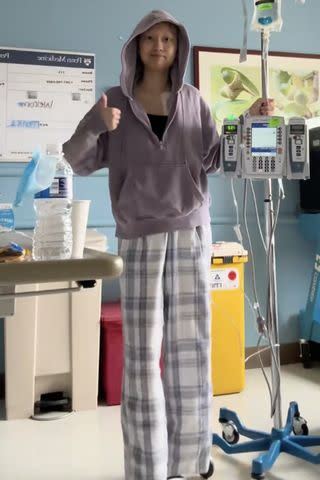
Giahan Tang in the hospital
Credit: Giahan Tang
Physically, the hardest part was the weakness.
“The first round was awful,” she says. “I had the shakes, hot flashes, cold flashes — my body just didn’t feel in equilibrium anymore.”
She lost weight and struggled with severe fatigue.
“I couldn’t shower by myself. I couldn’t cook. I had to wait until I felt stronger after each infusion just to do basic things,” she says. “Losing my independence was a huge struggle.”
One moment stayed with her: sitting in a car and watching children play sports in a park.
“I started crying because I missed that feeling,” she says. “Being healthy and free. You don’t realize what you take for granted until it’s gone.”
Emotionally, the lowest point came after she lost her hair.
“After two rounds of chemo, I finally had what I thought of as the ‘cancer look,’ ” she says. “I felt weak, insecure and very self-conscious.”
She spent much of that time at home, anxious about going out alone and focused only on getting through each day.
What kept her going, she says, was her family.
Her mother attended every infusion, drove her to appointments and cooked for her throughout treatment. Friends helped with rides, meals and even shaving her head when the hair loss became overwhelming.
“They made this journey so much easier,” Tang says. “I know not everyone has that, so I’m extremely grateful.”
A turning point came after her first PET scan. Despite how weak she felt, the scan showed no detectable lymphoma.
“My stage 4 cancer was completely gone after just two rounds,” she says. “It gave me so much hope.”
Doctors still recommended finishing all six rounds, and Tang pushed through. By the end of treatment, another scan came back clean.
“And now I’m cancer-free,” she says.
During treatment, Tang also found an unexpected outlet on TikTok. She began posting as a distraction while she was stuck in bed, and one comment from a stranger encouraged her to share her story.
“A person told me my story mattered whether I had 40 followers or 400,000,” she says.
She posted a slideshow about her cancer journey — and it quickly spread.
“I was blown away,” she says. “But more than anything, I was glad it reached people who understood.”
Now, Tang says the experience changed the way she sees life.
“Beating cancer taught me inner strength,” she says. “It made me more humble, more brave and more grateful.”
When she rang the bell marking the end of treatment, a woman she didn’t know approached her and gave her a hug.
“All I could say was thank you,” Tang says.
Today, she hopes others take two lessons from her story: gratitude and the importance of listening to your body.
“Don’t take your health for granted,” she says. “If something feels off, get it checked. Better to be safe than sorry.”
Read the original article on People
First Appeared on
Source link






