


Scientists discover something strange about cicada towers
Researchers have found that clay towers built by young Amazonian cicadas protect the insects from predators and help regulate air flow during their final stage of development.
The discovery resolves a long-standing mystery about the purpose of these structures and reframes them as a survival mechanism built into the cicada’s life cycle.
Cicada towers under pressure
Across the forest floor near Manaus in northern Brazil, small clay towers mark the final underground stage of the architect cicada Guyalna chlorogena.
Working through Serrapilheira Institute’s training program, the research team documented how these towers alter the conditions surrounding the developing insects.
Observations showed that the structures change how the nymph responds when air circulation inside the tower is disrupted.
Those responses point to the towers acting as functional extensions of the cicada’s own body, a finding that sets up the evidence from predator and airflow experiments that follow.
Ants on patrol
For the predator test, the team placed bait on tower tops and on the ground beside them.
Marina Méga, a doctoral student in ecology at the Federal University of Rio de Janeiro (UFRJ), had already noticed ants around the towers.
“There were eight times fewer ants on the towers than on the ground,” wrote Méga.
That simple height advantage suggests the towers buy time during metamorphosis, when the insects cannot dig back into safety.
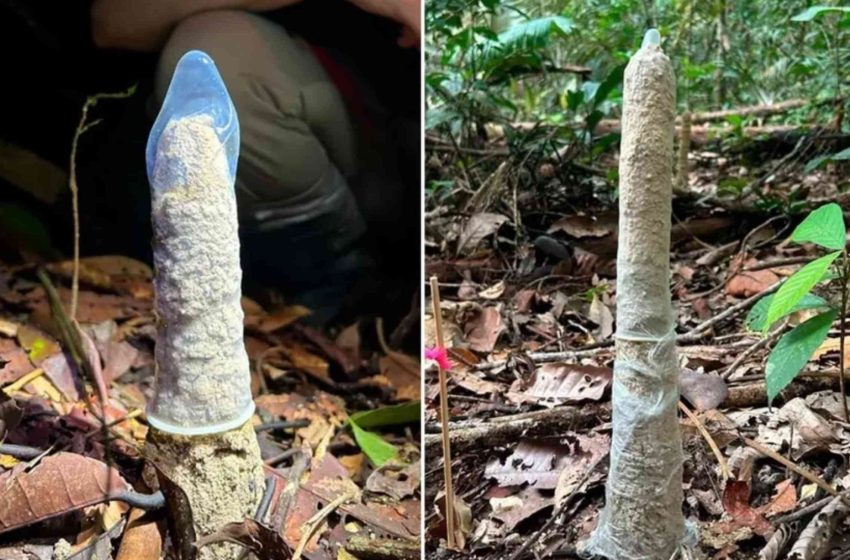
Latex seals air
To test breathing, the researchers slipped latex condoms over the towers and sealed the edges with plastic film.
That barrier stopped fresh air from moving through the clay, creating respiratory stress for insects still underground.
In the published paper, the sealed towers triggered different rebuilding responses once the researchers broke them open the next day.
A direct manipulation like that mattered because older explanations relied mostly on watching towers, not on forcing them to fail.
Cicada tower size
Once air flow was blocked, tower size started to matter in ways earlier observations had only hinted at.
Larger towers showed faster growth after the seal was removed, while smaller ones rebuilt less by the next morning.
More clay and more internal space may have buffered stale air, giving bigger structures a better margin under stress.
That uneven response helps explain why Amazon towers vary so much in height instead of following one standard design.
Bodies beyond skin
At that point, the study moved from describing a structure to redefining what counted as part of the insect.
The authors called the tower an extended phenotype, a body-related trait expressed through something an organism builds outside itself.
In plain terms, the cicada shaped mud into a survival tool that continued the job of keeping its body stable.
That idea matters beyond word choice, because it treats the tower as biology in action rather than leftover dirt.
Older clues return
Years before this experiment, earlier work had already shown that one cicada occupied each tower and rebuilt it night after night.
That study also found openings appeared when conditions changed, which hinted that the towers were responding to the environment.
Because wet clay can clog tiny air spaces, opening the top may help oxygen move and carbon dioxide escape.
The new experiment gave those older clues a harder test, and the two studies now fit together.
Danger above ground
Near the end of development, each cicada nymph, the immature stage before adulthood, has to leave the soil and climb.
During those hours, the insect cannot hide easily, and any ant patrol can turn exposure into injury or death.
A raised tower changes that encounter by lifting the animal off the ground, where ants were far more likely to gather.
Protection and breathing support fit the same moment in the life cycle, which is why the result feels coherent.
Fieldwork makes proof
Deep in the central Amazon, the project grew out of a training course rather than a long-funded laboratory campaign.
Long trails, humid heat, and limited gear pushed the team toward simple tests that changed conditions without fancy equipment.
That context helps explain why 40 condoms ended up in the field kit, solving a clean experimental problem in minutes.
Good field science often looks improvised on the surface, while the real strength comes from changing one thing clearly.
Questions still open
One result still hangs in the air, because the biggest towers may handle stress differently for more than one reason.
Extra height could change airflow, but it could also reflect stronger builders, different soil, or slightly different moisture.
The field team also reported a tower about 18 inches tall, an unusual outlier that hints at bigger variation.
Those loose ends keep the story alive, because a strange tower becomes more interesting once its function is no longer strange.
Why cicada towers matters
What emerged from these tests is a sharper picture of how a hidden insect engineers a safer path into adult life.
Researchers now have a clearer target for future work, including how soil, rain, and tower size combine to shape survival.
The study is published in Biotropica.
—–
Like what you read? Subscribe to our newsletter for engaging articles, exclusive content, and the latest updates.
Check us out on EarthSnap, a free app brought to you by Eric Ralls and Earth.com.
—–
First Appeared on
Source link






