


Who to pick to win the 2026 men’s NCAA college basketball tournament.
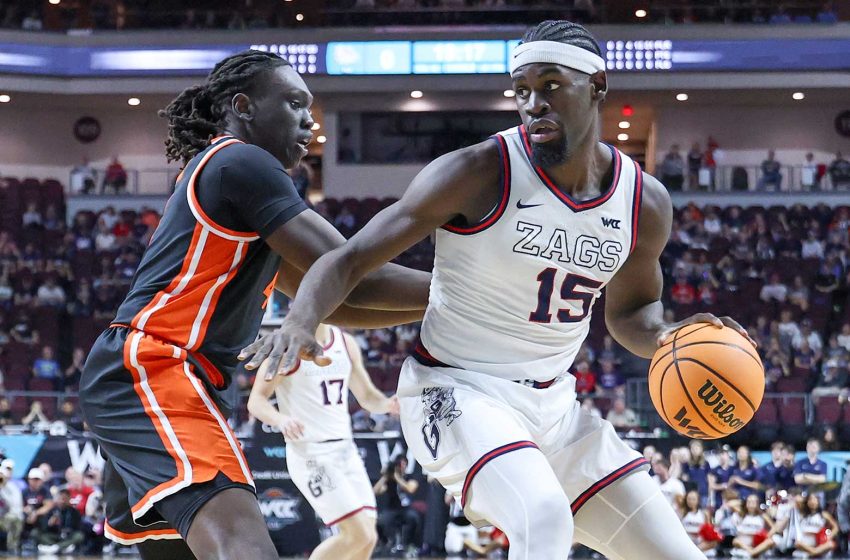
The Gonzaga men’s basketball program is in the midst of a highly abnormal run of March Madness futility. The Bulldogs have qualified for 27 consecutive men’s NCAA basketball tournaments. They have made the national championship game twice in the past decade but have yet to get over the hump. The question this story presupposes is: What if 2026 is the year that Zag Fever finally results in a championship?
I understand what you’re thinking: “Haven’t I read about this in Slate five times before?” Perhaps you have, yes. In 2021, Gonzaga was the clear best team in the country and took an undefeated record into the 67th and final game of March Madness. “Gonzaga Could Become the Greatest Men’s College Basketball Team Ever,” the headline on my pre-tournament story said. Things also looked good in 2022, when I promised that Gonzaga’s time had come. “And if it has not, I will rewrite this argument every March until it does.” In 2023, the Zags were not a front-line favorite but still seemed to have a real chance, so I stuck with my gut. In 2024, the shine had come off a bit, but the case was still strong. Once again, it didn’t happen. By 2025, my heart wasn’t really in it, but who was I to doubt a program that seemed to have the best draw of any of the No. 8 seeds in the 68-team tournament? Alas, the Zags went down in the second round, losing by a mere 5 points to a Houston team that came up 3 points short of the national title.
My faith has been a little shaken in recent years. More than once, I’ve asked myself coming into March Madness whether it was worth continuing to pick Gonzaga each year out of a fear that I’d walk away from the dock just before the ship pulled into port. I regularly put money on the line in bracket contests with friends, and that’s a lot of $20 and $50 increments to keep losing for the sake of what has started to feel like a silly internet bit. But the problem is that Gonzaga just keeps on giving itself chances, performing year in and year out as one of the finest teams in the country. And in 2026, Gonzaga has been unbelievably steady near the top of the sport. A team that started the year ranked No. 8 in Ken Pomeroy’s efficiency index got as high as No. 1 and then settled at a crisp No. 10, having lost all of three games, just two since December. The bracket draw turned out to be highly favorable. And so, in 2026, I make the pick with as much conviction as ever. It’s not if, but when. And I think the time for this No. 3 seed is now.
The case for Gonzaga starts with a robust defense. The Zags have had many good units since coach Mark Few took over in 1999, but only one of them—a 2017 defense that finished No. 1 in adjusted efficiency—has ranked more highly than the ninth-ranked D that heads into this tournament. The approach typically revolved around one or two big men who made the paint a completely inhospitable place for opposing scorers. (You will remember Drew Timme and newly minted NBA champ Chet Holmgren, who helped Gonzaga limit opponents to a nation-best 42 percent success rate on 2-pointers in 2022.) But those Gonzaga teams let the game come to them, relying on the big fellas in the middle to do their jobs. This year’s team is more flammable, eager to pressure the ball and force turnovers, which it does on more than 1 in 5 possessions, a top-20 mark nationally that the Zags had barely even sniffed under Few.
The Zags no longer have dudes like Timme and Holmgren, but they’ve got a good bit of speed and athleticism in the front court, led by 6-foot-9 center Graham Ike and 6-foot-7 (how culturally relevant!) forward Tyon Grant-Foster, who is in his eighth—yes, eighth—year of college basketball. There is yet another key frontcourt player for this team, center Braden Huff, who’s been out since January with some sort of knee injury. It sounds like Huff could return in this tournament, boosting an already considerable group of bigs. He’s a junior, while Ike and Grant-Foster are seniors. If you’ve heard it once, you’ve heard it a million times: Experience and defense win in March. Guess who has it? These three fellas are also the team’s leading per-game scorers. Huff’s specter looms large.
I don’t relish feeling so bullish on Gonzaga, a rich private school that is about to blow up one of the best rivalries in college hoops so it can chase additional television money in the Pac-12. But the Zags’ path to the Final Four is enticing enough that I couldn’t resist it. First-round opponent Kennesaw State is by far the worst of the tournament’s No. 14 seeds, according to Pomeroy’s efficiency metrics. The team’s second-round opponent will be No. 6 BYU (which has lost 10 of its last 17) or an exhausted No. 11 seed that will have had to win a First Four game earlier in the week. All of this will unfold in Portland, Oregon, as the Spokane, Washington–based Zags got perhaps the most favorable location draw of the whole bracket.
Not that it’s an easy draw. No. 1 Arizona leads the Zags’ West region and is one of three equally great teams at the top of the seed list. (The others are Duke and Michigan.) The caliber of play at the top of college hoops is quite high right now, as talent has flowed away from almost every non-Gonzaga mid-major and toward the Big Ten, SEC, Big 12, and ACC. Last year, all four No. 1 seeds made the Final Four, and there’s a reasonable enough chance of that happening again. I wouldn’t bet on it, though, and expect that either Arizona or Florida (a distant fourth-best of the No. 1 seeds) will be the one to stumble.
And what if things should come down to a Gonzaga vs. Arizona matchup for a trip to the Final Four? You might think, “Well, Gonzaga already played one of the No. 1 seeds this year, back in November, and Michigan beat it by 40 points. Why should this time be different?” Consider the hyperlocal context, though. Arizona’s head coach is longtime Gonzaga assistant Tommy Lloyd. Who better to know the tendencies of an arrogant young charge than the coach who mentored him? If that sounds like a wishful hypothetical to justify a Gonzaga upset pick, you need only think back to the 2012 tournament to see why it’s so much more. In that year’s Big Dance, a talented Florida team led by future NBA All-Star Bradley Beal led Louisville by 11 points with just over eight minutes to play, with a trip to the Final Four on the line. Then the Gators melted down and lost to the less talented (albeit more highly seeded and full of grit) Cardinals. What happened then? We can only assume that Louisville coach Rick Pitino stared deeply into the soul of his former player and mentee, Florida coach Billy Donovan, and caused Donovan and his team to wilt. Could the same kind of mental dominance be in play if Few matched up with Lloyd in the Elite Eight?
The trouble with staying on the Gonzaga train is that there’s no real sense in continually picking a team on the theory that eventually something has to go right. That would misunderstand how probability works from year to year. But there’s plenty of sense in trying to win your bracket competition by picking a national champion outside the consensus top three, who will garner the majority of selections in most bracket challenges among pals. It’s time to consider Zagging while the others zig.
First Appeared on
Source link






