


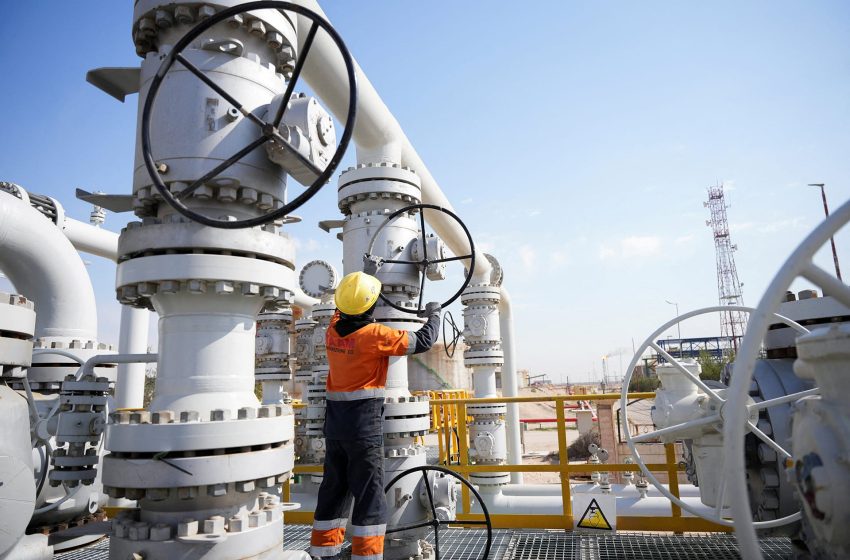
How the Iran War Ignited a Geoeconomic Firestorm
The Narrow Strait That Broke the Global Energy Market
Edward Fishman is a senior fellow and director of the Maurice R. Greenberg Center for Geoeconomic Studies at the Council on Foreign Relations.
In just over two weeks, the Iran war has already triggered what the International Energy Agency (IEA) calls the “largest supply disruption in the history of the global oil market.” Before the war, roughly twenty million barrels of oil and petroleum products moved each day through the Strait of Hormuz, the world’s most important maritime chokepoint. Those flows have now slowed to a trickle. Brent crude oil has surged above $100 per barrel, up from roughly $65 when tensions between the United States and Iran began heating up last month.
The strait has not been closed by mines or a naval blockade. Instead, Iran has used drones and other low-cost weapons to strike more than a dozen vessels—a small fraction of the more than one hundred commercial ships that transit the strait on a typical day. Yet even a handful of attacks has been enough to change the risk calculus of the entire global shipping industry.
Washington lacks easy options to bring prices down. Together with its partners in the IEA, the United States has coordinated the largest release of oil reserves in history: 400 million barrels over 120 days. But that equals just over three million barrels per day, far short of the disruption at Hormuz. U.S. President Donald Trump has also temporarily eased sanctions [PDF] on Russia in hopes of increasing supply. This move has delivered Moscow roughly $150 million per day in additional revenue with little visible effect on global oil prices.
Ultimately, the oil crisis will end only when traffic through the strait resumes. That leaves Washington with two unattractive options: persuading Tehran to reopen the strait, which will require making difficult concessions; or escalating the war further, including risking the loss of naval vessels and potentially deploying ground forces. Despite its emergence as an energy superpower, the United States remains inextricably bound to the global oil market.
The Oil Shocks From Iran’s War Are Just Getting Started
Brad W. Setser is the Whitney Shepardson senior fellow at the Council on Foreign Relations.
In normal times, more than twenty million barrels of oil pass through the Strait of Hormuz each day. The war in Iran has brought this steady flow to a stop, leaving oil-producing countries in the region with few options.
The Saudis can move two million barrels per day through an alternative pipeline—perhaps as much as four million barrels per day. But that leaves a shortfall of close to fifteen million barrels per day. Rory Johnston of Commodity Context thinks up to nine million barrels per day has been shut in, meaning the wells have shut down because there is no place to store the oil. Even with the release of strategic stocks, it is hard to see an extended de facto closure of the strait that doesn’t take about 10 million barrels per day off the market for an extended period of time. That is around 10 percent of global oil consumption.
One rule of thumb is that it takes a $10 per barrel increase in the price of oil to account for a 1 percent decrease in oil consumption. This kind of ballpark math suggests that a prolonged closure of the strait would push the price of oil up to around $170 a barrel (prior to the war, oil prices hovered around $70 per barrel). In other words, there is a clear risk that this oil shock isn’t over. And there are important disruptions in the markets for industrial gases like helium and the liquid natural gas market as well.
The United States will not be immune to these oil shocks. While the country produces about as much oil as it consumes in total, that doesn’t mean that higher oil prices aren’t a drag on the economy. Most households are oil consumers, but Americans on average consume more oil each day than Europeans or residents of China. When oil prices rise, most Americans either dip into their savings to keep up their overall level of consumption or scale back their consumption of other goods.
A reasonable estimate is that a $10 barrel increase in the price of oil leads U.S. growth to slow by about one tenth of a point of gross domestic product (GDP). The actual transfer from oil consumers to oil producers is more like a quarter of a point of GDP, so the one tenth of a point estimate assumes that some consumers reduce their savings to keep current consumption up and that there is some new investment in domestic oil production. The $30 per barrel increase in the price of oil since the start of the conflict, if sustained, is thus consistent with a three tenths of a point slowdown in growth. My personal view is that this estimate is a little on the low side, and the reduction in growth is likely closer to a half point of GDP if oil prices remain over $100 per barrel for an extended period.
The Gulf Conflict’s Toll on Global Food Security
Michael Werz is a senior fellow at the Council on Foreign Relations. His work focuses on the nexus of food security, climate change, migration, and emerging countries.
The consequences of the Iran conflict, which are already felt in the region, will reverberate globally as an exacerbated food crisis swells. The normally bustling Gulf is not only a regular channel for crude oil, but also for food and crucial agriculture fertilizers. But with the war at risk of expanding and the Strait of Hormuz essentially shuttered, the effect on these states and the role they are unable to play in global food markets will prove significant.
The countries in the region—which together are home to more than sixty million people—are particularly exposed to food shocks. They are almost entirely import-dependent when it comes to rice (77 percent), corn (89 percent), soybeans (95 percent), and vegetable oils (91 percent), according to the London-based Institute for Public Policy Research. Any disruption to supply chains will quickly have notable consequences. In Iran, food price inflation has risen over 40 percent in the past year. Meanwhile, prices for rice have increased sevenfold, while green lentils and vegetable oil prices have both jumped threefold. It is likely that new overland transport corridors will open, putting Russia, Syria, and Turkey in a position of strategic control over vital supplies. Saudi Arabia traditionally imports through its Red Sea ports, which have been massively affected because of attacks by Iran-aligned Houthi rebels.
With shipping activity through the Strait of Hormuz stalled, the effect on global fertilizer exports is enormous and will generate cascading effects. Countries across the world had already increasingly relied on Gulf states to offset fertilizer losses from Russia’s war in Ukraine and growing Chinese export restrictions. About one quarter of global fertilizer production pass through the strait, which means that prices are already spiking. In the Middle East, the price for urea—a high-nitrogen fertilizer—rose by 19 percent within a week, creating new fiscal challenges for agriculture sectors across the globe.
Iran Targets the Lifeblood of the Future Economy
Chris McGuire is a senior fellow for China and emerging technologies at the Council on Foreign Relations.
Iranian drone strikes on its Gulf neighbors have targeted commercial data centers, damaging two Amazon facilities in the United Arab Emirates (UAE) and one in Bahrain. The attacks caused widespread digital service disruptions in the UAE, including to the country’s banks. This marks the first time that any military has targeted commercial data centers, which are dual-use and extremely valuable. These attacks expose a fundamental vulnerability in plans to concentrate the world’s most valuable artificial intelligence (AI) infrastructure in one of its most volatile regions.
While oil infrastructure was the lifeblood of the twentieth century global economy, data centers are the lifeblood of the twenty-first century economy—particularly AI data centers that contain the supercomputers necessary to develop and run advanced AI models. Gulf governments, especially the UAE, recognize the waning influence of the oil economy and are investing heavily in AI infrastructure as the foundation of their post-oil economies. They are seeking to build the largest AI data centers in the world, positioning themselves as indispensable nodes in the global AI supply chain.
But as these attacks highlight, there is profound economic and strategic risk in U.S. companies becoming dependent on extremely valuable data centers in unstable regions—facilities that today cost tens of billions of dollars, soon to be hundreds of billions, and that host the frontier AI models that are the most valuable software on the planet. As long as Iranian drones and missiles represent a credible threat to the region, AI data centers in the Middle East will be vulnerable to disruption and destruction.
These attacks underscore one of the strongest reasons why U.S. AI companies should not rely on Gulf data centers for training or running their models. It should also inform decisions by the U.S. Department of Commerce on whether to approve export license applications that would allow the creation of large-scale AI data centers in the Gulf using U.S. chips.
The United States should be facilitating the global export of the full U.S. AI stack. But it should not do so in ways that create a fragile global AI supply chain, or that replace U.S. dependency on Middle Eastern oil with dependency on Middle Eastern AI computing power.
A Prolonged War Risks the Return of Stagflation
Roger W. Ferguson, Jr. is the Steven A. Tananbaum Distinguished Fellow for International Economics at the Council on Foreign Relations.
As the war in the Middle East enters a prolonged phase, its macroeconomic implications demand serious attention. While a swift resolution would likely contain the damage, a protracted conflict risks reprising the oil price shocks of the 1970s. Global oil dependence has declined since that decade, and the United States now enjoys substantial energy independence—yet the core lessons of that era remain relevant.
A supply-driven oil price spike would translate directly into higher energy costs worldwide, with gasoline prices the most visible pressure point for consumers. The United States is unlikely to see a return of 1970s-style fuel shortages, but Asia and Europe—regions that are heavily reliant on imported energy—face meaningful supply risks if the conflict persists.
For central banks, the policy challenge is acute. The Federal Reserve entered this period of conflict already contending with inflation above the 2 percent target and nascent softening in the labor market. Having paused its easing cycle, the Federal Open Market Committee, or FOMC, would find any resumption of rate cuts significantly complicated by an oil-driven inflationary impulse. Elevated rates against a backdrop of labor market weakness and a financially stretched consumer raise the specter of stagflation—a risk amplified by the extent to which equity market wealth effects have underpinned U.S. growth momentum.
How Markets Are Pricing the Iran War
Rebecca Patterson is a senior fellow at the Council on Foreign Relations, a globally recognized investor, and a macroeconomic researcher.
Financial market reactions to the first two weeks of war in Iran have been dramatic. Not surprisingly, given the effective halt of shipping through the Strait of Hormuz, crude oil and natural gas prices have surged, with Brent crude up around 40 percent to close above $103 per barrel on March 13.
Higher energy prices have raised expectations that inflation pressures could limit central banks’ ability to lower interest rates. Those expectations, combined with anticipated increases in government defense spending and debt issuance, pushed longer-term government bond yields higher—overwhelming the safe-haven flows into bonds that typically accompany falling equity prices. The MSCI All-Country World Index reflected global equities losing more than 5 percent since the war’s start in late February.
Currencies of commodity exporters generally outperformed those of commodity importers, with the broad U.S. Dollar Index up modestly. China’s renminbi was noteworthy—it lost less than 1 percent against the dollar over the first two weeks of the war. While a major oil importer, China has sizable petroleum reserves and a central bank known to intervene in markets during periods of stress. This likely contributed to the currency’s muted response.
Also noteworthy has been a decline in gold prices. The precious metal appears to be in a tug of war between competing pressures: safe-haven buying on one side, and on the other, selling from investors focused on rising interest rates (gold offers no yield), a stronger U.S. dollar, and potentially needing to lock in profits from gold positions to raise liquidity.
This work represents the views and opinions solely of the author. The Council on Foreign Relations is an independent, nonpartisan membership organization, think tank, and publisher, and takes no institutional positions on matters of policy.
First Appeared on
Source link






