


Faith, fortune and a phenom: How BYU became a player in college basketball’s new era
PROVO, Utah — AJ Dybantsa’s smiling face greets visitors to the bookstore inside BYU’s Wilkinson Student Center directly in the heart of campus.
Stacks of cream-colored T-shirts for sale feature his countenance, along with the No. 3 the freshman sensation wears for the Cougars, his scribbled AJ autograph — and five small stars. Underneath, there’s a quote from when the nation’s No. 1 recruit shook up the college basketball world in December 2024 by declaring on ESPN, “It’s just for the bigger picture,” going on to commit to a program unused to accumulating generational talent.
Less than a year and a half later, as Dybantsa enters what will be his one and only experience with March Madness, those words serve as an echo for the player and the program in the middle of trying to assimilate into the established elites of the sport.
Dybantsa is the highest-profile proof of the new level of ambition at BYU, which is owned and subsidized by The Church of Jesus Christ of Latter-day Saints. The athletic department has leaned into the era of name, image and likeness and revenue sharing, challenging assumptions about BYU’s limitations while also having to reconcile the mission of the LDS Church with spending big to win.
“I think BYU’s always wanted to be able to prove they can play with the big boys,” said BYU coach Kevin Young.
Landing Dybantsa from his hometown of Brockton, Mass., gave the Cougars a shot. Reports of Dybantsa’s single-year NIL compensation have oscillated from $4 million to $6 million, believed to be among the top paydays for a player to date. While Young declined to identify the exact number, he said Dybantsa could’ve made more had he chosen to sign elsewhere with more storied programs.
Young was hired in April 2024 after spending five years on the Phoenix Suns staff. To even be in the mix for players of Dybantsa’s caliber, Young vowed to run BYU basketball like a professional franchise, inspiring a new level of commitment from fans and, most importantly, the deep-pocketed boosters. Some of them come from the so-called Silicon Slopes, a hotspot for tech companies and startups between Salt Lake City and Provo.
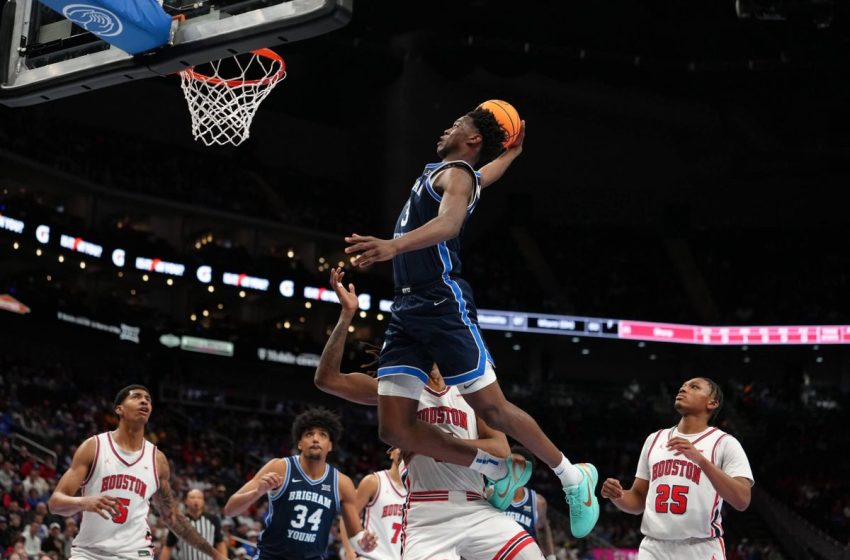
Dybantsa, a 6-foot-9 ball-dominant player, grew up idolizing the effortless scoring nature of his favorite player, Kevin Durant. He’s leading college basketball in scoring (25.3 points per game), played the entirety of a game five times in the past month alone and poured in 40 points last week in BYU’s Big 12 tournament opener. He is expected to be one of the first three picks in the NBA Draft and has NIL deals with Nike, Red Bull and Fanatics.
His rarity and the brevity of his time on campus makes this NCAA Tournament appearance one overflowing with intrigue. The Cougars (23-11, 9-9) earned a No. 6 seed in the West region and will face No. 11 seed Texas on Thursday in Portland, Ore.
BYU struggled down the stretch after starting the season 17-2 and being ranked as high as No. 7 in the country. The Cougars lost starter Richie Saunders to an ACL tear on Feb. 14, have floundered defensively and need more help for Dybantsa and secondary star point guard Rob Wright III.
“When you bring in a kid like AJ, people automatically think, ‘Final Four or bust,’” said Jimmer Fredette, the 2011 national player of the year who fueled one of BYU’s three total Sweet 16 runs with his depth-defying 3-point range. “With injuries it’s obviously been difficult, but people don’t temper expectations overnight.”
Expectations are a byproduct of not only emotional buy-in from BYU’s fan base, but also the investment made to create a program home to star recruits worldwide.
In the days after he was hired, Young hosted a dinner in The Annex, BYU’s basketball practice facility. It was a priority. To high-level boosters, he laid out his vision of building a staff, but most crucially, how he would change the level of recruits BYU could go after and even sign.
“I think it spoke the same language as a lot of the people that support this place,” Young said.
In Kevin Young’s first season, BYU made the program’s third-ever Sweet 16 and went 26-10. (Chris Gardner / Getty Images)
Young told The Athletic last week in Kansas City that BYU’s revenue-share salary structure for its roster this season featured an approach similar to what is done in the NBA: max out three players — Dybantsa, Wright and Saunders — and spend the remaining amount of your allotment on the rest of the roster. Wright, a former five-star high school recruit, is reportedly making $3 million this season after he left Baylor for BYU.
“What we did wasn’t that much rocket science,” said Young, who recently pushed back on the narrative that BYU is writing blank checks.
The school says its NIL approach has been quick and strategic and that its spending is sustainable. BYU’s moves have still furrowed brows within the college basketball establishment.
“There was a lot of discussion about being at the top,” said BYU vice president Keith Vorkink. “I think, for one, the fact that we were in the game shocked some people that we would even participate because we’re a faith-based university.”
Whether BYU should be investing in splashy athletic facilities and paying its coaches top dollar spurred handwringing among church leaders in recent decades, according to Patrick Q. Mason, chair of Mormon history and culture at Utah State University. In a podcast appearance last year, Elder Clark G. Gilbert, the former commissioner of the church education system, said he didn’t want BYU to get into the business of being the highest bidder at any cost for players. Gilbert was confirmed as a member of the Church’s Quorum of the Twelve Apostles in February.
“We can never become a pay-for-play culture,” Gilbert said on the podcast. “We would undermine everything at BYU if that comes out. It is tempting to buy one player at a time. If they don’t fit the mission, it would unravel everything.”
Athletes at BYU are part of a distinct culture. The stated mission of BYU Athletics is about Jesus Christ and inspiring others by living His values. Faculty, coaches and students must sign and abide by the school’s honor code, which requires they abstain from premarital sex, alcohol, drugs or vaping.
When asked what his favorite class was, Dybantsa routinely told TV announcers in production meetings it was his Book of Mormon class, a requirement for BYU students to fulfill a religious courses requirement.
“I just got to respect the rules, just like when you’re back home: You got to respect the house rules,” Dybantsa told The Athletic.
It was once considered a stiff challenge to recruit a steadier stream of non-LDS athletes to BYU; that is no longer the case. The school even touts its honor code as a strength for athletes who want a distraction-free culture.
But when the code is allegedly broken, it draws scrutiny.
In July, starting quarterback Jake Retzlaff withdrew from BYU and transferred to Tulane after a woman filed a civil lawsuit in May accusing him of sexual assault and battery. The lawsuit was later withdrawn. Retzlaff denied the allegations and said the encounter was consensual. He reportedly could have faced a seven-game suspension for violating the honor code. In November, BYU junior guard Kennard Davis Jr., a transfer from Southern Illinois, served a two-game suspension after being arrested on suspicion of driving under the influence and marijuana possession.
But adherence to the university’s values hasn’t hindered the revenue-generating programs from expanding their recruiting horizons.
Under Young and football coach Kalani Sitake, BYU athletics is an option for all blue-chip recruits, not just Latter-day Saints. In Young’s fewer than three years on the job, BYU has landed three commitments from five-star players — former guard Egor Demin (a lottery pick in the 2025 NBA Draft), Dybantsa and incoming recruit Bruce Branch III — none of whom are LDS.
From 1999 to 2023, every BYU starting quarterback had ties to the Church. BYU’s starting quarterbacks in recent years have been Jewish and Catholic. In 2022, under former head coach Mark Pope, BYU basketball fielded an entire starting five of non-LDS athletes for the first time in school history. Dybantsa is Catholic. Wright is Christian, but not LDS. And, this year’s BYU roster has six international players, continuing a trend set in motion by Pope before he took the job at his alma mater, Kentucky.
A more welcoming presence to outsiders from the LDS Church has, according to Mason, allowed BYU to expand its reach and allow its athletics department to adjust. There aren’t enough elite LDS athletes to be able to compete at the Power 4 level on membership alone.
“You cannot have a 90 to 95 percent LDS roster in today’s college athletics,” said Mason. “And that lines up nicely with the theological shift within the Church where the Church is much more comfortable with people of other faiths or no faiths at all, which was not the case as recently as 30 years ago.”
While no money is appropriated from the Church to the BYU athletic department, there remains cultural influence from the top down. Mason said the “fork in the road” was not ignored when, after a decade as an FBS independent in football and a decade in the West Coast Conference basketball footprint, BYU joined a power conference in the Big 12 in 2023. The move hasn’t come without its challenges. The BYU football and basketball teams have received derogatory chants targeting the LDS Church at venues of four conference opponents.
“It was a fork either toward irrelevance on the national stage or to prominence,” Mason said. “But the only way to get to prominence was through big money, and it just so happened that now over the past half-century, Latter-day Saints have become one of the more affluent minority groups in the country.”
That has worked in tandem with the explosion of Utah’s local economy in the past decade, highlighted by the area across the Wasatch Front that features more than 1,000 tech companies and startups, including companies such as Adobe, Oracle and Microsoft opening offices or campuses. Utah Jazz and Utah Mammoth owner Ryan Smith is a billionaire BYU graduate and has been a staunch supporter of BYU athletics.
Like Dybantsa, there are still T-shirts of Fredette being sold in the BYU bookstore. When college basketball fans think of BYU, they think of Fredette launching from just inside half court. Fredette said when the NIL era began in 2021, he had several wealthy donors reach out to him ready to help launch this next phase of BYU basketball.
“Everyone told me, ‘I cannot wait to put an imprint on these programs,’” Fredette said.
In February 2025, one BYU alumnus and donor told ESPN, “You’re not going to outbid us.”
Recently, BYU’s donors once again flexed their muscles, helping to retain Sitake, who at the 11th hour spurred a lucrative contract offer from Penn State. Jason McGowan, the founder of Crumbl cookie, a Utah-based dessert chain, told The Athletic donors went to “very substantial” lengths to keep Sitake and members of his staff in Provo after reaching the Big 12 title game.
These are the last days in BYU blue for Dybantsa, who has lived up to the hype and could make the Cougars a tempting dark horse for some bracket connoisseurs.
BYU is playing in its 33rd NCAA Tournament but still looking for its first Final Four. The Cougars last made an Elite Eight run in 1981 behind a star guard with a bowl cut named Danny Ainge. They made the Sweet 16 in Young’s first season last spring.
Dybantsa’s long-stated goals for his time at BYU include winning a national championship.
“I’ve got to go win six (games) in a row,” he said last weekend on “The Winning Formula” podcast.
Building off what Dybantsa has already accomplished this season, Young and his staff landed their third five-star recruit in as many years earlier this month. On March 4, Branch, a 6-foot-7 prospect from Gilbert, Ariz., announced his decision live on ESPN.
He unzipped his jacket to reveal a royal blue BYU jersey No. 3 — just like Dybantsa.
First Appeared on
Source link






