


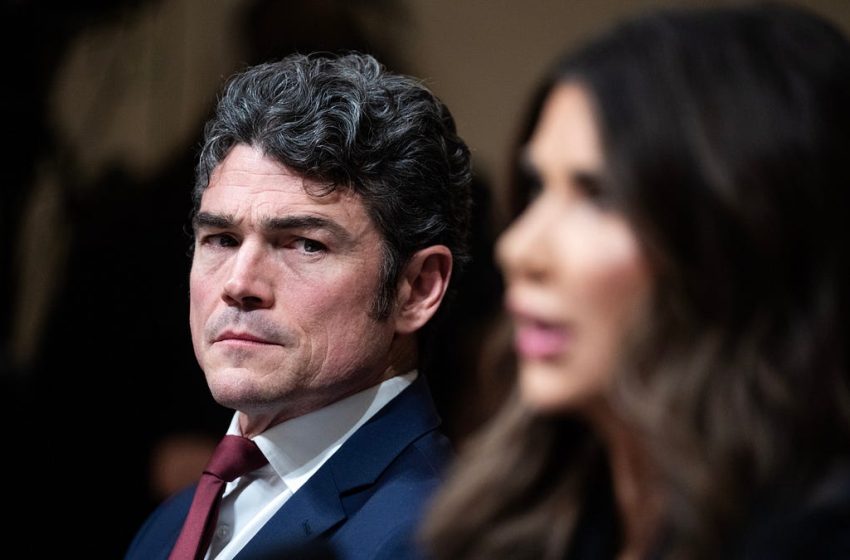
Joe Kent and the Fading MAGA Allure
The gas-price data keeps rolling in, and it keeps looking grislier. Gas is up eighty cents a gallon nationwide from this time last month, which the New York Times notes is the second-biggest four-week increase in at least 30 years: “bigger than the one at the start of the war in Ukraine in 2022, or the ones associated with the post-recession surge of 2009 and the OPEC production cuts in 1999.” Only Hurricane Katrina hit prices harder during that span. Happy Wednesday.
by Andrew Egger
Something odd is going on with the MAGA would-be stars. For a decade now, politicians and posters alike have had a single path to relevance: grabbing tightly to Donald Trump and distinguishing themselves by the strength of their adoration for him and the purity of their hatred for his enemies. But another path is emerging.
Yesterday, Joe Kent, Donald Trump’s director of the National Counterterrorism Center, charged onto that path. He announced that he was resigning from the administration, effective immediately. “I cannot in good conscience support the ongoing war in Iran,” Kent wrote in his resignation letter. “Iran posed no imminent threat to our nation, and it is clear that we started this war due to pressure from Israel and its powerful American lobby.” Trump, he wrote, had been “deceived” by “high-ranking Israeli officials and influential members of the American media” into abandoning his antiwar instincts and charging into an unwinnable conflict in Iran.
Kent went on: “I cannot support sending the next generation off to fight and die in a war that serves no benefit to the American people nor justifies the cost of American lives.”
The letter went off like a bomb in the administration, which was completely blindsided by the news. They rushed to work trying to discredit Kent: He was, they quickly whispered to Fox News, a known leaker who had been cut out of Trump’s intelligence briefings, whom the White House had thought should be fired, who had not been part of Iran planning discussions at all. “I always thought he was weak on security,” Trump told reporters of a man he had given a senior counterterrorism job.
If you’d never heard of Kent before now, you should pause before rushing to crown him a top fighter of the #Resistance. A special forces veteran and two-time failed congressional candidate, Kent was notorious early in his political career for rubbing elbows with the white nationalist podcaster Nick Fuentes, and later he enthusiastically embraced Trumpy conspiracy theories like the notion that the FBI was responsible for the Capitol insurrection on January 6th. His letter mixes understandable dismay over the course of the war and the Trump administration’s foreign-policy entanglement with Israel with some more broadly questionable anti-Israel tropes, like his claim that the Syrian Civil War—a conflict in which Kent’s wife died—was also “a war manufactured by Israel.”
But suspend for a moment the question of whether and to what degree Kent is a hero or a villain. The more interesting point now is that he sees political promise in turning on Trump at all.
For a while, it’s been clear that Trump—for all the chaos of his administration and for all his explosive hatred of the liberal establishment—now fully embodies a GOP establishment of his own. These days, your median empty-suit Republican congressman is more likely to make embracing Trump his entire personality than actual internet-poisoned true believers of the MAGA base are.
Now, we’re starting to see the corollary development: shades of MAGA countercultural revolt against that MAGA establishment. With a few exceptions—Tucker Carlson being the most obvious—you see this primarily among younger, smaller stars in Trumpworld. If you have a small right-wing following and you’re looking to make it a big right-wing following, and most especially if that following is concentrated among young right-wing people, it’s no longer the case that backing Trump to the hilt is the only move. Kent isn’t the only recent example of a figure popular with young anti-Israel Republicans to go out of his way to break with the White House: I wrote last month about Carrie Prejean Boller, an influencer appointed by Trump to his Religious Liberty Commission. She tripled her social-media following after provoking Trump into firing her after she derailed commission meetings by demanding to know if other commissioners thought her anti-Israel positions made her an antisemite.
There’s no reason to believe that the MAGA base broadly opposes Trump’s war in Iran; Trump’s voters have always been more blandly fine with Trump’s wars than the doves in MAGA media would like to believe. But the anti-war and anti-Israel types, who are disproportionately young, have established a beachhead in the Republican coalition. Joe Kent won’t be the last would-be right-wing star to flee Trump in a play for their support.
From a purely tactical point of view, is a divided MAGA better for the country than a united MAGA? Or will internal competition just make them all even more nuts? Share your thoughts with us.
by William Kristol
St. Patrick’s Day has its traditions. Kids apparently get pinched if they’re not wearing green (or so I’m told—I don’t actually recall this from growing up in New York, but I could well have been unaware of the customs of the cool kids). And every year, on St. Patrick’s Day, the American president plays host to the Irish Taoiseach (prime minister) in the White House.
So yesterday Micheál Martin found himself in the Oval Office as Donald Trump took questions from the press. Trump said he was disappointed with British Prime Minister Keir Starmer over his failure to support Trump’s war in the Middle East. In fact, pointing to the bust of Churchill in the Oval Office, the president said, “Unfortunately Keir is no Winston Churchill.”
Trump is surely correct that Starmer is no Churchill. Who is? Certainly not Trump. But what’s striking about Trump is that he takes no inspiration or guidance at all from Churchill. His world view is the opposite of Churchillian.
What slogan did Trump choose back in 2016 to characterize his foreign policy? “America First.” The whole point of the original America First Committee, in 1940 and 1941, was to stop America from joining the war against Hitler. What political leader did America First hate and fear above all others? Winston Churchill, who was standing against Hitler and imploring America to join the fight against fascism.
Trump has contempt for our allies and alliances. A constant in Churchill’s understanding of foreign policy, by contrast, from World War I through the early Cold War, was the importance of cultivating and standing by allies. In July 1938, he warned in a speech at the University of Bristol that “Civilisation will not last, freedom will not survive, peace will not be kept, unless a very large majority of mankind unite together to defend them and show themselves possessed of a constabulary power before which barbaric and atavistic forces will stand in awe.”
After the Grand Alliance, as Churchill called it, won World War II, Churchill was a great proponent of the democracies uniting in a constabulary power to keep the peace and secure freedom. Thus NATO, which Churchill said in 1952, was “the surest guarantee not only of the prevention of war, but of victory should our hopes be blasted.”
Meanwhile, at home, Churchill’s political life was characterized by a respect, even reverence, for his country’s parliamentary forms, its representative government, its traditions of deliberation and debate. In that same 1938 speech cited above, he defined “civilization” as a “society based upon the opinion of civilians. It means that violence, the rule of warriors and despotic chiefs, the conditions of camps and warfare, of riot and tyranny, give place to parliaments where laws are made, and independent courts of justice in which over long periods those laws are maintained.”
Not Trump-like!
And Churchill expressed the hope that
the same principles which have shaped the free, ordered, tolerant civilisation of the British Isles and British Empire be found serviceable in the organisation of this anxious world. Why should not nations link themselves together in a larger system and establish a rule of law for the benefit of all?
Churchill emphasizes that the rule of law has to be backed up by strength, not just good intentions. He was no wishful utopian. But he was just as far—even farther—from being a might-makes-right Trumpist.
As for the current war, one is reminded of a passage from Churchill’s lively and instructive memoir of his first three decades, My Early Life. He recalls the great confidence British officials had prior to the Boer war in 1899. Looking back from 1930, Churchill writes,
Let us learn our lessons. Never, never, never believe any war will be smooth and easy, or that any one who embarks on that strange voyage can measure the tides and hurricanes he will encounter. The Statesman who yields to war fever must realise that once the signal is given, he is no longer the master of policy but the slave of unforeseeable and uncontrollable events. . . . Always remember, however sure you are that you can easily win, that there would not be a war if the other man did not think he also had a chance.
If only Trump had read this paragraph before launching his hubristic war. If only Pete Hegseth had read it before boasting about our inevitable success. I suppose it’s out of the question that either would have done so. But is it out of the question to look forward to a day when we will once again have leaders who might not only know the name Churchill, but have learned from him?
-
Former General Gives Brutally Honest Iran War Assessment… In this Command Post edition of Bulwark Takes, MARK HERTLING and BEN PARKER break down how Trump’s snub of NATO allies is shaping the Iran conflict, and how even spectacular military success against the Iranian government and military won’t necessarily lead to victory.
-
What Pete Hegseth’s Spiritual Mentor Wants for America… Pastor-theologian Douglas Wilson advocates theocracy, the restriction of the franchise from women and nonbelievers, and much else—and he is closer than ever to real power, writes JULIE INGERSOLL.
-
The Iran War Is Not a Just War… Operation Epic Fury fails almost all the tests of righteous warfare, argues DAVID OPDERBECK.
PAM TO THE HOT SEAT: Is there something in the water recently? Earlier this month, Secretary Kristi Noem’s downfall at the Department of Homeland Security began when she faced unexpectedly hostile questions from Republicans during a pair of congressional hearings. Now, Rep. James Comer, the GOP chair of the House Oversight Committee, is taking the gloves off for a second cabinet official: Attorney General Pam Bondi. Yesterday, he issued a subpoena to Bondi requiring she testify before the committee over her handling of the Epstein files. CBS News has more:
The committee voted on March 4 to approve a motion to subpoena Bondi, with five Republicans voting with all Democrats to move ahead on the matter. The motion itself was introduced by GOP Rep. Nancy Mace of South Carolina. Republican Reps. Lauren Boebert of Colorado, Tim Burchett of Tennessee, Michael Cloud of Texas and Scott Perry of Pennsylvania also broke with their party to support it.
Bondi and Deputy Attorney General Todd Blanche are also scheduled to brief the committee behind closed doors on Wednesday. In an attempt to fend off the subpoena earlier this month, Comer noted Bondi had offered to give private briefings to members about the Epstein investigation.
As chair of House Oversight, Comer has richly earned his reputation for working tirelessly to uncover supposed self-dealing in the “Biden crime family” while somehow managing to avoid seeing the Trump family’s nonstop parade of open corruption. So it’s appropriate that he seems to have been dragged kicking and screaming to have to send this subpoena at all. The deposition will take place—if Bondi shows up—on April 14.
ALL THIS MONEY, NO GOOD WAY TO SPEND IT: More and more people are wondering: What on earth is AIPAC up to? The American Israel Public Affairs Committee and its associated PACs are working very hard to boost pro-Israel candidates in primaries on both sides of the aisle, typically by spending heavily to attack whomever they see as the pro-Israel candidate’s most viable opponent.
Sometimes, however, these ads are having the opposite effect in Democratic primaries this year. It goes like this: AIPAC, hoping to prop up pro-Israel candidate A, spends tons of money attacking mildly anti-Israel candidate B. (AIPAC, seeming to know its name is mud in some of these races, uses shell PACs and focuses on issues other than Israel in an effort to keep its prints off.) Candidate B is harmed by the attack—but so is Candidate A, particularly once voters get wind of the fact that AIPAC is getting involved on their behalf. The result: sudden, unexpected victory for anti-AIPAC, anti-Israel insurgent candidate C.
This is exactly what happened last month in New Jersey’s 11th congressional district, where AIPAC spending hammered Democrat Tom Malinowski—only for the race to go to his far more anti-Israel opponent, Analilia Mejia. (Malinowski wrote about the experience for The Bulwark here.) And last night in Illinois’s 9th District, it nearly happened again. In the Democratic primary, Evanston Mayor Daniel Biss—who faced a barrage of negative AIPAC ads—won the primary with 29 percent of the vote; progressive insurgent Kat Abughazaleh came in second with 26 percent. AIPAC’s preferred candidate, state Sen. Laura Fine, finished third.

First Appeared on
Source link






