


Top 100 Outfielders for Fantasy Baseball 2026
Welcome to the positional rankings! In addition to the expected positional ranks, there are two other additions:
First, a foreword by author Nate Schwartz! These give a breakdown of the position as a whole and provide an additional view on how to approach it on draft day.
Second, at the end of the article, you’ll find a table of all of the players at this position who wound up in my Top 300.
We hope that these rankings and the notes throughout give you something to think about as draft day approaches and help you feel as prepared as possible when it comes to hitters in your 2026 drafts.
- As a reminder, these rankings are geared toward a standard, daily, 12-team H2H redraft league, which is typically the most popular fantasy baseball format. They will only factor in the five standard categories: runs, RBI, home runs, batting average, and stolen bases.
- These are not best ball or draft and hold rankings. The 12-team redraft format with daily moves is the fundamental opposite of that. Pure volume plays are not valued as much here as in those no-move formats.
- The listed positions are based on five starts or 10 appearances, matching Yahoo’s eligibility rules. I use this because it’s the most inclusive standard across major platforms. If you’re in a format like ESPN or CBS, you may find certain players do not have one of the listed eligibilities. The most jarring example is Maikel Garcia, who could have anywhere from one to five eligibilities based on your site’s rules.
Ranking Philosophy
To keep things in the same ilk, here are a couple of notes on how I generally evaluate hitters before we dive in:
- In 12-team formats, I don’t see much value in guys who only provide stolen bases. It’s an important category, especially in Roto, but in shallower formats, there are too many other (and better) ways to get the steals you need without sacrificing production in the other categories.
- No stat is an island, and they should all be taken in proper context. For ranking purposes, the primary starting points I use are plate discipline, wRC+, quality of contact metrics (also known as Statcast batted ball data), lineup context, and the skills we can measure using tools such as our PLV Hitter Attributes (available for PL Pro members). I also use various projections (some free, some I buy) and dollar value generators.
- Positional eligibility, specifically multi-eligibility, is neat but isn’t a huge factor in many 10- and 12-team leagues anymore due to the prevalence of multi-eligible players. It’s of more value in deeper contests like the NFBC or in leagues with limited roster moves (draft and hold leagues, transaction limits/costs, extremely short benches, etc.). Still, the value is fairly situational and context-dependent.
- Similarly, I don’t penalize players for only qualifying in the utility slot. At most, it is a mild inconvenience if a DH-only player is available at a great value and you already have filled your utility spots.
- Regardless of true talent, anyone talented enough to make it to the big leagues can be brilliant or putrid for 50 to 100 at-bats. It could even last over a month with no change in potential or skill. It also could be wildly meaningful. We can’t and don’t know which will be valid until it’s over, though track record, scouting, and trends can give us hints.
- One of the most difficult things to account for in these rankings is the dynamic between low-ceiling players who have clear roles and players who could have higher ceilings but are without a clear path to playing time. I try to note this in the blurbs as much as I can. NOTE: PROJECTIONS AND AUCTION CALCULATORS WILL ALWAYS FAVOR THE FORMER OVER THE LATTER.
Read The Notes
If you’d like input on a player or have any feedback, your best bet is to contact me on Bluesky (@scottchu.pitcherlist.com), X (@ifthechufits), or Reddit (u/ChusephEsquire)
I also host an AMA in the r/fantasybaseball subreddit every Friday (starting sometime in late March) with Nate, starting around noon ET that lasts through the rest of the day and into the weekend, so feel free to join the fun and ask questions or make comments.
For additional insight, also check out the Hacks & Jacks podcast! This is a hitter-focused pod with myself, Brett Ford, and occasional special guests. We will soon be releasing episodes breaking down these rankings.
Want more from Nate? Check out The Approach Angle podcast, his weekly articles, or jump into our Reddit AMAs during the season! You can also find him on Bluesky (@nschwartz.bsky.social), X (@_nateschwartz), or Reddit (u/NateSchwartzPL).
Foreword
By Nate Schwartz
The outfield remains steady from last year, with new stars still hovering outside of being first-round worthy. The elite names provide you exactly what you want, and the new blood still leaves question marks among mostly polished players. We saw MVP potential in Pete Crow-Armstrong and James Wood, but they showed harsh reality checks. Wyatt Langford and Roman Anthony also flashed their sky-high potential; however, it’s unclear whether it can fill stat sheets the way people want.
After the names everyone wants, the position thins out quicker than anticipated. Dependable bats fill up the early middle rounds, giving you ample opportunity to fill out your outfield. However, there are likely only 30 outfielders who feel “safe-ish,” which means you need to know what your team needs later.
There aren’t many bulk stolen base options later, so it would be wise to get them earlier if possible, then take shots at plate skills to fill the position. You don’t want to end up empty-handed in the outfield.
Tier 1
1. Aaron Judge (OF, NYY) — Judge appeared in 148+ games for the fourth time in five seasons, shedding the “injury-prone” label, which was the only real knock we had against him. If you prefer to list him first overall over Ohtani, go for it. I did two months ago.
Tier 2
2. Juan Soto (OF, NYM) —It doesn’t matter what stadium he is in, what team is around him, or whatever. The batting average should bump back up 10-20 points in 2026 to get his OBP back over .400, and he should blast another 40 home runs.
3. Julio Rodríguez (OF, SEA) — I’m going to resist the “slow starter” narrative, though his career numbers have shown it has been the case in three of his first four seasons. The biggest thing we learned about Rodríguez is that the guy we saw in 2022 and 2023 was the real J-Rod, and the 2024 version was not. We know 30 home runs, 30 steals, and 200 combined runs and RBI are on the way; it’s just a matter of when and how. The return of Naylor helps to keep this lineup a little heavier at the top of a lineup that does get thin in a hurry with the loss of Jorge Polanco and Eugenio Suárez.
4. Kyle Tucker (OF/DH, LAD) — I’ve always been a huge Kyle Tucker fan, and seeing his greatness on full display to start 2025 was a lot of fun. The drop-off for the rest of the season was much less fun. Injury narratives are challenging to grasp, as they often oversimplify complex, multifaceted issues. In this case, though, I’m willing to give Tucker a mulligan and say the injury sapped his productivity in 2025 and that we will see a rejuvenated Tucker come spring.
Landing in LA certainly gives Tucker a boost to his counting stats, which hopefully offsets the lower stolen base totals that we should expect with the Dodgers, as they were much less aggressive in 2025 than the Cubs, and I don’t expect that to change. Something like 30-35 home runs and 20 steals should be there, though, and over 200 combined runs and RBI with a .280 or better batting average…assuming he stays healthy.
5. Fernando Tatis Jr. (OF, SDP) — Tatis Jr. endured a three-month power outage over the summer, hitting just five bombs in all of June, July, and August combined, though he rebounded in September to hit seven to close out the year. More importantly, he played in 150 games for the first time in his career and in at least 140 for the second time in three seasons. With a bit more confidence in his health and the hope that we don’t see another extended loss of power, Tatis move even higher.
Tier 3
6. Corbin Carroll (OF, ARI) — The power can be a bit uneven, but we saw a healthy Corbin Carroll hit 30 home runs and swipe 30 bases. The only genuine concern heading into 2026 I have is the counting stats, as the D-Backs got rid of two of their best hitters at the deadline, and their top prospect hasn’t looked ready to join the heart of a lineup. As of this moment, this lineup is three hitters deep, and unless they are aggressive in free agency, Carroll’s ceiling might be just a tad lower than others in this tier, but his floor is as good as anyone’s.
News that Carroll will have surgery on his hamate bone may scare some into dropping him in their ranks, but the limited data available suggests there isn’t a long-term impact on power or overall performance. He’s fallen just a few spots here, and I’m not going to go any further unless we see complications in his recovery.
7. Kyle Schwarber (OF/DH, PHI) — Schwarber is back in Philly, and hit the ball harder than ever in 2025. He also put up another season hitting .240 or better, and I think that should continue with how hard he hits the ball, how often he pulls it, and how often it’s in the air. In standard roto leagues or in formats where he’s only DH-eligible, I could see an argument for Schwarber to be lower in this tier, but in head-to-head categories or any league that rewards walks, Schwarber is as safe a player as you’ll find.
8. Ronald Acuña Jr. (OF, ATL) — The plus-plus contact ability we saw from Acuña in 2023 remains a complete anomaly, and without it, the incredible highs of that season feel more like a pipe dream, though we all know the real issue is whether he’s going to play in 140 games. This was the third time in five seasons he’s missed at least 60 games, and the fourth time in those five years he’s missed at least 40 games.
While we did see the power stroke come back with 21 dingers (he had just four in 49 games in 2024), the speed was absent. With a healthy offseason, we should see some of that speed come back, making Acuña a 30-30 threat with strong ratios (think more like a .280-.290 average, though, instead of that insane .337).
I bumped Acuña ahead of Alvarez as a healthy Acuña likely outperforms Alvarez due to the steals, but I’ve still ranked him far later than he’ll likely be available in drafts so the difference likely means nothing.
9. Yordan Alvarez (OF/DH, HOU) — If it wasn’t for the injury risk, he would be a Tier 2 outfielder. Alvarez had a slow start to 2025 when healthy, posting just a .646 OPS before hitting the IL, but was his usual self when he returned later in the season, evidenced by the 1.031 OPS. Obviously, injuries have been a major bummer throughout his career, but he did play in at least 135 games in ’21, ’22, and ’24, and hit 31 home runs with 97 RBI in his 114-game ’23. Yordan remains one of the best hitters in all of baseball, and those who feel a little light on power early in the draft should be aggressively circling this name on their board. If you’re risk-averse, you might want to push Alvarez down with the first basemen later on in this tier.
10. Jackson Chourio (OF, MIL) — Chourio’s career has started with back-to-back 20-20 seasons and a cumulative batting average of .272, and yet somehow we are all a little disappointed because we know he has the potential to give us even more. It didn’t help that Chourio missed 32 games in 2025, in large part due to a hamstring injury in the second half, and given a full season, I think we will see Chourio take that step forward to be more of a 25-25 player while keeping that solid batting average and providing plenty of counting stats.
11. Brent Rooker (OF/DH, ATH) — Rooker fell a bit short of my expectations in 2025 as I hoped the high batting average and gawdy home run totals would continue as he played half his games in a minor league park, but alas, it was not to be. That said, we did see a meaningful drop in his strikeout rate (from 28.8% in 2024 to 22.2% in 2025), and with his raw power, there’s a very good chance he improves upon his home power numbers with a second season in Sacramento. The healthy floor is 30 home runs with strong counting stats and a decent batting average, and I still believe there’s another 38-40 home run campaign in his bat.
Tier 4
12. Pete Crow-Armstrong (OF, CHC) — It was a tale of two halves for Pete Crow-Armstrong, going from one of the best hitters in the game through July to one of the worst from August to the end of the season. Oddly enough, plate discipline didn’t seem to play a massive role in his demise, as his second-half strikeout rate of 25.6% wasn’t that much higher than it was in the first half (22.9%).
There’s obviously a dynamic player in here who can hit 30 home runs and steal 30 bases, even if it comes with poor ratios. The question is whether he can tap into that explosion of power and hit ability again, and whether he can pick himself out of the horrible slumps a bit quicker. If either is true, he may come close to matching his 2025 numbers. It’s a gamble, but not a stupid one.
13. James Wood (OF/DH, WSN) — Wood was a top-10 player for me until the great cratering that happened after the All-Star Break. Strikeouts were the obvious issue, and the best explanation I’ve been able to come up with relates to his decision-making against breakers, as you can see below.
On the bright side, Wood has demonstrated his ability to make good decisions against breaking balls and hit any type of pitch with extreme power. He’s even pretty good at laying off breakers that are out of the zone. The problem is his extreme passiveness against breakers in the zone, and if you can’t hit a breaker for a strike, then you’re gonna have a bad time. This isn’t an easy fix, by any means, but the mountain Wood needs to climb to find his early-season form isn’t as high as his raw numbers suggest, and his ceiling is that of a top-10 player.
I may have underestimated how hard it can be for players to fix the issues he is facing (breakers are the bane of young power hitters everywhere), and this scary dip in home run power (a new metric we have for our PL Pros!). While it did start to rebound, there’s no guarantee that he picks back up there, especially with his struggles with making good contact.
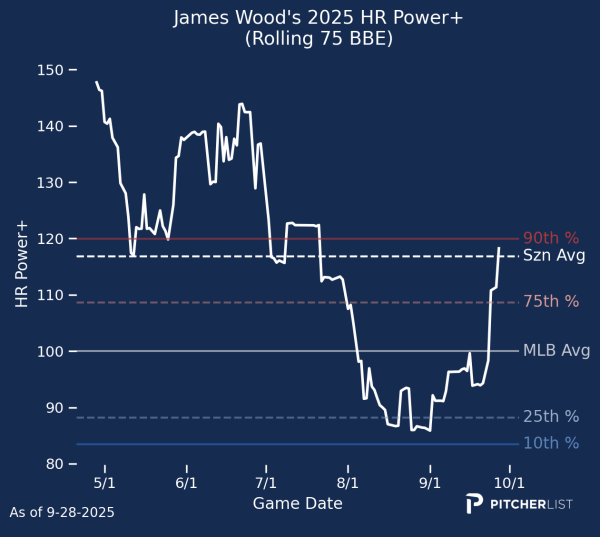
All that said, I moved Wood back up several spots because the risk is likely worth it. Spring Training stats will not sway me one way or another on Wood.
14. Riley Greene (OF/DH, DET) — If you’re familiar with my work, you know I’m a huge Riley Greene fan. Being a Tigers fan is part of it, and the other part is that a 25-year-old Greene makes very loud contact and has developed an extreme uppercut swing that can get balls out of the yard in a hurry, even in spacious Comerica Park.
That uppercut swing has a downside, though, and it’s the pesky holes it puts in his plate coverage. Greene made adjustments throughout the year, but the high strikeout rates persisted. He’s managed to keep the strikeouts to reasonable levels in years past, and I believe he can make the necessary adjustments in 2026, either as quickly or more quickly than he did in 2025. I expect 30+ home runs and 100 RBI, and should he find a little more patience and cover those holes a little better, Riley will be in the top 20 before you know it.
15. Jackson Merrill (OF, SDP) — Merrill hit the IL early on in April, and never really found his power stroke prior to hitting the IL again in August. It was quite a disappointment for the second-year outfielder, as his impressive 2024 had given us high hopes for the future. Merrill finished outside the top-120 hitters due to missed time and an underwhelming performance, but he finds himself ranked this high thanks to the return to form we saw following that second IL stint. Merrill smashed seven home runs in September, and also hit well in his tiny postseason sample, giving us a ray of hope that perhaps the downturn in production was more injury-related than anything else. If that’s the case, Merrill will easily outperform this ranking, though there’s still a risk that Merrill won’t consistently find power (it wasn’t really part of his scouting profile, and he didn’t show much of it in the minors).
16. Wyatt Langford (OF/DH, TEX) — On one hand, Langford hit more home runs and stole more bases in his sophomore season while taking more walks. He also improved his average exit velocity by almost two ticks and added about five points to his hard-hit and barrel rates. Sadly, he also added 5.8 points to his strikeout rate and finished outside the top-75 hitters, thanks in large part to inconsistency, as he gave us two months with a wRC+ above 160 and two other months with a wRC+ below 75. He also had three months where he slugged under .400.
Still, we did see signs that the tools we got excited about when he was a top-three prospect are in there, and his steadily improving plate discipline throughout the season suggests that maybe the consistency is coming soon. Langford has plus power, plus speed, and tons of upside heading into his age-24 season, and that’s more than enough to consider scooping him as a second or third outfielder.
17. Cody Bellinger (OF, NYY) — Despite hitting the most home runs he’s had since 2019, Bellinger’s barrel rate and hard-hit rate remained consistently below average. On the plus side, Bellinger will return to the Bronx and play in a park where he doesn’t really need the elite quality of contact to do a lot of damage.
Due to the crazy fluctuations in production for Bellinger over the last several years, Bellinger is a rather difficult player to project. It’s safe to assume he’ll keep hitting a ton of fly balls (the vast majority of which go up the middle or the opposite way), and the BABIP Gods will likely ensure he has two crappy months (like April and September last season). Still, he should hit 25 home runs with excellent counting stats, though I wonder how he can keep hitting close to .270 with the batted ball profile of a .240-.250 hitter.
18. Maikel Garcia (2B/3B/SS/OF/DH, KCR) — Garcia’s 16 home runs in 2025 were five more than he had in all of 2023-2024 combined, and he did it with a better batting average than ever before. Garcia doesn’t have a gawdy barrel rate thanks to his propensity to hit ground balls, but his average exit velocity of 91.3 mph shows he does have some thunder in his bat if he can get it up in the air to the pull side, which is precisely what he improved on in 2025. These changes can sometimes be fluky, but with a guy who can play several premium positions, enough raw power to make it believable, and the ability to steal over 20 bases in his back pocket, Garcia is a solid choice for managers who need speed and batting average boosts without sacrificing power entirely.
19. Byron Buxton (OF, MIN) — Buxton was a top-20 hitter in 2025, which is precisely what we’d expect if we knew Buxton would play in more than 125 games (he appeared in 126 games last season). Of course, this was the first time since his first full season in 2017 that he played in more than 125 games, and just the second time he played in over 100 games.
Picking Buxton is all about risk management. If you’ve played it safe in the first several rounds, you can even consider moving him up your board a tier or two. If you’ve already taken on some health risks (Acuña, Alvarez, Seager, etc.), you might need to take him off your board.
As a final note, I think Buxton should still get stolen bases, if only because the Twins will want to score runs somehow, and there aren’t many paths to scoring runs for this team if Buxton isn’t getting as close to home plate as possible.
Also, Buxton dropped down about a tier based on how bad the Twins look to me right now and how in drafts I found myself preferring to look elsewhere for high-risk players.
Tier 5
20. Christian Yelich (OF/DH, MIL) — Yelich isn’t getting younger (he’ll be 34 when we kick off the 2026 season), but he did just manage to play in over 140 games for the third time in four seasons while putting up the most home runs he’s had since the rabbit-ball era. Banking on Yelich to be fully healthy and fully productive for back-to-back seasons is an aggressive gambit, but it was nice to see Yelich put everything together. He still has a propensity to hit too many grounders, and he lost his outfield eligibility in leagues that require 20 appearances (he fell one short). The Brewers should be a potent offense again in 2026, and Yelich will be a central part of it, giving him ample opportunities to pile up counting stats while hitting at least 20 home runs (if not 25+) and swiping 15-20 bags with good ratios.
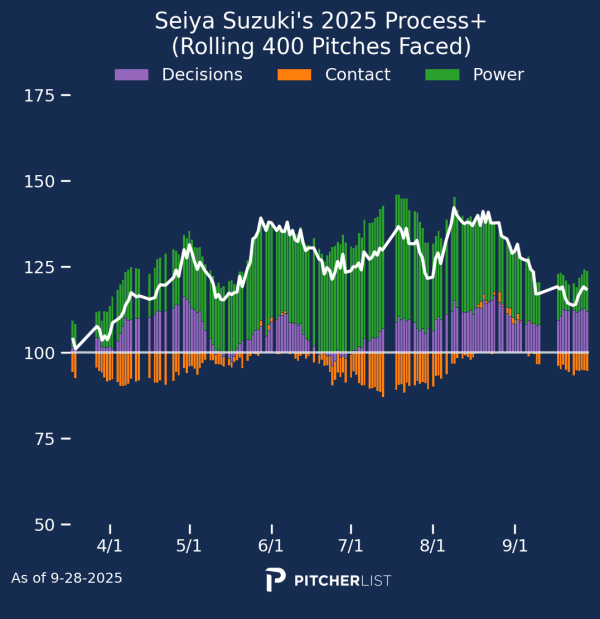
21. Seiya Suzuki (OF/DH, CHC) — Crow-Armstrong wasn’t the only Cubs hitter to have a hot start followed by a disappointing second-half, as Seiya Suzuki was the 16th-best hitter for fantasy in the first half per the FanGraphs Player Rater, thanks to a whopping 25 home runs and 77 RBI. Unfortunately, his second half was very pedestrian as he slashed .213/.336/.351 with just seven home runs (and five of those seven came in the last four games of the season, meaning many head-to-head managers did not get to benefit from them). Even with that bummer of a second half, Suzuki set or tied career highs in home runs (32), runs scored (75), and RBI (103). I don’t think there’s another gear in Suzuki’s bat in terms of power, but his .245 batting average was well below his norm, and there’s plenty of potential to see that number go up, which would also lead to better runs scored totals, likely a more consistent season.
Another quick point on that second half: our metrics suggest he was still making contact, still making good decisions, and still putting some thunder on the ball despite the poor results, so the poor results may have been more of a mirage than a real change.
22. Michael Harris II (OF, ATL) — Harris was dropped in just about every standard 12-team league by the start of June, and even the most patient fans were ready to bail when he was hitting a .205/.229/.310 line after play ended on July 10. Starting on July 11, though, Harris was a new man, as he clubbed 14 home runs and slashed .302/.317/.531 from then on. If you’ll recall, this late-season resurgence was also his story in 2024, though that one came even later. Maybe Harris turned a more permanent corner this time and is something resembling the top-20 hitter we saw in the second half. I just can’t shake the fact that we’ve seen three-month slumps in back-to-back seasons where he’s nearly the worst-hitting regular in the league, though, as there is just no way you can hold that in a 12-teamer.
Still, Harris is one of the younger players in the league (still just the age of most rookies), so there’s always a chance he finds more stability in 2026. Also, the loss of Profar means Harris II should have an easier time fighting his way into a better part of the lineup, even if the results aren’t consistent or fantastic out of the gate.
23. Jose Altuve (2B/OF, HOU) — Altuve apparently played through a painful injury on his right foot this season, though it didn’t stop him from a top-70 hitter finish with 26 home runs, 157 combined runs and RBI, and solid (if lower than we expected) ratios. Altuve will turn 36 next May and will be entering his 15th full season in the big leagues, so it’s more than fair to wonder how much tread is left on these tires. Since turning 30, Altuve has become a pull-heavy hitter who gets his home runs by targeting the shortest part of the field, so as long as he has his timing and swing, he should be able to hit 23-25 home runs with plenty of counting stats (especially if the Stros can get the offensive wheels turning more effectively than they did in 2025).
Also noteworthy is that this was his second-straight season with over 150 games played, which, for now, makes me think of him as less of an injury risk than we previously believed.
24. Roman Anthony (OF/DH, BOS) — Roman Anthony got off to a slow start, but when he found his groove, we saw why he was considered one of the top prospects in the game. The growth in power was especially noticeable, and our stats confirm it was no mere fluke. We’ve noticed some fluctuation in his ability to make contact, which is typical for a young player, but the tools are all there, and it’s time to start getting excited. In 2026, as a regular at or near the top of the order for Boston, we could be looking at a player who hits 22-25 home runs, swipes 10-12 bags, and scores 100 runs with elite ratios.
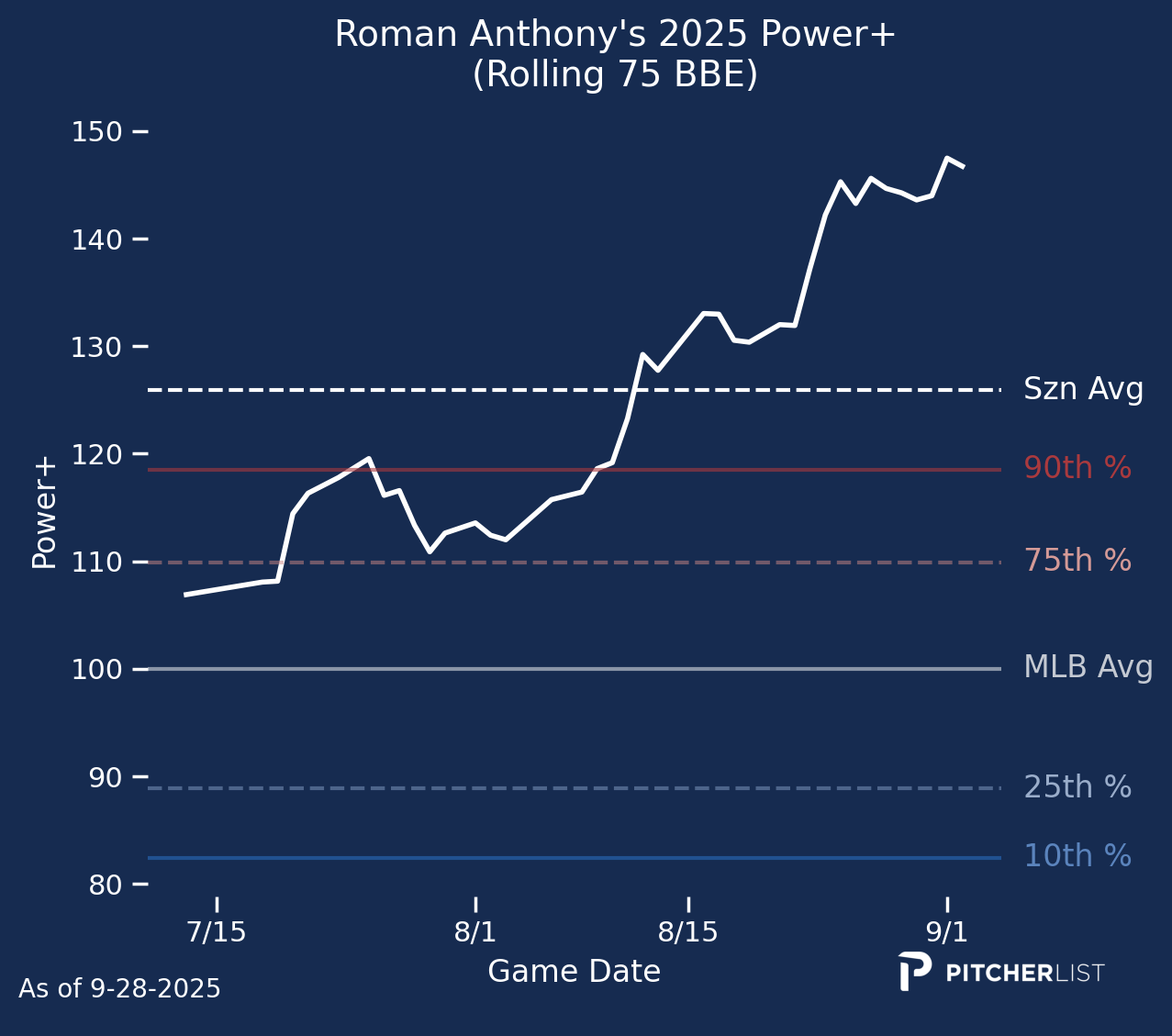
This ranking is a lot lower than the one I gave him in October, largely because most projection systems that I trust are a bit less rosy on the home run totals, so while the numbers I put in above are certainly possible, it is equally likely we see a guy who hits 18-19 home runs with more like 85-90 runs scored and ratios that are more good than they are great.
25. George Springer (OF, TOR) — Springer finished as a top-10 hitter in most formats in 2025, and while few expect him to find that kind of power again (he hadn’t hit more than 25 home runs since 2019 before his 32 last season), it’s not as though his results were based on luck. Springer had the best barrel rate, hard-hit rate, and average exit velocity of his career in his age-35 season, a rare feat in baseball history. I don’t think Springer will go entirely back to his 2021-2024 form, and he should continue to be an excellent source of runs scored at the top of the order, but some regression to his career norms has to be baked in, as does the fact that he’s played in more than 145 games just once since 2016.
The primary value statement here is simple, though: he’s the everyday leadoff man for an excellent offense who has power, a bit of speed, and a long track record of plus ratios.
26. Taylor Ward (OF/DH, BAL) — Taylor Ward stayed healthy for a full season for a second consecutive year, and while the .228 batting average and streakiness were a bit annoying, it was a small price to pay for 36 home runs, 86 runs scored, and 103 RBI. As an extreme fly-ball hitter, Ward’s batting average is never going to be high, but the power is more than real enough to get him back to 30+ home runs in 2026, and if he can make those slumps just a little less painful by managing the strikeout spikes, he could certainly repeat his 2025 totals for his new team.
27. Jarren Duran (OF, BOS) — Duran predictably fell short of his breakout 2024 season, but hitting 16 home runs with 24 steals is nothing to sneeze at, and there were plenty of counting stats to go around. Duran finished as a top-60 hitter in 2025, and that feels about right for what he brings to the table. There’s some upside for more runs scored and batting average, and even more importantly, the floor should be something like a top-75 hitter.
28. Kyle Stowers (OF, MIA) — Stowers was one of the best hitters in baseball back in July, smacking 10 home runs in 24 games and slashing .364/.451/.818 with an impressive blend of discipline, contact, and power. There’s no question that Stowers has the thump to slug over .500 for a season, but issues with contact in the zone and strikeouts have popped up over his short career, and those issues often spell volatility for power hitters. If he maintains the double-digit walk rate we saw in 2025 and keeps that zone contact rate north of 80% more often than he doesn’t, this is a guy who can hit .260-.270 with 30-35 home runs. If he can’t do those things, he’s more like a 30-35 home run guy that hits .220-.230.
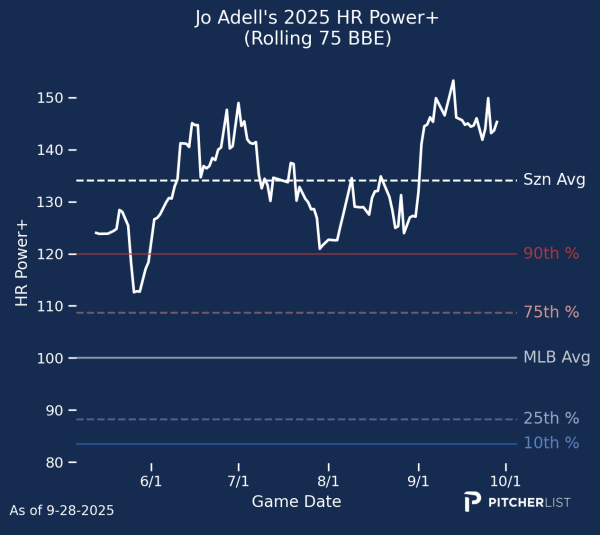
29. Jo Adell (OF, LAA) — We’ve held on to hope for a Jo Adell breakout because we knew 37 home runs and 98 RBI were a real possibility, and lo and behold, we finally got it. Yes, it came with a .236 average and some deep slumps, but the light finally shone through the clouds on Adell’s upside. He’ll likely always be a batting average drag due to his contact and discipline issues, and the counting stats might be tough to repeat in a streaky-at-best Angels offense, but you won’t find a lot of guys after the first two or three rounds who could hit 40 home runs, and if you’ve fallen behind in the category, this is the premier place to catch up.
Just for giggles, here’s the least surprising chart in this article.
30. Tyler Soderstrom (1B/OF, ATH) — Soderstrom is the type of hitter who produces in large spikes with long lulls in between (two separate 25+ game stretches with no home runs, for example), but because he burns so hot when he’s on, the final numbers work out in his favor. Soderstrom’s strikeout rate improvement was a significant positive and helped him post a .276 batting average, though the high ground-ball rates force me to hesitate on his power ceiling, as hitting 30 home runs with so few fly balls is difficult even when your home park is a bandbox. Soderstrom is a solid back-end first baseman in 12-teamers, but make sure you’re aware of his particularly volatile on-again, off-again nature and are ready to deal with that emotionally.
31. Andy Pages (OF, LAD) — It was an impressive breakout for Pages, who hit 27 dingers with 14 steals and a .272 batting average in his first full season in the majors. Pages is not the type of hitter who takes walks, and that .272 batting average is not likely to be repeated (.250-.260 is more realistic). Also, the 14 steals were a shock, as he had never stolen more than 10 in a single season in the minors (and that was in rookie ball back in 2018 as a 17-year-old), and he wasn’t particularly efficient in his attempts, getting caught seven times in 21 attempts. Even if we accept that the batting average will take a dip and the stolen bases will be cut in half, Page’s pop and the fact that he plays for a high-powered offense mean he should be a valuable source of home runs and RBI without hurting you in other places.
32. Jakob Marsee (OF, MIA) — Marsee exploded on the scene when the Marlins promoted him late in the summer, and his 189 wRC+ in August was the second best in the majors among qualified hitters. Marsee excels at making contact, and unlike many contact-oriented hitters, he does a great job avoiding offerings out of the zone. I’m skeptical of the power, as he never slugged better than .428 in any full season in the minors, but the hit tool and speed are for real, and Marsee showed that he’s more than capable of handling same-sided pitching.
Marsee will hit at or near the top of the order in Miami this season. Fifteen home runs is probably the ceiling for his power (and under 10 is a very realistic possibility based on the issues he’s had with popping out). The counting stats might be less than desirable, but he could also steal 40 bases with a solid OBP. In those OBP formats or in cases where you need a significant boost in steals, you can move Marsee to the top of this tier or even the bottom of the prior one.
Tier 6
33. Randy Arozarena (OF/DH, SEA) — Arozarena set a new career-high in home runs in his age-30 season with 27 while also stealing 31 bases and scoring 95 runs, finishing inside the top-50 hitters in most formats. Arozarena’s career-long struggles with making contact in the zone (career rate of 77.9%) cause him to be particularly streaky, making it tough to trust Arozarena to consistently be more than the baseline we’ve seen over his career, which is a 20 home run, 20 stolen base guy with plenty of runs scored due to his place at the top of the order and a batting average that can fluctuate anywhere between .230 and .250. There’s upside for more, of course, but the floor can be pretty disappointing, especially in head-to-head leagues when you’re trying to endure his brutal slumps.
34. Brandon Nimmo (OF/DH, TEX) — The final season totals give the impression of a steady, consistent player, but on a week-to-week basis, Nimmo is quite the opposite, showing dizzying highs and terrifying lows throughout the season, with multiple weeks providing deeply negative values and about as many with hugely positive values. Still, he’ll play a full season and get to 23-25 home runs and double-digit steals with decent ratios at the end of it all and earn a value inside the top 75 with a ceiling of a top-40 to top-50 guy.
His move to Texas doesn’t really change a ton for Nimmo, other than maybe lowering his runs scored ceiling due to the weaker lineup.
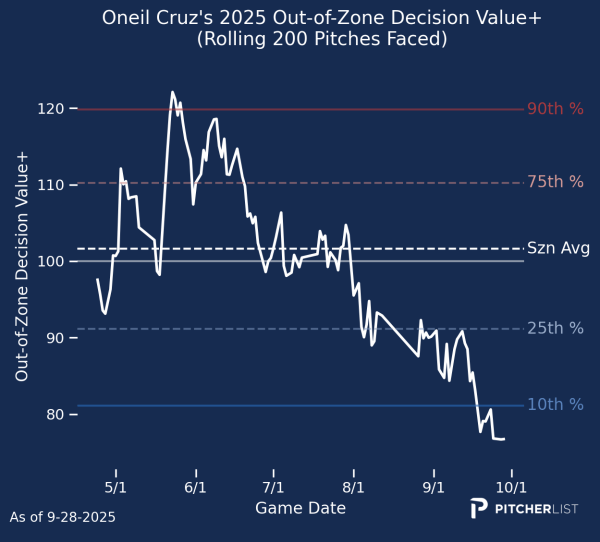
35. Oneil Cruz (OF/DH, PIT) — At the end of play on August 1, Cruz had 18 home runs and 34 steals thanks to a much-improved walk rate and, of course, the fact that he’s one of the hardest hitters in baseball. The end of the season was unfortunately much more sour, as he hit just two more home runs and stole just four more bases over his final 37 games with a soul-crushing .140/.234/.228 line. While Cruz still hit the ball hard and his plate discipline was essentially the same as it was in the first several months, his ground-ball rate spiked to 56.2%. His weakness against lefties was also entirely on display as he hit just .102 against them on the season with a single home run in 125 plate appearances.
The poor finish pulled him out of the top-100 hitters on the season, but I’m still not ready to give up on a guy who can hit the ball 122.9 mph and has 93rd percentile sprint speed. If he can keep that walk rate in the double-digits and find a way to keep the ball off the ground, he can still tap into the 30 home run, 30 stolen base upside, and even if he can’t, he could still crack the top-50 hitters. The floor is depressingly low, though the ceiling is as tantalizing as just about anyone in the league.
If Cruz can make better decisions outside the zone, watch out. That was the fuel of his first half fire.
36. Ceddanne Rafaela (2B/OF, BOS) — Rafaela was the second-best second baseman in the first half as he hit 14 home runs, swiped 13 bags, and hit a robust .271 with much-improved metrics under the hood. Unfortunately, following the All-Star Break, things fell apart for Rafaela. He hit just two more home runs the rest of the way with a .218 average. It was encouraging that we didn’t see a spike in strikeout rate, as his contact ability remained strong (as it needs to be due to his aggressive nature), but his power fell off a cliff, particularly against fastballs.
Rafaela is a classic low-floor/high-ceiling sort of play, and to me, it hinges on whether he can punish fastballs. If Rafaela can bring back even average power against heaters, he’ll outperform this ranking and have a shot to be in the top 75. If he doesn’t, his floor is unfortunately very low, and he may not even be roster-worthy in 12-teamers.
37. Ian Happ (OF/DH, CHC) — For a third consecutive season, Ian Happ hit at least 20 home runs while scoring at least 85 runs and driving in at least 79 runners with a batting average between .240 and .250 and an OBP between .340 and .360. His ceiling is something like a top-60 hitter, and his floor is something like a top-100 hitter. Happ is a very bankable contributor, and if you’re in an OBP or points league, feel free to bump him up.
38. Steven Kwan (OF/DH, CLE) — Steven Kwan’s hit tool is the story here, as he’s one of the best in the league at making contact. He doesn’t walk a ton, so the OBP isn’t as valuable as his batting average, but even on a subpar offense like Cleveland, Kwan should score 80-90 runs with double-digit home runs and about 20 steals with a batting average that could be as high as .300. In points leagues, he can be bumped a tier, but in OBP, he should be dropped a tier.
39. Teoscar Hernández (OF, LAD) — Heading into Hernández’s age-33 season, we have a pretty good idea of what he is and what to expect. He’ll have at least one month where he carries your roster, like his March and April, where he was tied for the league lead in RBI with 32 to go with his nine homers, and at least one month where he’s one of the worst guys on it, like his June when he slashed .189/.243/.347.
Still, despite his inconsistency (which stems from his struggles with making contact), Hernández piles up RBI because he gets to bat in the middle of the order for the Dodgers, and the last time the Dodgers were not a top-five offense in RBI was 2018 (they were sixth). You’ll be desperate to cut him at times in 2026, but if you hold firm, you’ll get 25 home runs and 90-100 RBI, though he won’t score that many runs, and the ratios will be a bit painful (especially in OBP). Still, when it comes to high-end RBI production at this point in the draft, you won’t find a better bet.
40. Trent Grisham (OF/DH, NYY) — Grisham is coming off a late-career breakout season, hitting 34 home runs in 143 games while scoring 87 runs with a career-best 14.1% walk rate and 23.6% strikeout rate. Under the hood, everything looks kosher as the home runs came from pulling more fly balls and hitting the ball harder while making excellent swing decisions. It’s a perfect time to hit free agency, though it does add a level of uncertainty to his fantasy profile.
Grisham returning to the Yankees was an excellent outcome for his fantasy outlook, as he should start the season as the everyday leadoff man with very little competition for that job. He’s still not good against lefties, mind you, but he takes a ton of walks against pitchers from both sides, and as long as he gets on base, there’s a pretty darn good chance he’ll end up scoring.
41. Luis Robert Jr. (OF/DH, NYM) — Will he hit for a low average? Yes. Will he have weeks where you wonder how he’s an everyday player? Yes. Will he miss time with an injury? Yes. But hear me out…he’s also super talented. Those 14 home runs and 33 steals in 110 games (in a full season, that’s nearly 20 home runs and 50 steals) were no fluke, and it’s worth noting that for the final month of the season, he had been posting sub-20% strikeout rates for a month. If you can survive the roller coaster and squeeze 140 games out of him, you’ll have a shot at a top-60 hitter despite his flaws. Of course, the floor is pretty awful between the injuries and poor performance, and if you don’t need stolen bases, it’s not an attractive package.
Joining the Mets will rob Robert of a premium spot in a lineup, but he should still get a chance to steal bases despite batting eighth, and a new home may be exactly what the doctor ordered to help Robert find a bit of consistency with a lot of players to look up to and/or emulate.
42. Bryan Reynolds (OF/DH, PIT) — Reynolds was pretty awful in the first half, but performed more like the guy we thought he was in the second half, hitting for a solid average with a decent number of home runs. He doesn’t run, and the Pirates don’t have a strong enough offense to provide good runs scored or RBI totals consistently, but if Reynolds can be the guy we saw in the second half more often than he isn’t, this is a top-80 hitter. Unfortunately, the floor is quite awful even if he stays healthy, as we just saw him finish as the 139th-best hitter in fantasy. A trade likely boosts his fantasy value, but we’ve expected that to come for years, and it’s never been more than an “ought to” rumor, and with the Pirates pretending to build a competent roster, it’s even less likely for the time being.
43. Alec Burleson (1B/OF/DH, STL) — Burleson is best deployed in points leagues due to his low strikeout rate and his role in the middle of the order, and his ability to make contact keeps his floor very high when healthy. He should hit at least .280 in 2026, and there’s a chance he boosts his power a bit to something like 23-25 home runs. The lack of depth in the Cardinals’ lineup makes him a liability in runs scored, though, and his RBI totals will be more decent than good, but this is a good hitter who will help your bottom line.
44. Ramón Laureano (OF/DH, SDP) — Laureano was remarkable in 2025, setting new career highs in exit velocity, barrel rate, and hard-hit rate by considerable margins, especially considering it was his age-30 season and already had more than 600 games in the majors when the season began. I’m often skeptical of late-career out-of-nowhere breakouts, though the strong expected stats and consistency he showed in 2025 make this one slightly more believable.
Injuries have always been an issue for Laureano, as he hadn’t played in more than 105 games since 2019 and averaged just 96.5 games played per season from 2021-2024. Asking Laureano to repeat a career year in both performance and health is a tall order, though if he does, this ranking would be 30 spots too low.
45. Lawrence Butler (OF, ATH) — Butler was a second-half breakout in 2024 and can’t be considered a total bust in 2025 as he did finish with 21 homers and 22 steals along with 83 runs scored. Still, Butler was basically unusable for fantasy against lefties (.570 OPS) and on the road (.633 OPS), and those limitations cap Butler’s ceiling in a big way. The road woes were likely just a bit of a random sample, but the plate discipline against lefties was atrocious with nearly ten strikeouts per walk (4.9% BB%, 39.8% K%). Butler should have better ratios and production in 2026 as he gets more experience, but unless he figures out how to tame left-handed pitching, he might wind up in a platoon.
46. Daulton Varsho (OF, TOR) — When healthy, Varsho was hitting better than we’d ever seen him hit, smacking 20 dingers in just 71 games, albeit with his typical poor batting average and even worse OBP. Varsho has always been a streaky hitter, though this spike was even hotter than any of his prior ones, and they did well to prevent the steep slumps that have often come with those spikes. Steals aren’t a big part of Varsho’s game anymore, but if he can keep flashing power and continue to hit fifth for the Blue Jays heading into 2026, we could be looking at a solid fantasy outfielder.
Again, this performance was well outside of the norm for Varsho, and it’s not as though we can reasonably expect a guy who hits this many fly balls to keep a 21.3% home-run-to-fly-ball rate, but even keeping just some of these improvements would be a big win. Otherwise, he goes back to being a low-end streamer.
Tier 7
47. Heliot Ramos (OF/DH, SFG) — Ramos ended the season as the leadoff man for the Giants despite a very pedestrian second half, and if I felt like he would keep that role, he would likely be ranked higher. Most of Ramos’s good times came in May and June, and for the rest of the season, he was mostly average or worse. If he were to find more consistency, this would be a top-75 bat with 25 home runs, 160 combined runs and RBI, and ratios that don’t hurt you, but I get the feeling he’ll be more of a top-50 player for two or three months and outside the top 150 the rest of the time. In roto, that works out just fine, but in head-to-head, it causes a bit of heartburn.
48. Giancarlo Stanton (OF/DH, NYY) — Stanton missed half the season due to injury, which was even more than usual, but sure enough, he hit his way to 24 home runs and 66 RBI with a .273 batting average. Stanton is going to miss time, that much is certain, but when healthy, he’s an elite power contributor and was even a top-20 hitter overall in the second half. Given more plate appearances, the bad side of Giancarlo would likely have reared its ugly head (tons of strikeouts, too many pop-ups) to level out his numbers a bit, but if you’ve got space to take on some risk in 12-teamers, this is not a bad lotto ticket to pick up. In deeper leagues, though, the certainty of missed time due to injury has a much greater impact, and you might drop him a tier or so.
49. Kerry Carpenter (OF/DH, DET) — Carpenter has missed time throughout his career due to injury and being platooned against lefties, and both of those things are likely to happen again in 2026. Still, when healthy and in the lineup, Carpenter has 30-35 home run pop and will be in a prime lineup position to take advantage of it. He’s a frustrating player at times, but if you need power and can afford to use a bench spot on a hitter, Carpenter, plus a replacement-level outfielder, can be a strong combination. In those scenarios, I’d bump Kerry Bonds up a tier, but recognize that in many 12-teamers, your bench is mostly reserved for streaming pitchers.
50. Dylan Crews (OF, WSN) — In his first 116 major league appearances, Dylan Crews has shown some power (13 home runs), speed (29 steals), and major struggles with getting the ball in the air (52.7% ground-ball rate). Injuries cut his 2025 much shorter than we hoped, and likely played a role in his volatility last season, but assuming he can stay healthy, Crews could hit 15 home runs with 35 steals (but poor ratios and counting stats). That’s an exciting ceiling, but keep in mind that the Nationals may not be entirely willing to give Crews everyday work for long if he continues to slash .211/.282/.352, even if his glove is strong. This is a clear ceiling over floor play, and you should only be scooping Crews if you already feel good about your outfield.
51. Wilyer Abreu (OF/DH, BOS) — Injuries and platoons cut Abreu’s season short, which is a bummer because when we saw flashes of a solid player, especially in his first 42 games, where he hit .281/.375/.555 with 11 home runs and four steals. Injuries and strikeout issues plagued him over the rest of the season, though, and over his final 73 games, he hit just .225 with a .278 OBP, though he did manage to hit another 11 home runs. Abreu is likely to find himself on the large side of another platoon this season, though the upside if he can find a full-time role is that of a streaky top-75 hitter who provides plus power and counting stats and inconsistent ratios.
52. Brenton Doyle (OF/DH, COL) — Doyle didn’t give us the season we hoped for after his strong 2024, but he picked it up in the second half, slashing .282/.307/.462 with power and speed. The slumps are horrible, and he’s impossible to trust away from Coors, but Doyle should be a bit stronger in 2026 and could provide 20 home runs and 25 steals. The ratios will be poison, and he’s not an automatic start even when he’s hot if he’s away from home, but there is production and upside to be had from Doyle.
53. Chandler Simpson (OF, TBR) — Simpson came to the bigs with a lot of fanfare about stealing 104 bases in 110 games across Low-A and Double-A last season, and his 44 steals in 104 games put him on a pace to fall just short of 70 steals in a full season. Simpson is all speed and batting average, to put it mildly, as he did not have a single barrel across his 376 batted-ball events and ranked dead last in the majors in average exit velocity.
There’s some risk with a platoon, because despite Simpson hitting .299 against lefties, all 32 of his hits were singles, and despite his speed, he’s been quite bad in the field; but even with 120-130 starts, he should get to 70 steals (with the upside for 80+) and continue to hit .290 with some runs scored. Just keep in mind that he will likely sit once or twice a week and that he’ll be a big negative in RBI and power. I’d drop him a tier in points and OBP leagues, too.
54. Ryan O’Hearn (1B/OF, PIT) — Surprisingly, O’Hearn is a Pirate! That means he’s likely to be a mostly everyday player simply due to the lack of options and competition in Pittsburgh. PNC Park is quite spacious, but O’Hearn should still be a decent bet for 15-17 home runs and solid ratios, plus as many counting stats as the Pirates can muster (which isn’t a lot unless a few guys find a new level). The ceiling isn’t terribly high, but the floor is as good as it gets in the later rounds.
55. Mike Trout (OF/DH, LAA) — Mike Trout played in 130 games for the first time since 2019, and unfortunately, the results weren’t quite what we hoped for as he finished outside the top-120 hitters in standard leagues due to a career-high 32% strikeout rate and a career-low .439 slug. Trout’s strikeout rate really spun out of control at the end of the season, and while an elevated strikeout rate and lower batting average aren’t a huge surprise, I expect Trout to clean this up a bit heading into 2026. Obviously, this is still Mike Trout, a guy with 87.2 fWAR over his career and who still can put up excellent barrel and hard-hit rates, so there’s still a ceiling that a 120+ game season provides a top-80 hitter, and if you’re going to take a shot, why not in the outfield and why not with one of the best hitters of this generation?
56. Daylen Lile (OF/DH, WSN) — What a debut for Daylen Lile, who crushed his way through the high minors and earned a spot in the Nationals’ plans by hitting .299/.346/.498 in his rookie season and being a top-40 hitter in the second half. Lile brings a line-drive heavy approach with fantastic contact ability, and while that approach and swing plane limit his home run upside, it provides a path to repeating that .299 batting average, and he should have enough pop and speed to get to double digits in both categories. Lile wasn’t a very efficient base stealer, converting just 8 of 14 attempts, but that could improve a bit with experience. Counting stats will be a question mark, as this offense is not exactly high-octane, but Lile could quickly become one of the premier batting average contributors by the end of 2026. Those in OBP leagues, though, should probably drop him due to his below-average walk rate.
57. Noelvi Marte (3B/OF/DH, CIN) — When Marte is good, he’s excellent. He was raking before being slapped with an 80-game PED suspension (three home runs and four steals in 14 games with 16 RBI) and also showed his upside when he returned, slashing .288/.328/.508 for 48 games in July and August. When Marte is bad, though, he’s horrendous. For the final 23 games of the season, Marte had a .502 OPS with 32 strikeouts to just three walks and five total extra-base hits. We’ve seen this narrative throughout his career, from his exciting 2023 debut to his incredibly disappointing 2024 and what I just described in 2025.
If we were talking about upside alone, this is a guy who could hit 25 home runs, steal 15 bases (it would have been higher, but Francona is much less aggressive than the prior manager), and hit .270 (albeit with a crummy OBP because he doesn’t walk). Unfortunately, the floor is especially low based on what we’ve seen, and he’s not yet shown he can break out of those slumps in-season.
58. Austin Hays (OF/DH, CHW) — Hays landed on one of the teams that won’t actively try to platoon him, as they don’t actually have a left-handed outfielder to platoon him with unless Tristan Peters or Jared Kelenic somehow find a way onto the roster (which does not seem likely at all). Hays has struggled badly against right-handed pitching for the last two seasons, though it wasn’t a problem for him prior to 2024. Hays is an aggressive swinger who can be streaky due to his tendency to put bad pitches in play, and he ends up on the IL a fair amount, but despite that, Hays managed to be a top-100 hitter (barely) in the second half last season. Hays has just enough power to be relevant, as he could hit 20 home runs if he stays a full-time player, but the upside is limited by the team context and his approach.
59. Brendan Donovan (2B/SS/OF, SEA) — Brendan Donovan faded hard down the stretch, mostly due to injury, but when healthy, he was a solid, if unspectacular, hitter who could hit .280 or better and score runs while leading off due to an elite ability to make contact. He doesn’t do much else, though, and injuries have been an issue in two of the last three years.
A move to Seattle probably boosts his run-scoring opportunities a bit, though the fact that his power is quite limited, combined with his durability issues, still apply so his overall outlook doesn’t really change.
60. Jordan Beck (OF/DH, COL) — If Beck didn’t play half his games in Coors, he might not be on this list (though in fairness, had a better organization developed him, he might be a more well-rounded hitter). Beck has the power to reach 20 home runs if he plays his cards right and the wheels to swipe 20 bases, though, like most Rockies hitters, he’s more or less unusable on the road. He also struggles with strikeouts, and it got worse as the season wore on, as he was called out on strikes 31.9% of the time in the second half, with an average walk rate. Limiting the strikeouts would make Beck more interesting as he’d be less prone to volatility, but either way, he’ll be a very streamable outfielder who provides power and speed with decent ratios as long as you don’t start him on the road.
61. Willi Castro (2B/3B/OF, COL) — Willi Castro is interesting because he’s in Coors. He doesn’t hit the ball hard, nor does he force himself into most lineups every day, but in Coors Field, his limited power and willingness to spray the ball should turn into something like 15 home runs and a .260 batting average as an everyday player (which he can be for the talent-starved Rockies). He might even steal 15 bases, too. Those in deeper formats that utilize a middle and corner infield spot (like the NFBC format) should move him to the top of this tier, though, as he can be plugged into many of the most difficult spots to replace on the wire (MI, CI, and OF), which helps keep you flexible when looking for replacement options on the wire.
When healthy, look for 13-15 home runs, decent counting stats, and excellent ratios from a guy who can cover second base in all formats and shortstop in some others, and in points leagues, Donovan should be moved up a tier.
62. Konnor Griffin (SS/OF, PIT) — If your league allows you to stash players with a minor league spot or a deep bench, move Griffin up a tier or two, as he’s the premier stash in the game. There’s incredibly little chance he breaks camp with the big club, which isn’t the worst thing in the world (he only notched 98 plate appearances in AA).
Griffin has exceptional power and lightning speed, along with a maturing (but not yet mature) hit tool, and will be the talk of the time when he makes the big leagues. The only real question is when that will happen. I’d take the slight under on 100 games played for Griffin in 2026, and it may be rough going upon initial callup, but make no mistake: this is baseball’s best prospect.
63. Jac Caglianone (1B/OF/DH, KCR) — Caglianone has oodles of upside, though he was positively miserable in his 232 plate appearances in 2025. While Cags avoided strikeouts, he hit far too many grounders and wasn’t able to really tap into any of his prodigious power.
He gets a significant jump in these ranks because of what could now be a spot closer to the middle of the order. The strong spring numbers are cool too, but only insofar as they land him a more secure role in a top-heavy offense.
Tier 8
64. Lars Nootbaar (OF, STL) — Nootbaar finally played in more than 120 games, and while he was excellent to start the season, posting a 140 wRC+ in April with more walks than strikeouts and 21 runs scored, he faded as the season wore on, slumping a bit in May and June before hitting the IL for several weeks and then completely falling off the wagon, hitting just .216/.304/.270 over his final 30 games with just five extra-base hits and zero home runs.
Nootbaar has flashed the tools of a top-100 hitter at times in his injury-marred career, and it wouldn’t be much of a shock to see him make his way back to the top of the Cardinals’ lineup and hit 16-18 home runs with a strong OBP and plenty of runs scored. It’s an uphill climb to that relatively unexciting ceiling, though, especially in standard leagues. In points and OBP leagues, though, he’s a solid late-round flyer.
65. Jung Hoo Lee (OF, SFG) — Lee started strong, but was more mediocre than good for the majority of the season in standard leagues. He should get another shot to establish himself as a leadoff man due to his contact-oriented approach. Lee is at his best in points leagues as he puts a ton of balls in play, and the batting average should be closer to .270 or .280 next season, but he won’t offer much in the way of homers or steals, and while he was bumped down the order from first to fifth, he should have a shot at close to the same total value he had last season, albeit with fewer runs and a few more RBI.
66. Addison Barger (3B/OF, TOR) — Barger was a revelation over the summer, hitting 15 home runs with a 133 wRC+ over 76 games across May, June, and July. That promise faded, though, as he posted just a 75 wRC+ over the remaining 49 games. It remains to be seen if Barger can find that power he displayed in the middle of the season again, and he’ll open the season locked into a platoon that will be quite difficult to break out of.
67. Adolis García (OF, PHI) — García looks poised to play a (mostly) everyday role in Philly, and while 2025 was a nightmare in many ways (including a demotion to Triple-A for a time), the 33-year-old slugger still drove in 75 runs for the Rangers with double-digit steals and a bit of power, plus the strikeout rate hasn’t collapsed yet. He should accumulate slightly better stats in Philly, and perhaps the change of locations helps him find just a little more of his old self in 2026.
68. Gavin Sheets (1B/OF/DH, SDP) — Sheets is a streaky lefty with power who will give us one or two good months and three or four bad ones. Keep him on your streaming radar, but don’t fool yourself into thinking this is a full-season option. On the bright side, O’Hearn’s departure gives Sheets a clear path to regular playing time, though remember that you don’t want his games against lefties.
69. Cedric Mullins (OF, TBR) — Landing with the Rays all but ensures Mullins will be in a platoon at times, but it also means he’ll be on an aggressive baserunning team. Mullins isn’t getting any younger or any faster, but he shouldn’t have any issues swiping at least 20 bags and hitting another 15-17 home runs. The ratios will stink, but there’s value in what Mullins can do.
70. TJ Friedl (OF, CIN) — Friedl put up a full healthy season for the first time in his career, and while the runs scored, plate discipline, and ratios were solid, we were left a bit disappointed with the overall output based on what we had seen from him in the past. Under their new manager, Terry Francona, the Reds were much less aggressive on the basepaths than in years past, which suggests that a return to 20 steals may not be in the cards for Friedl. However, it seems clear that Friedl is the locked-in leadoff man for the Reds, meaning a ton of plate appearances in one of the most hitter-friendly parks in the league.
71. Mike Yastrzemski (OF, ATL) — Yaz is a left-handed platoon bat at this stage of his career, though he’s coming off the best strikeout rate of his career by far (19.4%) and a strong walk rate. If all goes well, he could approach 20 home runs with a bad batting average and usable OBP, plus a fair number of RBI if he plays most days, hitting behind Drake Baldwin and Austin Riley.
Yaz gets a big boost from the suspension of Profar as it makes him a de facto starter for Atlanta near the middle of the order. The limited skills and upside keep him out of the top-150, but there is plenty of value to be had later in drafts if you’re a bit light on power.
72. Colton Cowser (OF, BAL) — Cowser had a miserable second half, which may very well be because he apparently played through two fractured ribs. Cowser could still give us a repeat of his 2024, where he finished as a top-30 outfielder with plus power and counting stats, but the strikeout issues have gotten worse over his career and threaten to keep him stuck in a platoon. If you’re chasing some power late in the draft, Cowser can provide that for you, and I’m willing to believe that the ribs were the real cause of his problems, but if he can’t get that strikeout rate below 30% in short order, he’ll be a streamer.
It’s also worth noting that Cowser is unlikely to win back the leadoff role he had at times in 2024 and 2025, and is more likely to hit near the bottom of the order. I think he’s safe from being platooned at the moment, but if he should struggle again, it could get ugly.
73. Jeff McNeil (2B/OF, ATH) — McNeil moves into one of the few parks that his power can handle, and due to the overall state of the A’s roster, McNeil will also bat fifth behind four strong hitters. If healthy, he should accumulate counting stats with streaky ratios and good plate discipline, but there’s really no ceiling to be found, as even in the small park with 130 games, he’ll struggle to clear 15 home runs, and he doesn’t steal bases. The average isn’t all that good either, or at least it hasn’t been since 2023.
74. Sal Frelick (OF, MIL) — Frelick improved dramatically in 2025, adding 10 home runs, 31 RBI, and 39 points of batting average to his 2024 totals to finish as a top-75 hitter. Oddly, Frelick basically stopped running in the second half, and almost all of his production came when he was leading off (except, weirdly, the steals). If Frelick were to be the leadoff man on Opening Day, I’d move him up a tier or so, but unfortunately, I think he’s destined to return to the bottom half (or even bottom third) of the order, which will push his counting stats down in a big way. That, combined with my suspicion that 12 home runs were more fluky than real, pushes Frelick down these rankings, though points leaguers can bump him up a bit.
This ranking is 50 points lower than where I had him in October and 100 points lower than where he finished in 2025, but many projections also rank Frelick here likely because he’ll have many fewer plate appearances in 2026 as he may get platooned at times, and his 2025 performance feels like a 90th percentile outcome for Frelick, with most outcomes being a replacement-level outfielder or worse.
75. Jake Mangum (OF, PIT) — Mangum is a slap-hitting speedster who plays excellent defense and can hit from both sides of the plate. The skills are there for him to win an everyday role for a Pirates team that’s trying to find its footing with a plethora of new outfielders, and if that happens, look for a guy who hits .280-.290 with 35 steals, though the counting stats and home runs won’t really be there. If you’re in a points league, Mangum should be in your top 150. If you don’t need speed or ratios, you can essentially remove him from your board.
76. Spencer Steer (1B/OF/DH, CIN) — Steer might be the big loser in the Eugenio Suárez signing, as he may get moved to a utility role and not have enough plate appearances to be interesting. He can hit 20 home runs with a full-time role, but he doesn’t run well, and his overall skillset is uninspiring. If anyone at any corner infield or outfield position goes down or slumps badly, Steer can jump in and take over a role, which gives him a boxer’s chance to be relevant in March.
Tier 9
77. Brandon Marsh (OF, PHI) — Brandon Marsh is only 28? It feels like he’s 35. Anyway, he’s currently slated to hit fifth for the Phillies, which would be a lot more interesting if he didn’t have a 38.4% strikeout rate against lefties with a 61 wRC+ in his career. It’s hard to imagine him playing more than the 130ish games he’s played the last few seasons. Those in deeper leagues will likely appreciate the steady role, but the upside here is very limited, especially considering he didn’t run like he did in 2024. Think something like 15 home runs, 10 steals, and a batting average between .240 and .260 (due to a wide BABIP variance).
78. Matt Wallner (OF/DH, MIN) — Big power and big contact issues combined with an inability to hit lefties means that Wallner is likely someone you’ll scoop on the wire when he’s hot and dream about what he’d do with a full season, and then be given a reminder as to why he hasn’t been given that opportunity when he goes 0-20 in a week with 15 strikeouts.
79. José Caballero (2B/3B/SS/OF, NYY) — Caballero will be a popular name during draft season for his speed and versatility late in the draft, but it’s hard to see how he stays fantasy relevant once Volpe returns. I also can’t ignore that the Yankees also signed another right-handed utilityman (Amed Rosario) to keep around, and I am not sure why they’d do that if they already had Caballero and planned a long-term role for him.
Caballero fell 40ish spots since my October rankings, but in reality, Caballero is either going to be higher on your board at this point or totally off of it based on whether you need steals, since he is a sandbag in all the other categories.
80. Josh Lowe (OF, LAA) — Lowe has mostly been a streaky platoon bat in Tampa for the last two seasons after a strong 2023, providing mostly speed and a little pop. Landing in Anaheim gives Lowe a better chance to play 130+ games than he had in Tampa, though there is some chance that the Angels still platoon him with a righty, considering his career .504 OPS line against same-sided pitching in 265 plate appearances. If you need 20 steals and don’t mind playing around the platoon or the bad ratios, Lowe can do that.
81. Chase DeLauter (OF, CLE) — Injuries have made it tough for the top Cleveland prospect, though in the 42 games he did manage to play in the minors this season, he showed excellent plate discipline and plenty of pop (51.9% hard-hit rate). In his brief playoff debut, DeLauter did show us the plate discipline, though he struggled to do much else.
DeLauter has the potential to be a 20+ home run hitter as early as 2026, though the batting average might be a challenge based on his minor league stats. Grounders were elevated in 2025, which is something to watch, as it could keep him from reaching his power potential. Still, the opportunity to be an everyday hitter near the middle of the order is there for him, even if it comes with some significant platoon risk if he struggles.
82. Dylan Beavers (OF, BAL) — Beavers should be on the larger side of a platoon in Baltimore’s outfield, and while he wasn’t as explosive in the majors as he was last season in the minors, we did see him bring that fat, juicy walk rate (19%!) to the bigs. Assuming Beavers finds a way to keep hitting, he could spot something like 12 homers and 12 steals with a bad batting average and a decent OBP, but I won’t be that interested unless he can find a way to be a little more aggressive, as major league pitchers started Beavers off at 0-1 in 57.7% of his plate appearances just by throwing half-decent strikes.
83. Jesús Sánchez (OF/DH, TOR) — Despite a few moments of showing promise, Jesús Sánchez finished yet another season as a replacement-level outfielder both in fantasy and reality. He could hit 15 home runs and steal 15 bases with a large side of a platoon, but he’ll do it with mediocre-to-bad ratios thanks to a high groundball rate that limits how much he can tap into his power.
A trade to Toronto, at this moment, looks like a bad scene for Sanchez as the Blue Jays already have three left-handed outfielders slated to start in Varsho, Barger, and Lukes. Sanchez will need to show something this sprint to give Toronto a reason to give him 100 games.
84. Mickey Moniak (OF, COL) — Moniak had the best zone contact rate of his career in 2025 (it helps when the ball doesn’t move as much in your home park), but he remains a very streaky power hitter who you can’t start on the road and who will sit against nearly all lefties. He’ll be on streamer lists all season when he’s at home against righties, and cut the moment either one of those conditions is no longer met.
85. Harrison Bader (OF, SFG) — I wasn’t sure we’d ever see back-to-back 140-game seasons from Bader, but here we are. Bader should hit somewhere around 15 home runs and steal 15 bases in 2025, though I cannot imagine he repeats a .359 BABIP (his career BABIP is .305), so the ratios will likely fall more in line with his career line of .247/.301/.401. Counting stats may be tough to come by as well, as the bottom third of the Giants’ lineup could be a tough place to score.
86. Cam Smith (OF, HOU) — Smith did not break out the way his fans hoped in his first full season, and just to be clear, that’s a completely reasonable outcome for a guy who had just 20 plate appearances in the high minors. I’d be shocked if the Astros give Smith 134 games again in 2026, but he should be able to fight for playing time against Zach Cole. Should he win 100 games or so, Smith should get to double-digit home runs, and of course, there’s still upside to be a plus regular at some point, because we don’t give up on 21-year-old hitters who had only 20 plate appearances in the high minors before they debuted.
The trade of Sanchez to Toronto, for the time being, gives him a slightly more solid chance to at least be on the big side of a platoon, which moves him up the ranks a bit.
87. Justin Crawford (OF, PHI) — The young speedster has a chance to win at least a share of the starting centerfield job for the Phillies this spring, and while the power is extremely limited, it was great to see Crawford double his walk rate in Triple-A in 2025. Crawford has been a .300 or better hitter in the last three seasons in the minors, and the addition of a double-digit walk rate would make Crawford a viable candidate to steal 30 or more bases with solid ratios. The counting stats would likely be ugly in the bigs at the bottom of a rapidly aging lineup, but if you need speed and ratios and a bit of excitement, look Crawford’s way.
The more spring goes on, the more it looks like the Phillies want to give Crawford the reins in center right out of the gate, which jumps him up these ranks.
88. Evan Carter (OF, TEX) — Injuries have devastated the once-promising young outfielder, who went bonkers in 2023 during the Rangers’ World Series run. Carter doesn’t have much power to speak of, though his hit tool and speed could still make for an intriguing play in deep leagues if he is ever able to stay healthy. He could legitimately steal 25-30 bases if he played 150 games, though Carter is very unlikely to provide any positive value in any other category.
89. Jorge Soler (OF, LAA) — Soler will be 34 when the season starts, and while he has shown flashes during his career of being a guy who can hit 30 home runs, he’s only hit more than 25 three times in 11 162-game seasons due to a ton of injuries and a lot of inconsistency. Maybe Soler gets to 20 dingers for the Angels with a .320 OBP, but it looks like he’ll be buried in the bottom third of this lineup. Between the injury risk, low counting stats, and miserable batting average, Soler is best left to deep leagues where a manager needs a guy who will be a starter when healthy.
90. Jordan Walker (OF, STL) — Cue the hype train as Jordan Walker went to Driveline over the winter. While Walker has a plus exit velocity (92.3 mph in 2025) thanks to some elite bat speed (99th percentile), he still hits far too many grounders and has major contact issues. If this winter learning experience helps resolve either of those issues, Walker will be on my radar, and if it somehow resolves both and lives up to his pedigree as a one-time top-five prospect in baseball, he could be a viable starter in many leagues; however, that’s an extremely tall order and not one I am going to try and chase too much.
91. Zach McKinstry (3B/SS/OF, DET) — McKinstry had a much better first half than second half in 2025, but even though he faded down the stretch, he managed to set a career high in virtually every stat. I’d say 10 home runs and 15 steals sound about right with a .250 average, though the counting stats will likely come down as the bulk of the run scoring came in the first two months of the season when the Tigers were one of the best teams in baseball.
92. Isaac Collins (OF, KCR) — Collins broke out as a 27-year-old rookie, posting a 122 wRC+ for the Brewers with strong plate discipline while stealing 16 bases. Collins has since been traded to the Royals, and it appears he’ll be a starter for them in left field and hit at the bottom of the order.
While Collins had a strong line to end the season, it was slightly misleading, as Collins went on a three-month hot streak in June, July, and August, but was quite awful in April, May, and September to the point where he was only starting against some lefties by the end of the season. If Collins can hold the starting job all year, maybe he hits 8-10 homers with 15-17 steals with a decent OBP, but the batting average will likely be .230 or so, and the counting stats will be nonexistent.
Tier 10
93. Andrew Benintendi (OF, CHW) — Benintendi will likely miss some time due to injury at some point, but when healthy, he can hit like 15-17 home runs while batting .250 (I don’t buy the 20 he hit in 116 games last year). The healthy floor is rather decent, but there’s no real upside here. Still, he’ll play every day when healthy, and the final numbers are useful in very deep formats.
94. Tyler O’Neill (OF, BAL) —Not a TON to say here, folks: O’Neill remains incredibly volatile as he still has plus power and speed, but is also prone to deep slumps and has as much injury risk as anyone in the league. He’s a deep-league lottery ticket who will be very relevant for a few weeks this season and either hurt or bad for many weeks.
95. Victor Scott II (OF, STL) — The glove gives Scott a decent shot at playing 130 games or more again if he stays healthy and also a shot at 30 steals, but the weak-hitting outfielder will be a fairly severe negative in every other category. If you only want speed, go ahead and take Scott. If you need anything else, you need to avoid, as there’s nothing in his profile to suggest that there’s another level here.
96. Jonathan India (2B/3B/OF, KCR) — India should play in 130 or more games if he stays healthy (which has been an issue in his career), and it’s hard to imagine he puts up another goose egg in the stolen base volume. I expect something like 10-12 homers, just under 10 steals, and a .240 batting average with mediocre-to-bad counting stats. His volume and positional flexibility are his greatest and only-est fantasy tools.
That said, few were likely as happy as India to hear the fences were being moved in, so perhaps there’s a touch more power upside than originally projected.
97. Trevor Larnach (OF, MIN) — Larnach is a platoon outfielder with slightly plus power who keeps his strikeout rate reasonable. He’s unlikely to get 142 games again for the Twins, despite the poor state of their roster, but when he is in the lineup against righties, he should hit like .250/.330/.420. It’s not flashy, but it’s honest work.
98. Lane Thomas (OF, KCR) — Thomas has struggled to stay off the IL in the last two seasons, and outside of that fantastic first half with the Nationals in 2024, he’s been incredibly pedestrian when healthy. He’s probably still a 15-15 kind of guy if he plays 120 games, but the rising strikeout rate and poor batting average of late make Thomas a sandbag outside of those two categories.
99. Owen Caissie (OF, MIA) — Caissie consistently hit for a high average in the minors while taking a ton of walks, though he also consistently struck out 28-30% of the time. I’m not sure that’s going to translate to the majors very well, but the Marlins should at least give him a platoon job out of camp. If Caissie keeps the strikeout rate near 30% with a double-digit walk rate, he could carve out a bigger role and hit 15+ home runs with upside for more as he taps into his power. That’s a big ask for a guy with high strikeout rates in the minors, though, as most guys add about 5% to that rate when they face major league pitching.
100. Wenceel Pérez (OF, DET) — Pérez won’t be platooned by the Tigers, but between injuries and wanting to get other guys in, he’ll still likely miss 30-40 games. When playing, expect a .240 average and a bit of pop and speed, though not quite 15 of either homers or steals. The floor is fairly high for a player this late, but the ceiling is not much different from the floor.
Photo courtesy of Icon Sportswire | Adapted by Aaron Polcare (@abeardoesart on Bluesky and X)
First Appeared on
Source link






