


Astronomers Just Watched Two Planets Vaporize Each Other 11,000 Light-Years from Earth
For a long time, Gaia20ehk looked like the kind of star no one would linger on. It sat about 11,000 light-years away near the constellation Puppis, shining with the steady, predictable light expected from an ordinary main-sequence star. Then, in 2016, its behavior changed. Three dips appeared in its light curve. A few years later, the pattern gave way to something much stranger: irregular, high-amplitude flickering that made the object stand out from the background of otherwise routine survey data.
That anomaly drew the attention of Anastasios Tzanidakis, a doctoral candidate at the University of Washington, who was combing through archival observations when he spotted the star’s odd behavior. “The star’s light output was nice and flat, but starting in 2016 it had these three dips in brightness. And then, right around 2021, it went completely bonkers,” he said.
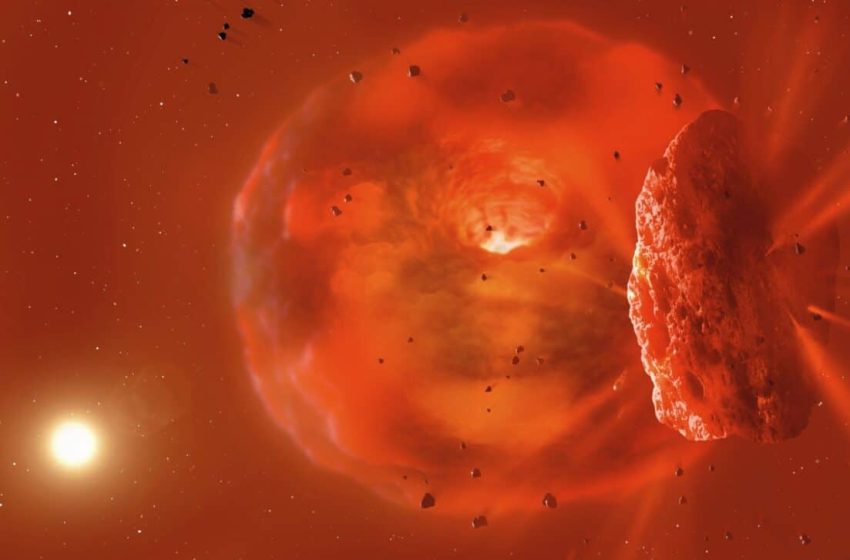
What followed is now one of the more intriguing planetary-collision candidates astronomers have found: a star whose flickering may be caused not by the star itself, but by a hot, clumpy cloud of debris left behind after two planetary bodies smashed together. That is the interpretation Tzanidakis and co-author James Davenport make in a paper published in The Astrophysical Journal Letters, where they describe Gaia20ehk, also called Gaia-GIC-1, as a likely “planetesimal collision afterglow.”
The Clue Came from Infrared Light
The visible-light data alone showed only that something was blocking the star. The turning point came when the team compared those measurements with infrared observations. Instead of fading along with the optical light, the system brightened in infrared, suggesting that the obscuring material was hot enough to glow.
“The infrared light curve was the complete opposite of the visible light,” Tzanidakis said. “As the visible light began to flicker and dim, the infrared light spiked. Which could mean that the material blocking the star is hot, so hot that it’s glowing in the infrared.”
That anti-correlation is central to the team’s case. In the paper, the authors argue that freshly generated circumstellar dust can absorb and scatter optical light while reradiating thermally in the infrared. Their measurements point to dust at about 900 Kelvin, with a minimum emitting cross-sectional area of 0.13 square astronomical units. The system has also remained in an infrared-bright state for roughly four years, with recent SPHEREx observations confirming that the excess emission is still there.
A Debris Cloud on a One-Year Orbit
The paper adds another piece of evidence: timing. Before the infrared brightening began, the Gaia optical data showed a significant 380.5-day periodic signal. Using an estimated stellar mass of 1.3 times that of the Sun, the researchers infer that the transiting material orbits at about 1.1 astronomical units from the star, close to the Earth-Sun distance in our own solar system.
That matters because it places the debris in the region where rocky worlds are expected to form and collide. The authors estimate a conservative minimum dust mass on the order of 4 × 10^20 kilograms, roughly the mass scale of a small icy moon such as Enceladus. They also stress that this is only the dust visible through the infrared excess. The original colliding bodies would have been substantially larger.
The earliest three dips may preserve the lead-up to the larger event, though the team is careful not to overstate that point. “That could be caused by the two planets spiraling closer and closer to each other,” Tzanidakis said. “At first, they had a series of grazing impacts, which wouldn’t produce a lot of infrared energy. Then, they had their big catastrophic collision, and the infrared really ramped up.”
The paper itself keeps the wording more cautious. The authors say Gaia-GIC-1 “resembles a transiting planetary collision afterglow” and “likely” contains newly generated material from a collision between two planetesimals. They also note that the geometry may be complex, possibly involving an elongated dust structure or eccentric orbit rather than a simple circular ring of debris.
Why the System Matters Beyond One Strange Star
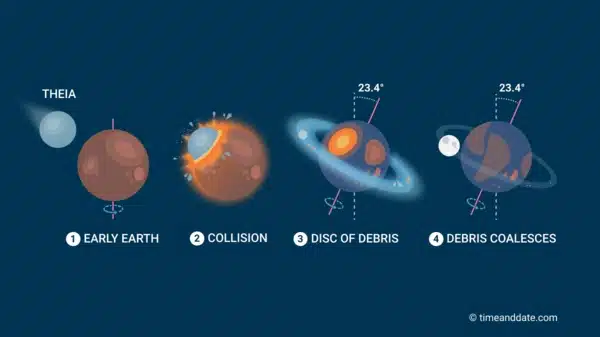
Part of the excitement comes from how closely the event echoes ideas about our own solar system’s violent early history. The leading model for the Moon’s origin holds that Earth was struck by a Mars-sized body early in its history, producing a debris cloud that later coalesced into the Moon. Gaia20ehk is not a replay of that event in any strict sense, but it may be a rare live example of the kind of giant impact astronomers have long invoked in models of terrestrial planet formation.
The star itself appears to be a young F-type star, with the paper describing it as a likely young F5 star based on pre-event spectral-energy-distribution fitting. Nearby open clusters, FSR 1347 and FSR 1352, have ages of roughly 6 to 16 million years and are broadly consistent with Gaia20ehk’s distance and extinction, though the authors say the star’s age cannot yet be tightly constrained from the available photometry alone.
That uncertainty does not erase the broader significance. Planetary systems are expected to be chaotic in their youth, and collisions are a major part of how rocky planets finish assembling. What makes Gaia20ehk unusual is that the event seems to have been caught while the aftermath is still evolving, with the star continuing to dim irregularly as the debris cloud moves through the system.
A Preview of What Rubin May Find Next
Gaia20ehk may not stay a one-off for long. The paper argues that continued infrared monitoring, especially with JWST, could help distinguish a rapidly cooling impact afterglow from more ordinary circumstellar material and trace how the debris changes over time.
And larger sky surveys may soon make discoveries like this more common. Davenport told UW News that the Vera C. Rubin Observatory’s Legacy Survey of Space and Time could uncover around 100 such impacts over the next decade. “How rare is the event that created the Earth and moon? That question is fundamental to astrobiology,” he said. “But if we catch more of these collisions, we’ll start to figure it out.”
For now, Gaia20ehk remains partly obscured, still flickering, still bright in the infrared, and still not fully settled into a simple explanation. But after years of looking like background noise, it now appears to be something much more revealing: a planetary system caught in the messy act of making, and breaking, worlds.
First Appeared on
Source link






