



Static electricity is a big mystery — a jolt of fresh research could help to solve it
Static electricity is so commonplace that it can come across as simple. Rub a balloon against your head, and the transfer of charges will make your hair stand on end. Shuffle your feet on a carpet, and the charge imbalance you produce can shock an innocent passer-by.
Leading the charge to explain static electricity
So it might come as a surprise that static electricity — which arises from what researchers in the field call the triboelectric effect — has left scientists racking their brains for centuries. Some of the basics are clear. Materials transfer charges when they’re rubbed or otherwise come into contact with each other: one becomes more positively charged and the other more negatively charged. Opposite charges attract whereas identical charges repel, and ta-da, you have a primary-school science experiment.
But most everything else in this field remains baffling. Is it the electrons, ions or bits of material that transfer the charge? Why do some materials charge positively and others negatively? What happens when two samples of the same material come into contact? For instance, when “rubbing a balloon on a balloon”, says experimental physicist Scott Waitukaitis at the Institute of Science and Technology Austria in Klosterneuburg. A big part of the problem is that experiments tend to misbehave, with the same procedures producing different results.
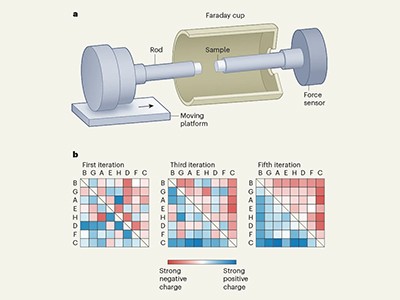
Now, researchers are picking apart some of the puzzles that have long plagued the field. With sophisticated laboratory set-ups that carefully control for compounding factors, Waitukaitis and his team have found that the charging of some materials has a strange tendency to hinge on their past interactions1. This week in Nature2, Waitukaitis and his colleagues report that carbon-carrying surface molecules can have a role in guiding which way charge is exchanged.
The secrets of static electricity are finally being revealed
These discoveries “are the best work in a really long time” in the field, says Daniel Lacks, a chemical engineer who has studied triboelectricity at Case Western Reserve University in Cleveland, Ohio. Other teams are investigating how surface area and velocity during impact might govern charge transfer, and how the breaking of chemical bonds contributes.
The influx of research seems to be driven by a desire to scrutinize the fundamental physics at play, says Laurence Marks, a materials scientist at Northwestern University in Evanston, Illinois. A better understanding of the science of static electricity could lead to improved devices that use it to power remote sensors or wearable technologies without batteries3, for example. It could also help to prevent the electrical discharges that can cause industrial explosions.
It’s becoming increasingly clear that static electricity is far from a simple phenomenon that abides by one clear-cut set of rules, researchers say. Instead, each exchange of charges could be shaped by several factors that vary with the circumstances. Some of these factors are now known and others are still waiting to be uncovered.
Ancient observations
The history of static electricity dates back to at least the ancient Greek period. Triboelectric includes the Greek words for ‘rubbing’ and ‘amber’, because, after amber is rubbed against fur, it attracts light objects such as feathers. At the end of the sixteenth century, English physicist William Gilbert identified other materials that had the same attractive power, including glass, diamonds and sapphires, and distinguished this type of electrical pull from that of magnetism. In the centuries that followed, scientists learnt that lightning was an electrostatic discharge, a supersized version of the benign zap that comes from shuffling feet across a carpet, and invented early electrostatic generators — forerunners of the Van de Graaff generators that wow students in science museums.
By the mid-eighteenth century, researchers had also begun documenting which materials became negatively charged and which positively, producing lists called triboelectric series. These rank materials from the most likely to charge positively to the most likely to charge negatively, with rabbit fur listed close to the top and silicon near the bottom, for instance.

Dust devils on Mars can produce electrostatic discharges similar to lightning.Credit: NASA Image Collection/Alamy
There was a lull in efforts to understand the phenomenon for part of the twentieth century before interest resurged around the turn of the twenty-first century. Marks attributes this renewed interest at least in part to the invention of the triboelectric nanogenerator4. This device relies on the triboelectric effect to convert mechanical energy into electricity. It attracted researchers who were interested in fresh ways to power small technologies. “In the last ten years, the field has literally exploded,” says Giulio Fatti, a mechanical engineer at Imperial College London.
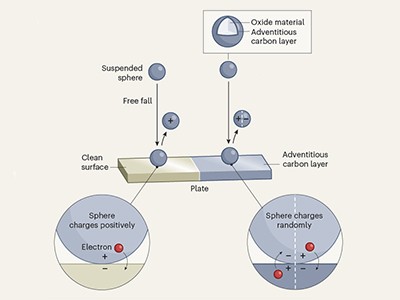
Hair-raising: how carbon contamination can drive static charging
Even with the attention boost, however, the fundamentals of triboelectricity have remained elusive. There are some generally accepted ideas, says Marks. A material has a specific potential for a charged particle to escape that depends on the material’s surface and composition. This potential is called the material’s work function and, so far, it applies best to metallic materials, Waitukaitis says. A sample also needs to be able to trap the charged particles, so they are kept in place when the materials separate after the exchange. But physicists are still pinning down the exact mechanisms behind these phenomena.
Other details of the contact seem to matter, too5. But what matters most under which circumstances and for what materials remains unclear. Whether triboelectricity can be explained by existing physics or whether it demands its own model has been an open question, says Marks.
Looking to the past
Waitukaitis and his team were investigating how samples of the same material can exchange a charge when they encountered the inconsistent results that have long frustrated researchers in the field. Triboelectric series are difficult to reproduce. Teams have obtained variable results concerning which materials become more positively or negatively charged, and, even, different findings with the same samples.
Waitukaitis tasked his then-PhD student Juan Carlos Sobarzo with attempting to form a series using samples of the same silicone-based polymer. But Sobarzo couldn’t obtain any consistent results. In one experiment, sample A would become negatively charged when interacting with sample B. In the next, it would become positively charged.
“For a very long time, we thought we were doing something wrong,” Waitukaitis says. “We thought there was some variable we weren’t controlling.”
Even when the team carefully controlled for humidity — because researchers thought that water on a material’s surface could affect how it charges — the results remained befuddling.

Is there lightning on Mars?
Then, Sobarzo dug up a set of samples that had already been through many experiments, and tested how they interacted with fresh ones. Quickly, the researchers noticed that the samples that had been through more contact tended to become negatively charged. In further experiments, they kept track of how many contacts each sample had already undergone.
“That’s when things started to make sense. The samples that had more touches in their history were always charging negatively,” Waitukaitis says. “What looked like chaos was an indication of the samples evolving.”
The researchers suspect this evolution has to do with how the sample’s surface deforms with each contact1.
In the current paper2, Waitukaitis, working with Galien Grosjean, an applied physicist at the Autonomous University of Barcelona, Spain, and their colleagues, looked deeper into how charge is exchanged between two seemingly identical materials. This time, they worked with oxides — materials, such as sand, that are made up of atoms bonded to oxygen — and used several technologies, including a device that levitates samples to keep their charge from changing. They also used a high-speed camera to measure the samples’ charge precisely.
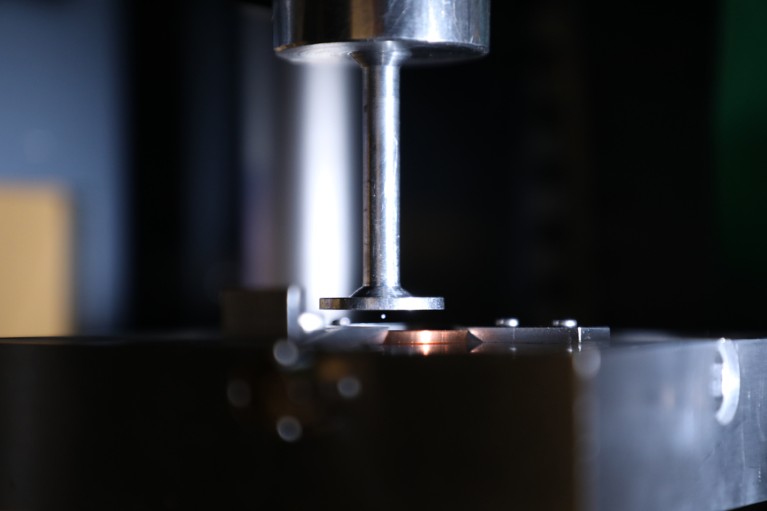
By levitating an alumina particle, researchers can control for outside influences on its charge.Credit: Galien Grosjean
First Appeared on
Source link






