


The challenges of securing Hormuz as 6 nations issue joint statement
The leaders of the United Kingdom, France, Germany, Italy, the Netherlands, Japan and Canada issued a joint statement on the Strait of Hormuz. They expressed their readiness to contribute to appropriate efforts to ensure safe passage through the Strait. As things stand today however, such a task appears to be rather difficult.
The joint statement reads:
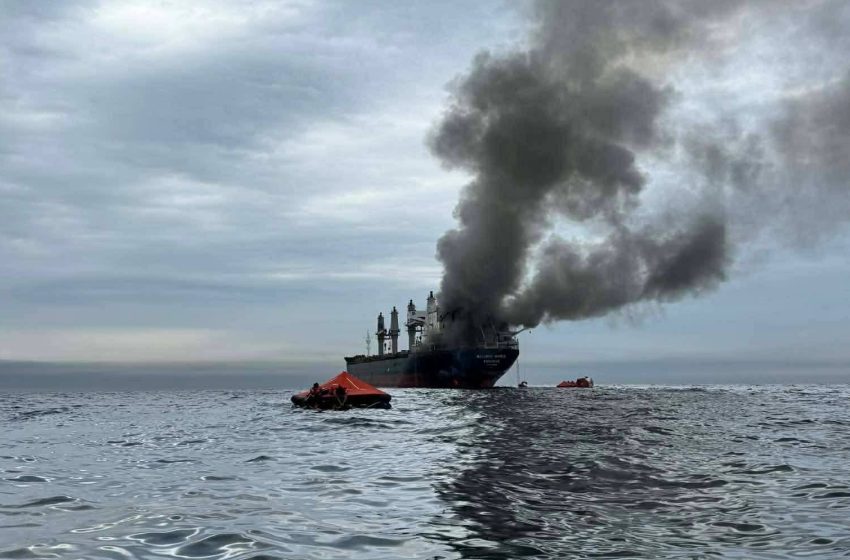
We condemn in the strongest terms recent attacks by Iran on unarmed commercial vessels in the Gulf, attacks on civilian infrastructure including oil and gas installations, and the de facto closure of the Strait of Hormuz by Iranian forces.
[…]
We express our readiness to contribute to appropriate efforts to ensure safe passage through the Strait. We welcome the commitment of nations who are engaging in preparatory planning.
Follow this link for the full statement.
Naval News comments
By Tayfun Ozberk, former Turkish Navy officer and regular contributor to Naval News
Securing the Strait of Hormuz would be a highly demanding military task. In practice, warships would first need to gather at the entrance of the strait and then escort groups of commercial vessels through the passage in convoy formation. A destroyer or another escort ship could provide a protective screen around several tankers, but that protection would be limited by both time and geography.
If a convoy came under attack from Iranian missiles or drones, the escorting warship would have only seconds to respond. Similar escort and air defence efforts have already been seen in the Red Sea against Houthi attacks, so there is a working model. The problem is that such operations consume major resources and are extremely costly if they are to be sustained for every transit.
The danger would not come only from the air or the shore. Iran could also rely on swarms of fast attack craft operating from nearby coves and coastal bases. That would make every crossing risky, because escort forces would have to deal with several threats at the same time, including missiles, drones, and small boats approaching at high speed.
To lower the risk to a manageable level, escorts would need support from helicopters for surveillance and rapid reaction, while combat aircraft would have to monitor the wider area above the strait. Even then, one of the most serious threats would remain naval mines. If mines were laid in the waterway, traffic could be disrupted or stopped entirely until mine countermeasure teams cleared the area. That is a slow and delicate process, especially if it has to be done under the threat of further attack.
For that reason, any serious attempt to secure the strait would likely require more than naval escorts alone. As long as Iranian forces along the coastline remain able to strike from land, sea, or air, the Strait of Hormuz would remain a highly dangerous environment for commercial shipping. Without at least temporary control over the coastal threat, any convoy system would operate under constant risk of ambush.
First Appeared on
Source link






