


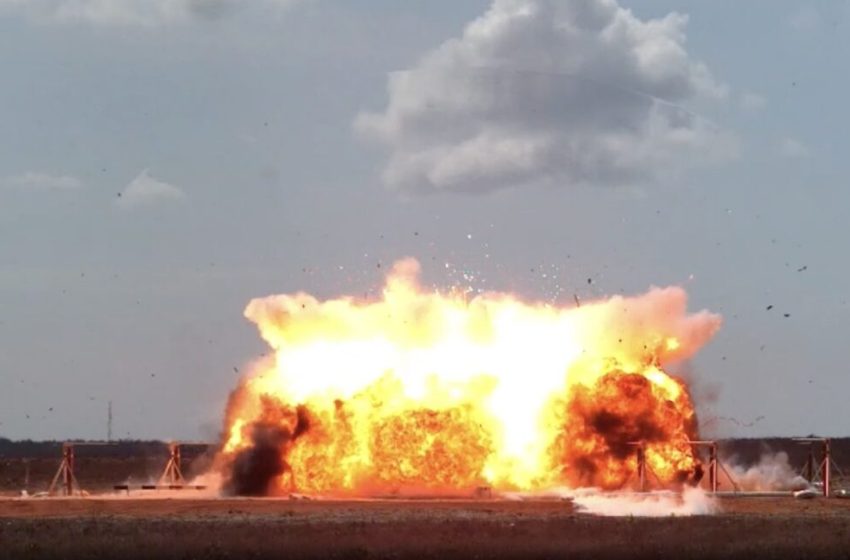
NASA wants to know how the launch industry’s chic new rocket fuel explodes
For more than 60 years, nearly every large rocket used some combination of the same liquid and solid propellants. Refined kerosene was favored for its easy handling and non-toxicity, hydrazine for its storability and simplicity, hydrogen for its efficiency, and solid fuels for their long shelf life and rapid launch capability.
About 15 years ago, rocket companies started serious development of large methane-fueled engines. SpaceX and Blue Origin now build the most powerful of these new engines—the Raptor and BE-4—each capable of generating more than half a million pounds of thrust. SpaceX’s Starship rocket and its enormous booster are powered by 39 Raptors, while Blue Origin’s New Glenn and United Launch Alliance’s Vulcan rockets use a smaller number of BE-4s on their booster stages.
Burning methane in combination with liquid oxygen, these “methalox” engines have several advantages. Methane is better suited for reusable engines because they leave less behind sooty residue than kerosene, which SpaceX uses on the Falcon 9 rocket. Methane is easier to handle than liquid hydrogen, which is prone to leaks and must be stored at staggeringly cold temperatures of around minus 423 degrees Fahrenheit (minus 253 degrees Celsius). Methane is also a cryogenic liquid, but it has a warmer temperature closer to that of liquid oxygen, between minus 260 and minus 297 degrees Fahrenheit (minus 162 to minus 183 degrees Celsius).
A Chinese rocket became the first methane-fueled launcher to reach orbit in 2023. In the United States, Rocket Lab, Stoke Space, and Relativity Space are also developing methane-fueled engines for their next-generation launch vehicles.
But rockets sometimes blow up. The US Space Force and NASA, the agencies responsible for range safety at America’s federally owned spaceports, want to better understand how the hazards from an exploding methalox rocket might differ from those of other launchers. This is important as launches become more routine, with companies foreseeing multiple flights per day from launch pads that are, in some cases, just 1 or 2 miles apart.
“We just don’t have the analysis on those to be able to say, ‘Hey, from a testing perspective, how small can we reduce the BDA and be safe?’” said Col. Brian Chatman, commander of the Eastern Range at Cape Canaveral Space Force Station in Florida, at a roundtable with reporters last year.
SpaceX’s 11th Starship flight climbs away from Starbase, Texas, in October 2025.
Credit:
SpaceX
A fine idea
Launch pads for methalox rockets are now operational or under construction on government property at Kennedy Space Center and Cape Canaveral Space Force Station in Florida, Vandenberg Space Force Base in California, and NASA’s Wallops Flight Facility in Virginia. SpaceX currently launches Starship test flights from South Texas on private property. The Federal Aviation Administration has jurisdiction for public safety there.
First Appeared on
Source link






