


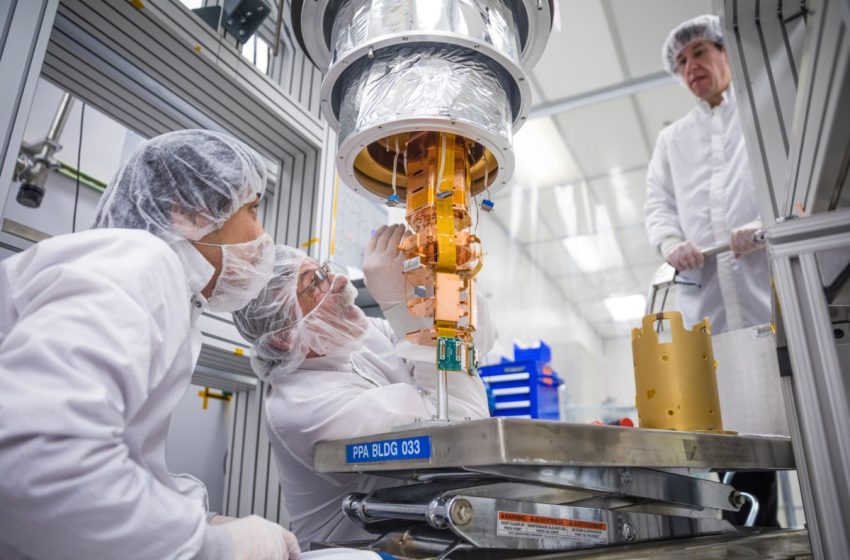
Chilly SNOLAB experiment reaches near absolute zero
The experiment is part of Super Cryogenic Dark Matter Search, a project aimed at finding the sub-atomic particle believed to comprise up to 85 per cent of the mass of the universe
An experiment at SNOLAB has reached an extreme cold, just tens of millikelvin, or a hundredth of a degree above absolute zero (−273.15 C).
The project, Super Cryogenic Dark Matter Search (SuperCDMS), is aimed at finding the sub-atomic particle believed to comprise up to 85 per cent of the mass of the universe.
The temperature was reached at the heart of what a media release issued by SNOLAB describes as “a series of large, nested copper vessels.”
The system includes 24 cryogenically cooled detectors made from ultra-pure silicon and germanium crystals, each just larger than a hockey puck.
“When a dark matter particle strikes one of these crystals, it produces a tiny vibration called a phonon, along with a small electrical signal,” according to the media release. “To detect those minuscule signals, the crystals are outfitted with superconducting sensors that only work when they are extremely cold.”
“What sets SuperCDMS apart from other dark matter searches is its low threshold for detecting tiny energy depositions,” Miriam Diamond , University of Toronto assistant professor in the Department of Physics and Department of Astronomy and Astrophysics, said in the media release.
“This gives it exquisite sensitivity to low-mass dark matter candidates, including WIMP-like particles, axion-like particles, dark photons, and lightly-ionizing particles.”
Reaching near absolute zero marks the culmination of years of preparation and months of detailed planning. Cooling the experiment reduces thermal noise, the random motion of atoms that can mask faint signals.
“When everything is that cold, the crystals are basically quiet,” SLAC National Accelerator Laboratory scientist Richard Partridge said in the media release. “Even very small energy deposits become detectable.”
Now that the base temperature has been achieved, the collaboration will move into detector commissioning, a months-long process of turning on, calibrating and optimising each detector channel.
Once this is complete, the SuperCDMS will begin its first science run, which is expected to last for approximately one year.
“Even the first few months of data could be enough to set world-leading limits on light dark matter or reveal something entirely new,” according to the media release.
The SuperCDMS will also allow scientists to probe previously inaccessible energy scales thanks to its sensitivity and potentially uncover new kinds of particle interactions.
The SuperCDMS SNOLAB experiment is a joint project of the U.S. Department of Energy Office of Science, the U.S. National Science Foundation, the Canada Foundation for Innovation, the Natural Sciences and Engineering Research Council of Canada, and the Arthur B. McDonald Institute (Canada).
First Appeared on
Source link






