


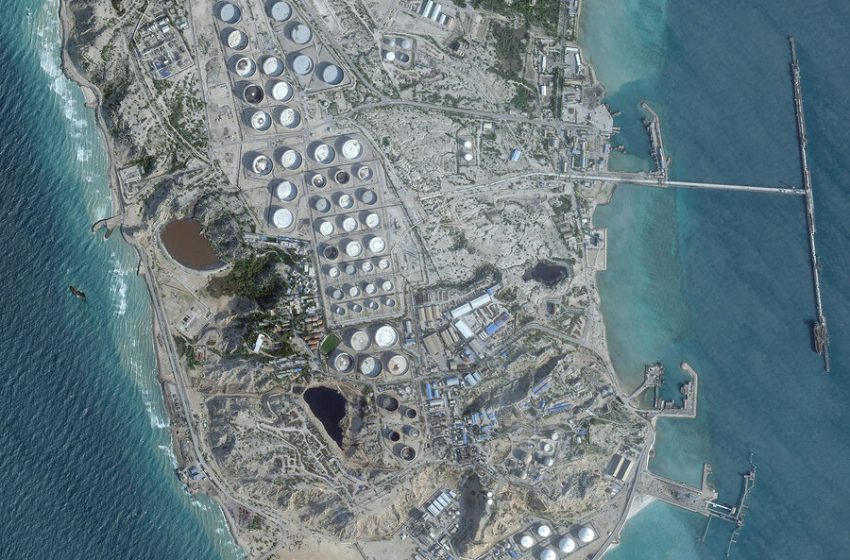
High risk, high reward? US considers taking Iran’s Kharg Island.
As gas prices rise at a record-setting pace, the Trump administration is reportedly considering sending U.S. troops to occupy Kharg Island, Iran’s main oil export hub.
Seizing the island at the northern end of the Persian Gulf would give the White House negotiating leverage with Tehran, but it would also pose significant risks to U.S. service members.
Some 2,200 U.S. Marines stationed on Okinawa, Japan, are on their way to the Middle East, according to analysts who track U.S. military movements. The 31st Marine Expeditionary Unit has been sailing on the USS Tripoli since March 13 and is due to arrive in the Gulf region in the coming days.
Why We Wrote This
Over 2,000 U.S. Marines are headed toward the Persian Gulf. A possible goal: to gain leverage over Iran’s regime by seizing Kharg Island, with its vital oil-shipping infrastructure.
The Tripoli, at 850 feet long, is essentially a small floating military base that can carry F-35 fighter jets, helicopters such as the MH-60S Seahawk, and MV-22 Osprey aircraft. The Marines on board are trained to quickly gain a foothold on shore. An amphibious assault of Kharg Island would involve the Marine unit escorted by U.S. Navy destroyers to provide anti-missile and anti-drone coverage, according to military analysts.
There would also likely be U.S. Air Force planes overhead and Army Apache helicopters, “which are very good at shooting down drones,” says retired Marine Col. Mark Cancian, a senior defense adviser at the Center for Strategic and International Studies. “So, you’d have lots of things coming together to protect the Marines while they get ashore.”
But first, the Tripoli has to get to Kharg Island, a pivot point in the U.S.-Israeli war on Iran that President Donald Trump called the country’s “crown jewel.” This involves passing through the Strait of Hormuz, where Iran has by some reports begun laying mines, making it a critical choke point for both global commerce and naval military maneuvering. Demining efforts are intensive, a mission for which the U.S. Navy is ill-prepared.
If Kharg Island is successfully seized, holding it would almost certainly require more U.S. forces, some analysts say.
To this end, the Trump administration is considering deploying thousands more U.S. troops whose missions could include everything from occupying Kharg Island to operating along Iran’s shoreline to helping secure safe passage for ships traveling through the Strait of Hormuz.
Because the island, 15 miles off Iran’s coast, is within range of Tehran’s missiles and drones, such an operation would be dangerous for U.S. forces if they were stationed there, analysts say.
“Any operation that would be aimed at opening the straits – of which this would be a part – is going to be a major combat operation,” Mr. Cancian says. “There are going to be [U.S.] casualties, because the Iranians will fight back. We don’t really know how well they can do that,” he adds. “But we know that they can.”
U.S. Central Command, which runs military operations in the Middle East, last week carried out a bombing campaign on more than 90 targets in Kharg Island.
In a social media post, Mr. Trump called it “one of the most powerful bombing raids in the History of the Middle East,” which “totally obliterated every MILITARY target in Iran’s crown jewel, Kharg Island.”
“For reasons of decency,” Mr. Trump added in his post, he had chosen not to “wipe out” oil infrastructure on the island. That would change, he said, should Iran interfere with ships trying to pass through the strait.
In a social media post on the heels of last week’s strike, Republican Sen. Lindsey Graham of South Carolina wrote: “Seldom in warfare does an enemy provide you a single target like Kharg Island that could dramatically alter the outcome of the conflict.”
First Appeared on
Source link






