


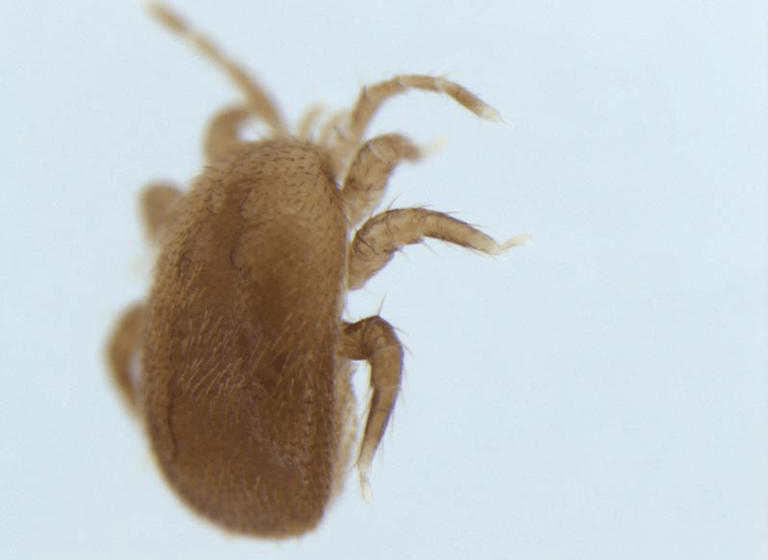
New Research Links Honey Bee Swarms to the Spread of an Invasive Mite
By Carolyn Bernhardt
The global beekeeping industry faces a significant new emerging threat: the ectoparasitic mite Tropilaelaps mercedesae. Originally found only in parts of Asia, this invasive pest has recently expanded its reach into Eastern Europe, sparking concern from scientists and beekeepers alike.
The giant honey bees Apis dorsata and Apis laboriosa are the Tropilaelaps mite’s natural hosts and are commonly found across South and Southeast Asia. But somewhere along the line, the mite latched onto western honey bee (Apis mellifera) colonies. Researchers are investigating how the mite managed this, since Apis mellifera is kept by beekeepers worldwide, and the parasite now has immense potential to greatly expand its reach. Tropilaelaps mites have already begun that process by showing up in the southwestern regions of Russia, as well as in Georgia. Understanding how these pests spread is essential for predicting and, hopefully, interrupting their ecological impact.
A collaborative research team spanning institutes across Europe and China recently investigated how Tropilaelaps mercedesae mites disperse when honey bees swarm as they look to establish a new colony. They published their findings last week in the Journal of Economic Entomology.
While the Tropilaelaps mites’ dispersal has been investigated in a tropical context, researchers still know very little about their transmission in more temperate climes, and colony dynamics and beekeeping management styles can differ greatly between these settings. In pursuit of protective management strategies, this team of scientists conducted their study in Georgia, under temperate conditions typical of western-style beekeeping.
According to Aleksandar Uzunov, Ph.D., a professor from the Ss. Cyril and Methodius University in Skopje, North Macedonia, and the Macedonian Academy of Sciences and Arts, the research team focused on a very fundamental question: “How do Tropilaelaps mites naturally disperse between colonies?” With this information, beekeepers can better develop management tactics to help keep these mites at bay.
In the field, the team observed a natural swarming event. They saw eight female mites move from their original colony to a new, swarming colony. However, four of them died shortly thereafter. The researchers found the remaining four mites inside sealed brood cells with developing bee offspring. Two of these mites each produced three offspring, demonstrating to the scientists that the mite has the ability to reproduce in a new colony. These findings confirmed that bees swarming and creating new colonies offer the mites an opportunity to continue their life cycle and to spread.
The team also created two artificial colonies by collecting returning foragers from T. mercedesae-infested natural colonies, simulating drifting—a behavior in which bees enter the wrong colony. They saw the mites spread to the artificial colonies this way, with one artificial colony hosting 23 mites and the other 17. The artificial colonies produced brood at a similar rate as colonies formed from a natural swarm, but none of the mites successfully reproduced, and all died within 4–6 days.
The study’s results challenge the prevailing assumption that T. mercedesae can only survive outside of brood for up to three days. Also, according to Uzunov, “The number of mites found on foraging bees demonstrates that inter‑colony dispersal within an apiary, through drifting or robbing, is both likely and common.”
The study made clear that natural or human‑induced swarms may serve as a transmission route for T. mercedesae, even when they contain no brood. This raises a serious concern about how the commercial bee trade, which involves long-distance transport across regions or even continents (as in North America), could introduce the mite into new territories.
These findings underscore the need for sound beekeeping practices to prevent drifting and robbing in an apiary. “Moreover, foragers could further spread the mites in the field when they come into contact with foragers from neighboring apiaries,” says Maggie Gill, Ph.D., a researcher based in the United Kingdom, founder of PHIRA-Science, and senior author on the study.
Invasive Tropilaelaps mercedesae mites can hitch rides on swarming honey bees, survive, and reproduce in new colonies, a new study shows. It’s the first time these mites have been shown to move via swarming, and it’s a key risk factor to understand in the effort to prevent the parasite’s spread beyond Asia. Here, T. mercedesae mites can be seen running on brood comb from an infested hive, with caps removed. (Video by Aleksandar Uzunov, Ph.D.)
Meanwhile, the team is left wondering why they saw such a difference in life expectancy between the mites stuck to forager bees drifting about and those that hitched a ride on swarming bees. “Whether the colony’s physiological status contributes to this pattern is something we still need to figure out,” says Gill.
While drifting and robbing behaviors should be discouraged by beekeepers, experts generally view swarming as a healthy process for a colony. However, this study shows how swarming can also offer mites an opportunity to spread, a risk that must be acknowledged and better understood. “This transmission route has never before been demonstrated for this mite species in western honey bee (Apis mellifera) colonies,” Uzunov says.
Carolyn Bernhardt, M.A., is a freelance science writer and editor based in Portland, Oregon. Email: [email protected].
Related
Discover more from Entomology Today
Subscribe to get the latest posts sent to your email.
First Appeared on
Source link






