


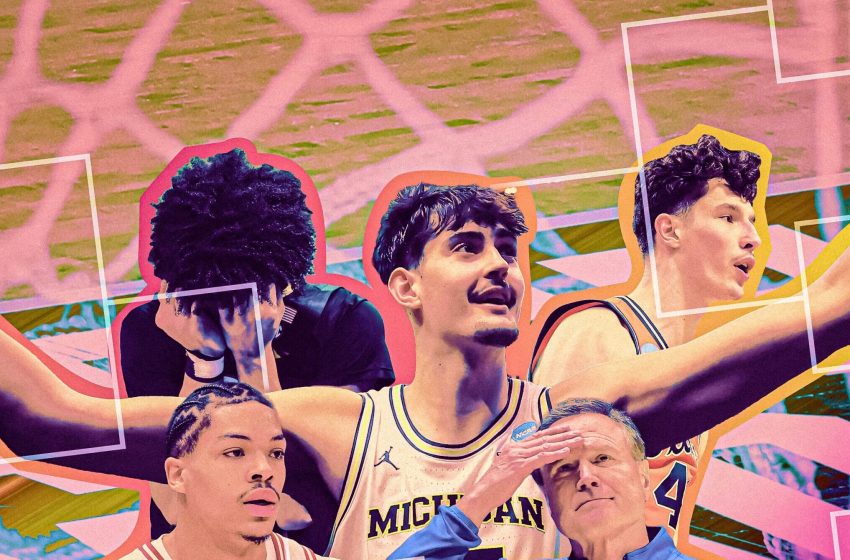
The Winners and Losers of the Second Round of the Men’s NCAA Tournament

Who shined brightest in the second round of March Madness? Who fell short? Let’s dive into a special edition of Winners and Losers.
Winner: Wingspan
Michigan has been the country’s best defensive team all season, and its 95-72 win over Saint Louis on Saturday was a 40-minute exhibition of what makes the Wolverines so damn hard to score on. I mean, just look at this shot of center Aday Mara defending an inbounds play.
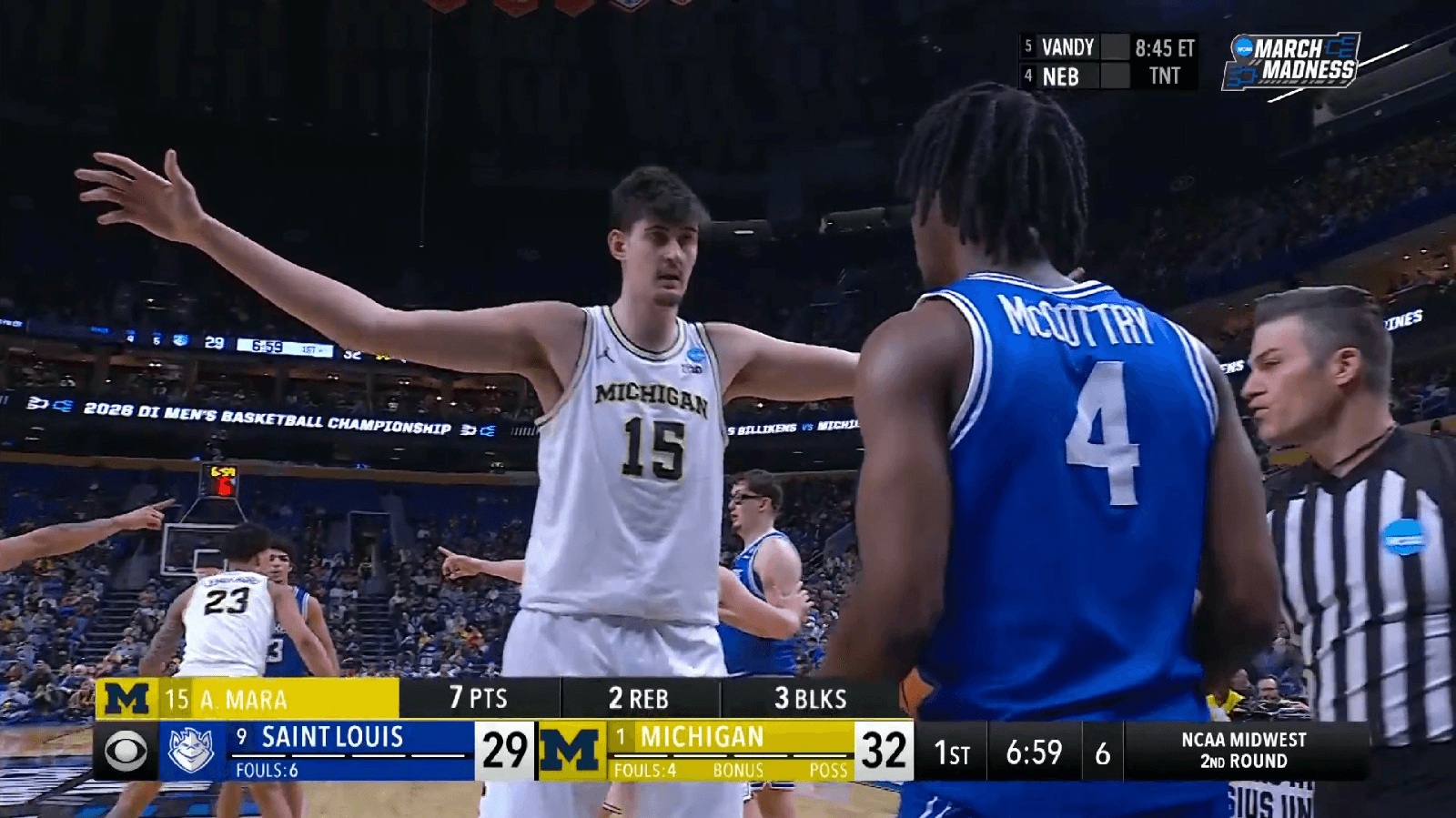
That photo hasn’t been altered in any way. Mara’s arms are really that long. He’s got a wingspan that can block out the sun. When Mara loiters around the basket—which is his primary assignment when the Wolverines are on defense—the opposing offense is pushed away from the rim and into inefficient midrange shots. The average distance of a 2-point attempt in college basketball is 6 feet, per KenPom. For Michigan opponents, it’s been 7.4 feet, which is tied for the longest in the country. That directly correlates to Michigan ranking third in 2-point field goal defense. “Easy” shots aren’t easy against Michigan’s length.
That made Saturday’s matchup a fascinating one for college hoops nerds. The Billikens take the shortest 2-point shots in the country, per KenPom, and they combine that with accurate 3-point shooting to form one of the nation’s top offensive attacks. Saint Louis hit its 3s against Michigan, but it had a difficult time getting shots around the rim. The Wolverines blocked nine Saint Louis shots in the game. Mara had four blocks, and the other four starters had one apiece. Even when Mara and Co. weren’t swatting opposing attempts, their presence around the rim deterred others. Here Mara thwarts three possible attempts at the rim by just hovering around the basket.
Michigan has length across the front line—even by NBA standards. Mara is 7-foot-3, and the two forwards, Morez Johnson Jr. and Yaxel Lendeborg, are 6-foot-9. Those two can also move their feet on their perimeter, which gives coach Dusty May endless tactical options, as Purdue coach Matt Painter explained last month.
“They have three defensive [centers],” Painter said after a home loss to the Wolverines. “Our issue is two of those guys can switch and guard point guards. That’s where the difference is. The difference isn’t in their scheme. Their difference is how hard they play, how long they are, and how athletic—but that versatility. Because Mara can guard a [center], right? He can cause problems, but you can pick on him—just like people could pick on Zach [Edey]. You can pick on him, but those other two guys are difference makers defensively.”
May is comfortable with either Lendeborg or Johnson defending a guard, so Michigan can switch most matchups, negating a lot of the screening actions opposing offenses use to free up shooters and cutters. And when the Wolverines go “small” with Mara off the floor, they can switch every matchup, so it’s basically impossible to run any kind of offense. Teams often resort to iso ball at the end of the shot clock. Take this possession from Saturday’s game. Saint Louis tries to run an off-ball screening action, and the two Michigan defenders just switch it. Then the Billikens flow into a ball screen with a third man involved, and the Wolverines sort it all out by switching again.
Saint Louis put up an admirable effort but could never get comfortable against Michigan’s length. Robbie Avila, the Billikens center who’s earned nicknames like “Cream Abdul Jabbar” and “the College Jokic” because of his play style, looked out of place. The undersized center can typically take opposing big men out to the perimeter and either shoot over them or dribble around them. But Avila threw up a bunch of bricks against Mara and couldn’t get a shot off against Johnson when he tried to take it inside the arc, finishing 0-for-3 from 2-point range. This possession, which ends with a Saint Louis shot clock violation, does a good job of summing up how the game played out on that end of the court.
There are still legitimate questions about the Wolverines offense with guard L.J. Cason out for the rest of the season, but Michigan has a defense that can carry the team to a title even if shots aren’t falling on the other end. This team might be too big to fail.
Loser: Tyler Tanner
Dude.
DUDE.
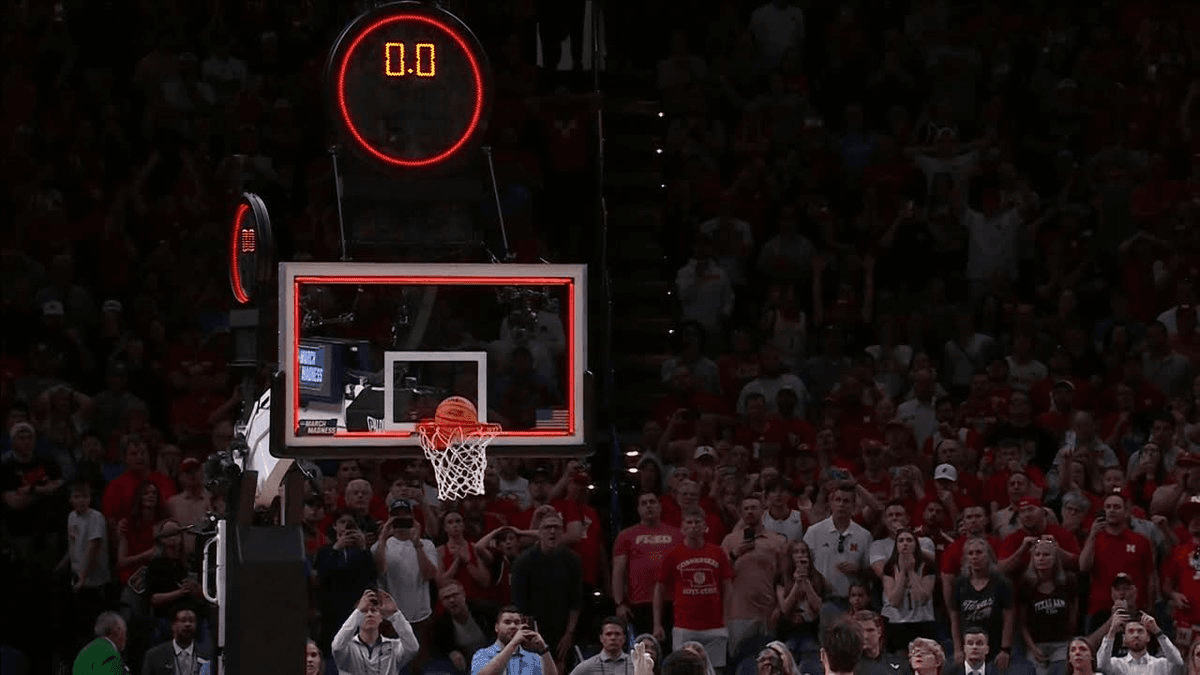
Tanner was that close to sending Vanderbilt to its first Sweet 16 since 2012 and cementing his spot in March lore. Calling Tanner a “loser” after that performance, which single-handedly kept the Commodores in the game until his teammates finally woke up in the second half, feels really rough. The sophomore scored 27 points and made several shots to stop Nebraska from running away with the game in the first half and quiet an absurdly partisan crowd.
But because of a cruel bounce of the basketball, most of that performance will be forgotten, and Tanner will be remembered as the guy who almost made the shot. I’m still not sure how it didn’t drop, and the Nebraska players seemed to be just as shocked. Most of the ones on the court didn’t even celebrate initially, like their brains needed a few seconds to work out that the ball didn’t go through the basket. Is this the look of three guys who just won the most exhilarating basketball game of the tournament thus far?
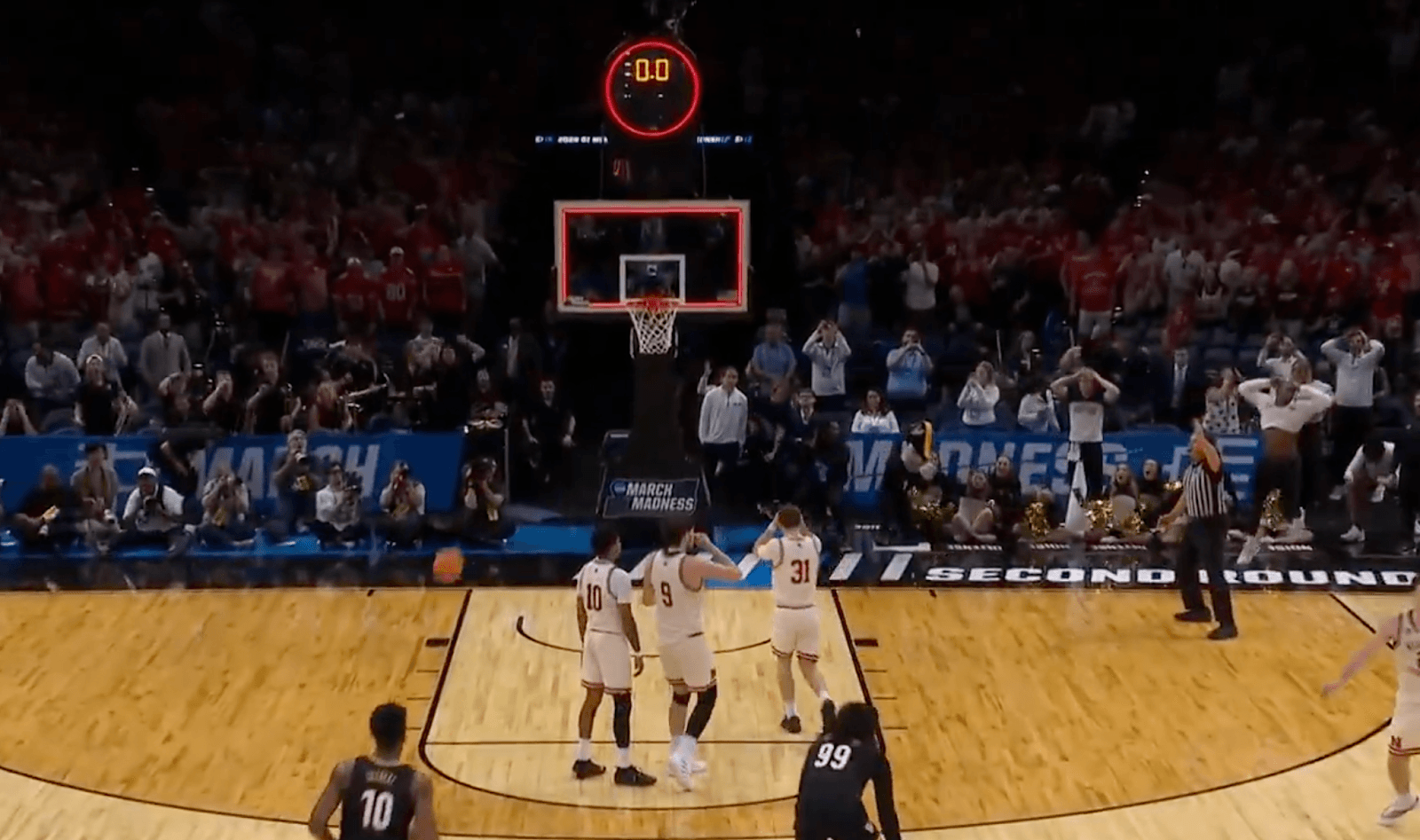
Even before the final sequence, this was a highly entertaining game, featuring unreal shotmaking from both sides. Nebraska got a tip-in on the offensive boards from the shortest guy on the court, Sam Hoiberg, to tie it late after a go-ahead 3 from Vanderbilt. Tanner answered with a tough, contested layup, but two Nebraska layups, including the game-winner by Braden Frager, proved to be too much. It was a perfect game of college basketball. I’ve got no notes—although it would have been a lot cooler if that shot had dropped.
Winner: Violent Dunk Attempts
Basketball is a sport that requires remarkable skill and features layers of strategic complexity. But sometimes it boils down to two tall people jumping as high as they can and competing in a mid-air joust. As much as I love a smooth jump shot or flashy pass, nothing beats two big guys meeting at the rim, so this sequence from Illinois’s 76-55 win over VCU hit me like a kick in the chest.
My god, that was violent. I appreciate the confidence from VCU’s Lazar Djokovic, who saw 7-foot-2 Zvonimir Ivisic standing under the rim and decided a dunk was an appropriate course of action. That decision was followed by instant regret, and before everyone in the building was able to process what had happened, Ivisic was on the other end of the court hammering a dunk home over the entire VCU front line.
It’s pretty wild that Illinois has a 7-foot center who can run and jump like that, and he’s probably the fifth-best player on the team—behind his brother, who’s also a 7-footer who can step out and hit a 3, which is the basketball equivalent of a queen in chess. Those are rare floor spacers in college basketball, and Illinois has two of them! They’ve also got Keaton Wagler, a playmaking guard who’s projected to be a lottery pick in the upcoming NBA draft; Kylan Boswell, a veteran guard who can make 3s and handle the ball; and three dynamic scorers on the wings in David Mirkovic, Andrej Stojakovic, and Ben Humrichous. Plus there’s Jake Davis, the team’s eighth scoring option, who leads the nation in offensive efficiency, per KenPom.
Coach Brad Underwood has built a deep team full of players who have dynamic skill sets. Every guy on the court can put the ball in the basket or create an opportunity for another. That gives Underwood plenty of backup options if one or two of his top scorers go cold, which is bound to happen in college basketball. Stojakovic, who’s coming off the bench because Illinois has too many scoring options in its starting five, was that option against VCU. And isolating him and putting him on the ball in a pick-and-roll boosted Illinois until the rest of the offense eventually found a rhythm. Once that happened, the Illini ran the underdog Rams off the court.
This offense always puts on a show and scores enough points to give Illinois a chance—which is why all of their losses, outside of games against Michigan and UConn, have come down to the final possession. Four of their eight losses went to overtime. Another came on on a buzzer-beater by Nebraska, and there was a four-point loss to Alabama back in November. This team has issues closing out games, which may ultimately lead to their downfall, but they’re my basketball guilty pleasure. I have them going to the Final Four in my bracket, and not because I think they’re the best team in the South region. I just think it would be a really fun March if Illinois makes a deep run, and I didn’t want to root against that. So far, so good.
Winner: Ben McCollum
Iowa ended Florida’s title defense in a brutally physical game that played out more like a Gator Bowl in the early 2000s than a college basketball game in 2026. The fight for space wasn’t contained to the paint—it extended out to the perimeter as well, with defenders trying to blow up every screen, handoff, and cut to the basket. There were a lot of collisions, and eventually the teams had to be separated after Alvaro Folgueiras and Alex Condon’s fight for a rebound got a bit too physical.
From certain angles, it looked like Folgueiras took a swing at Condon. The CBS announcer team, Tom McCarthy and Dan Bonner, thought that the Iowa forward would be ejected, and Bonner even said, “Look up punch in the dictionary, and that’s what you’ll see.” Florida coach Todd Golden said after the game that an official had told him a punch was thrown, and he seemed to draw the same conclusion after watching a replay on a sideline tablet. He went on to “motherfuck” the Iowa bench, and Hawkeyes coach Ben McCollum matched Golden’s energy.
A reverse angle, though, showed that Folgueiras never threw a punch—or just threw a really bad one at the ball.
“They were just going for the ball,” McCollum told A.J. Ross during an in-game interview. “Then everybody got all sensitive. Then, their people got sensitive. We’re just trying to play ball. It’s whatever. We’ll compete. We’ll fight. We’ll see what happens.”
Iowa came to the game looking for a fight and held its own against the bigger, stronger Florida team. The Hawkeyes start a 6-foot-7 power forward and a 6-foot-9 center. That’s the same height as Gators small forward Thomas Haugh, and they still managed to draw even in the rebounding battle and outscore the giant SEC team in the paint, 32-30. The fight for the paint was a stalemate, but for undersized Iowa, that was a major win.
The Hawkeyes churned the game into a 61-possession grind. That’s the slowest game the Gators have played all season, per KenPom, and the half court execution contest suited McCollum’s team. The Hawkeyes built their lead to 10 in the second half before the defending champs seemed to realize that they were the bigger team. Condon and Haugh led a rally by running the court and attacking the offensive glass. Iowa’s offense fell into a cold spell and started turning over the ball, which allowed the Gators to get out in transition. They eventually took the lead and had it up until the game’s final seconds.
But with 8.9 seconds remaining and Iowa trailing by two, McCollum drew up a play to get his best player, Bennett Stirtz, downhill in a hurry. The Iowa star had had a dreadful night by his standards, but his gravity ended up winning his team the game. Stirtz beat his primary defender down the court, which forced Condon to leave Folgueiras, the guy who was nearly ejected from the game, open in the corner for the go-ahead 3.
Florida still had plenty of time for a rebuttal, but Golden didn’t have much of an answer. The Gators attempted to get point guard Xaivian Lee downhill, but Iowa walled off his dribble and forced him into a cul-de-sac of defenders. Florida couldn’t even get a shot off before the buzzer.
Now, McCollum is headed for his first Sweet 16 as a Division I coach, but this is not his first taste of March success. He won four national titles in a six-year span at Division II Northwest Missouri before making the jump to D-I with Drake in 2025. After leading the Bulldogs to the round of 32 last year, he was hired by Iowa. Less than 12 months later, he has his new school a couple of wins away from the Final Four.
Loser: Bill Self
Kansas hasn’t made it out of the first weekend of the NCAA tournament in four seasons, a streak that continues after St. John’s bounced the Jayhawks from the tournament on Sunday with a buzzer-beating layup from Dylan Darling.
Darling had 50 feet of hardwood between him and the basket and only 3.9 seconds to get there, but Kansas made it as easy as a game-winning layup can get. The players could have turned in a better effort, but Jayhawks coach Bill Self shares some of the blame for lowering the degree of difficulty for Darling. Kansas had a few fouls to give when St. John’s gained possession after Darryn Peterson’s free throws leveled the game with 13 seconds remaining, so Self had his team commit three straight fouls to burn clock. The Jayhawks did manage to waste nearly 10 seconds, but the Red Storm were in the bonus, so any foul would have sent them to the free throw line. So Darling’s on-ball defender, Elmarko Jackson, was left with no margin for error.
Self did a little too much there at the end, and he got beat by a coach who decided to keep it simple. Rather than drawing up an elaborate play to free up his best shooter, Rick Pitino gave the ball to a guard who hadn’t scored all day, spread the court for him, and let him attack. According to the St. John’s coach, it was actually Darling’s idea.
“Bells comes up to me, and says run ‘power,’ which is a high backscreen pick-and-roll,” Pitino said after the game. “So I walk away like, wait a second, he hasn’t scored a bucket and he wants to run a play for himself? And I’m thinking, but he’s Bells!“
If you’re wondering whether Pitino’s “Bells” nickname for Darling is a reference to testicals, that’s exactly what it is. Bells is short for “Church Bells,” a nickname that stuck after Pitino said Darling’s “got balls as big as church bells” after he hit a game-winning 3 to beat Xavier in February.
Had Self known the lore, he may have done more to get the ball out of Darling’s hands. Really, though, it’s hard to blame the Kansas coach for how things played out. The ball was in the hands of the opponent’s fifth-best scoring option and the lefty was forced to drive to his right. Every coach in the country would sign up for those terms in a late-game situation. The on-ball defense simply wasn’t good enough.
Kansas as a team hasn’t been good enough in a couple of seasons. It’s been three years since the Jayhawks finished as a top-20 team on KenPom. They finished 27th in 2024 after starting the season ranked second. They dropped from a no. 7 preseason ranking down to no. 24 in 2025. This season, they started at no. 21 and that’s where they currently sit after Sunday’s season-ender. Self is still one of the top coaches in the country, but the program has fallen into a rut, and its performance in the transfer portal is the main culprit for the stagnation. The 2023-24 transfer class was a bust. And the 2024-25 class was a straight-up disaster. This year was just OK, with Melvin Council Jr. and Tre White carving out important roles, but there were no real star additions to speak of. Title contenders around the country are adding needle-moving talent every offseason while Kansas goes looking for role players to play around star high school recruits. That model has failed over multiple seasons now, but we still haven’t seen Self and his staff make an adjustment when it comes to roster construction.
Whether Self will stick around long enough to adapt is another matter. He has had a few health scares over the past few seasons, including a trip to the hospital in January that caused him to miss a game. He was asked Sunday whether he was considering retirement, and he didn’t shut down the question.
Self doesn’t have too much time to ruminate over the decision. The transfer portal opens up in two weeks and Kansas had better be ready.
Winner: Darius Acuff Jr.
Saturday’s Arkansas–High Point was playing out like a typical John Calipari loss in March. You know, those games where it looks as if Cal’s team hasn’t watched a single second of film or read a single line in the opposing team’s scouting report? The favored Razorbacks did nothing to take High Point out of its game, and it turned into a 77-possession track meet. That’s the sort of effort the Panthers needed to pull off the upset.
And they may have completed it if not for a cold shooting night—and Darius Acuff Jr. High Point hit 10 of 38 attempts from 3, a 15-point dropoff from its upset over Wisconsin, and it watched as Arkansas’s freshman star went for 36 points.
Now that Kansas’s Darryn Peterson and BYU’s AJ Dybantsa have been ousted, Acuff could be the best player remaining in the field. Cameron Boozer is still alive with Duke and he’ll probably win national player of the year, but he’s played a bit timidly over the Blue Devils’ first two games. Boozer may be too willing of a passer and he can disappear as a scorer. You don’t have to worry about that with Acuff, who can get any shot he wants at any time. I don’t know what Acuff would have to do over the next week or two to leapfrog Boozer on NBA big boards, but I don’t think it’s out of the realm of possibility. If Acuff averages 30 points a game and leads Arkansas to the Final Four, he’s going to garner consideration for the no. 3 pick. Teams with the second pick may even give him some thought. I love Peterson and Dybantsa as prospects. UNC’s Caleb Wilson, who missed the tournament with a broken hand, has a superstar ceiling as well. But I’d be terrified to pass on Acuff, who has close to zero bust potential given that jump shot, those handles, and that feel for the game.
Loser: Cinderella
The Sweet 16 is set and the closest thing we have to a Cinderella story is an SEC team with the biggest budget in college sports and its own television network. The seeding said otherwise, but Texas taking down Gonzaga on Saturday should not be considered a massive upset in a sport that is increasingly becoming dictated by how much a school can shell out for players.
The gap between the “haves” and “have nots” is wider than ever in college basketball, which has led to chalkier results in March. This tournament is following the trend, with three of the top-four seeds advancing to the Sweet 16 in each of the four regions. The lowest seeds remaining are no. 11 Texas, no. 9 Iowa, no. 6 Tennessee, and no. 5 St. John’s. Every other slot is filled with the highest possible seed, and for the second consecutive year, we don’t have a single team from a non-power conference in the final 16. In 2023, when teams were still figuring out the portal and NIL deals, we got two schools outside of the power conference in the Final Four. That already feels like a different era of the sport.
It’s a bummer that we won’t have any true underdogs next weekend, but the upside is a slate loaded with compelling matchups between the big brand names of college basketball. Houston-Illinois could be one of the best Sweet 16 matchups of the decade. St. John’s–Duke is a television exec’s dream. And we’re also getting Danny Hurley vs. Tom Izzo, Nate Oats vs. Dusty May, Rick Barnes vs. T.J. Otzelberger, and John Calipari vs. Tommy Lloyd. Look, I’m not saying March Madness is better off without the bracket-busting upsets and Cinderella runs, but the viewing options this Thursday and Friday night sure are good.

Steven Ruiz
Steven Ruiz has been an NFL analyst and QB ranker at The Ringer since 2021. He’s a D.C. native who roots for all the local teams except for the Commanders. As a child, he knew enough ball to not pick the team owned by Dan Snyder—but not enough to avoid choosing the Panthers.
First Appeared on
Source link






