


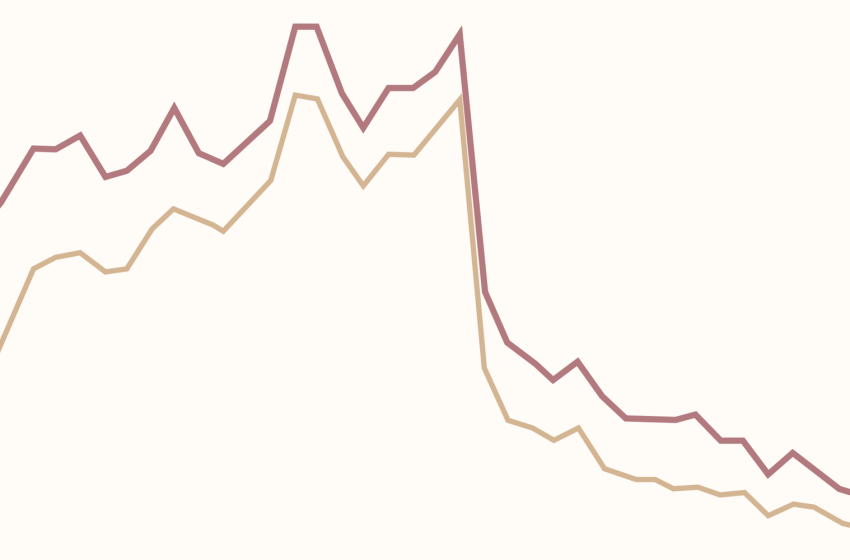
The human cost of unsafe abortions
Romania’s history offers a rare natural experiment on what happens when abortion laws change rapidly. What can the rest of the world learn from this?
In the two decades from 1965 to 1985, maternal mortality fell sharply across Europe. Rates in my own country, the United Kingdom, fell by more than two-thirds.
Romania was the exception. Its rates increased by almost 150%.
By the late 1980s, Romanian women were dying at rates several times higher than in other Eastern European countries, and ten times higher than those in Western Europe, as the chart below shows.
Why were Romanian women dying at much higher rates than in neighboring countries? To understand this, we need to go back three decades.
In 1957, Romania legalized abortion. Surgical procedures became readily available, affordable, and relatively safe.1 At the same time, there was very little access to contraception, which made unintended pregnancies extremely common. As a result, many women relied on abortion to control their fertility. By the mid-1960s, more than a million abortions were performed each year, four times the number of babies born.2
You can see the impact of this in the next chart. In the decade from 1957 to the late 1960s, births fell by around 40%.3
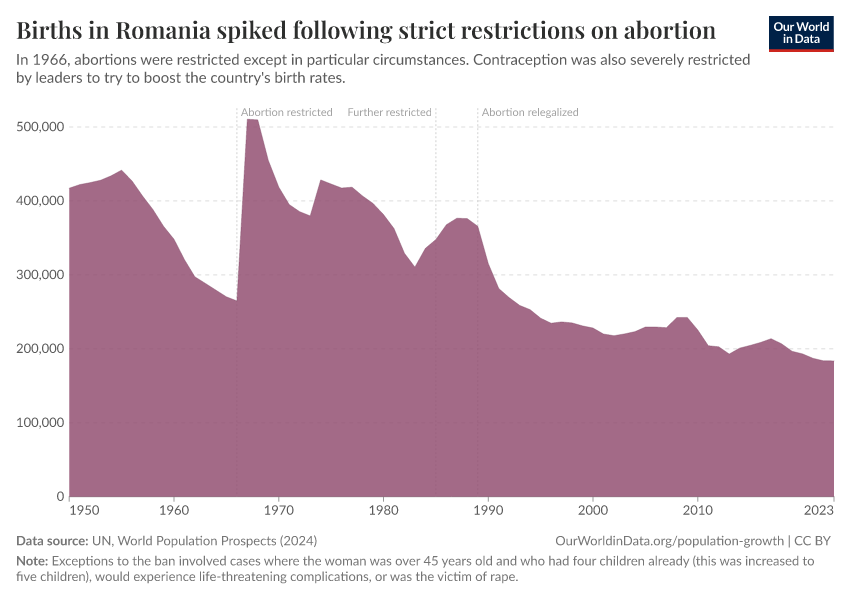
But things changed when Nicolae Ceaușescu became president in 1965. Worried about declining births in Romania, Ceaușescu implemented “Decree 770”, which put tight restrictions on abortions and contraception. Abortion was banned except for women who were over 45 years old, had at least four children (later raised to five), faced life-threatening complications, or had been victims of rape.4
The impact of these restrictions was dramatic. Births nearly doubled from 1966 to 1967. Fertility rates increased from less than 2 births per woman to more than 3.5, as you can see in the chart below.
Eventually, they fell again as couples found other ways to manage births, but it took many decades for them to drop back to pre-ban levels.
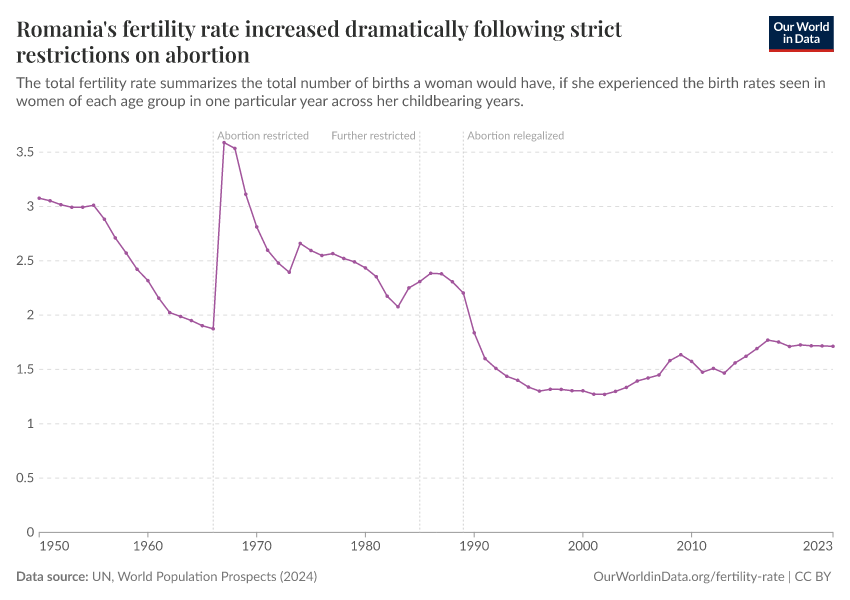
So Ceaușescu’s plan to boost population growth worked. But making abortion illegal for most women meant that many turned to more dangerous alternatives.
We know abortions continued because women and those who performed them were imprisoned or heavily fined when caught. Records suggest that many of these people were not medically trained.5
These procedures often relied on non-sterile metal instruments, improvised tools, or toxic substances to induce a miscarriage. As a result, many women suffered from severe internal bleeding, perforation of the uterus, or life-threatening conditions caused by infections. Because these procedures were illegal, women often delayed seeking medical help when complications arose, turning treatable problems into fatal ones.
As you can see in the chart below, maternal mortality rates in Romania increased substantially in the decades following the abortion ban. This reflects the expansion of illegal abortion methods and practitioners, and partly explains why births gradually fell over the same period. A growing fraction of maternal deaths were caused by unsafe abortion; by the 1980s, these deaths accounted for more than 80% of the total.6
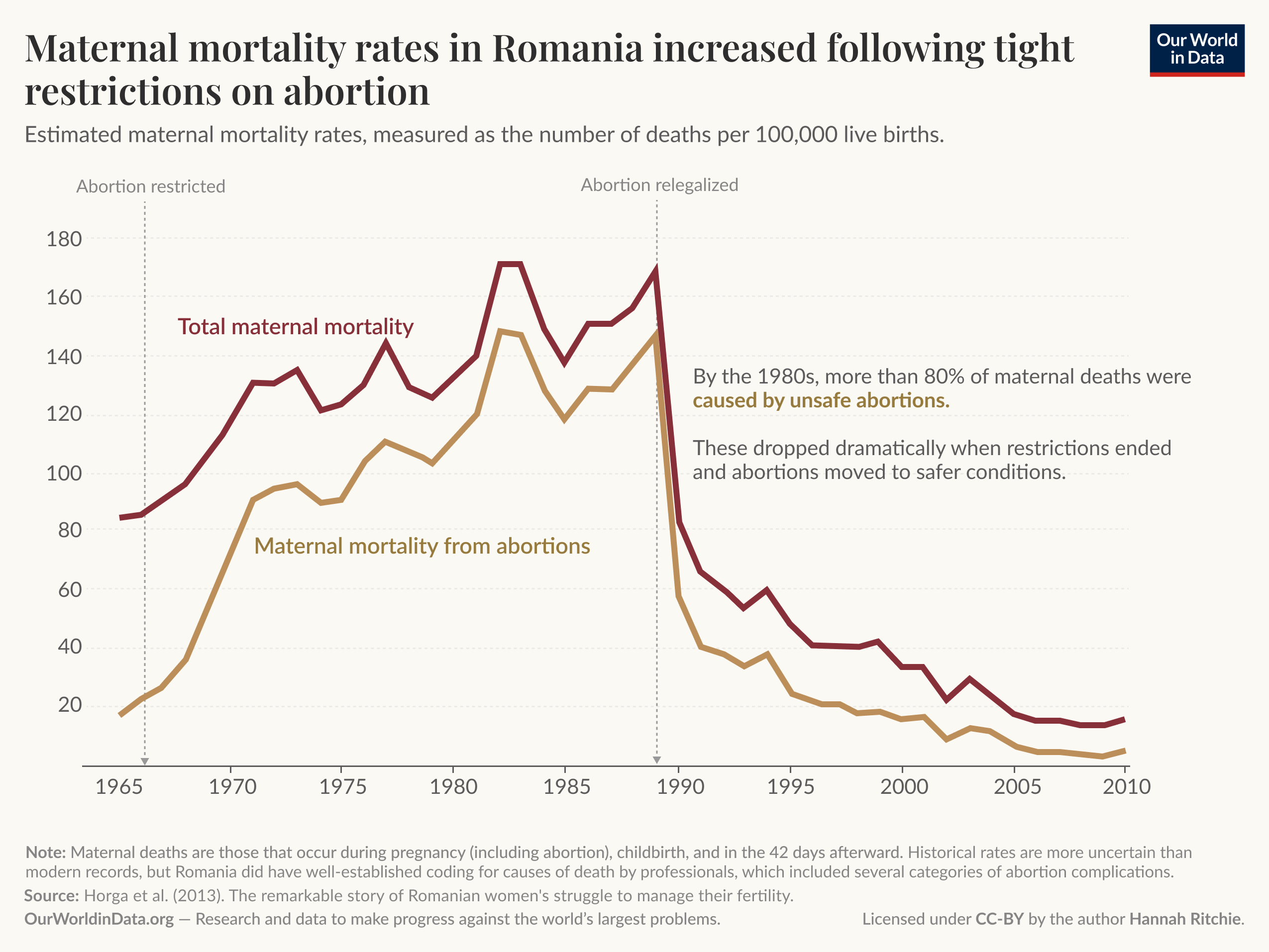
In 1989, Ceaușescu was overthrown, and just as quickly as abortion was criminalized, restrictions were lifted again. Maternal deaths declined as abortions moved from illegal methods to regulated ones.7
Over the course of the two-and-a-half decades when abortion was restricted, it’s estimated that around 10,000 Romanian women died from unsafe terminations.8
Romania’s sudden policy changes created a rare natural experiment: when abortion was legal, maternal deaths were low; when it was banned, they rose; and when it was legalized again, they fell.
If we want to draw lessons from Romania’s history, we need to keep in mind that its situation was unusual.
Over the two-and-a-half decades when abortion was restricted, it’s estimated that around 10,000 Romanian women died from unsafe terminations.
No country today has anywhere close to the abortion rates that Romania had in the early 1960s. I estimate that around 20% of women of reproductive age in Romania were having an abortion each year at that time.9 Globally, the country with the highest rate today is less than half that of Romania in the 1960s.10 Most countries in Europe and North America have rates closer to 1%.11 Romania was an extreme case, and we shouldn’t expect changes today to have such dramatic consequences. But the mechanism still applies.
It is estimated that around 40% of women in the world live in countries where abortion is either completely illegal or severely restricted. Yet abortion rates are still higher in these places than they are in Western Europe and many other places where abortion is legal.
Where abortions are illegal, most take place in unsafe and unsanitary conditions. In countries with tight restrictions, three-quarters of abortions are estimated to be unsafe, compared to far less than 10% in North America and North and Western Europe.12
How does this affect the health risks for women? Safe abortions have very low mortality rates, typically below 1 death per 100,000 abortions.13 In regions where the majority of abortions are unsafe, mortality rates can be several hundred times higher; in Western and Middle Africa, around 1-in-200 abortions result in the woman dying.14
Estimates suggest that unsafe abortions account for 8% of maternal deaths globally.15 This means that an estimated 23,000 women die every year.16 Romania learned about the consequences of unsafe abortion at an enormous cost. In many parts of the world, that lesson continues.
Acknowledgments
Many thanks to Max Roser and Edouard Mathieu for editorial feedback and comments on this article.
Cite this work
Our articles and data visualizations rely on work from many different people and organizations. When citing this article, please also cite the underlying data sources. This article can be cited as:
Hannah Ritchie (2026) - “The human cost of unsafe abortions” Published online at OurWorldinData.org. Retrieved from: 'https://archive.ourworldindata.org/20260323-091329/the-human-cost-of-unsafe-abortions.html' [Online Resource] (archived on March 23, 2026).BibTeX citation
@article{owid-the-human-cost-of-unsafe-abortions,
    author = {Hannah Ritchie},
    title = {The human cost of unsafe abortions},
    journal = {Our World in Data},
    year = {2026},
    note = {https://archive.ourworldindata.org/20260323-091329/the-human-cost-of-unsafe-abortions.html}
}
Reuse this work freely
All visualizations, data, and code produced by Our World in Data are completely open access under the Creative Commons BY license. You have the permission to use, distribute, and reproduce these in any medium, provided the source and authors are credited.
The data produced by third parties and made available by Our World in Data is subject to the license terms from the original third-party authors. We will always indicate the original source of the data in our documentation, so you should always check the license of any such third-party data before use and redistribution.
All of our charts can be embedded in any site.
First Appeared on
Source link






