


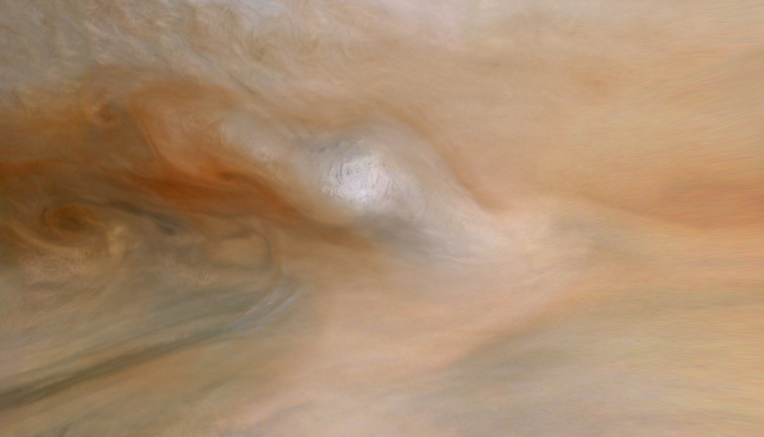
A mission NASA might kill is still returning fascinating science from Jupiter
Over the course of 12 passes, Juno detected 613 microwave pulses from lightning, with power ranging from about the same as a lightning bolt on Earth to at least 100 times more. There is uncertainty in the interplanetary comparison, so it’s possible Jupiter’s lightning flashes could have been a million times more powerful than those on Earth.
Lightning on Jupiter is likely sparked by a mechanism similar to what happens inside Earth’s atmosphere, where ice crystals within clouds obtain an electrical charge, and voltage differentials lead to cloud-to-cloud or cloud-to-ground lightning strikes.
There are notable differences between the planets, too. There is no true surface on Jupiter, and ice crystals inside the Jovian atmosphere contain water and ammonia. On Earth, it’s just water. Atmospheric convection also works differently at Jupiter, where moist air wants to sink because it is heavier than the surrounding hydrogen rich-atmosphere. Nitrogen, heavier than water, dominates Earth’s atmosphere, so moist air rises.
Therefore, it is not only Jupiter’s immense size than leads to such large and powerful storms. It requires much more energy to propel moist air upward, resulting in stronger winds and more intense cloud-to-cloud lightning. There is still a mystery about what drives lightning to be so extreme on Jupiter.
“Could the key difference be hydrogen versus nitrogen atmospheres, or could it be that the storms are taller on Jupiter and so there’s greater distances involved?” said Michael Wong, a planetary scientist at the University of California, Berkeley’s Space Sciences Laboratory. Wong is the lead author on the Jupiter lightning study.
“Or could it be that greater energy is available because with moist convection on Jupiter, you have a bigger buildup of heat needed before you can generate the storm to create lightning?” Wong said in a press release. “It’s an active area of research.”
First Appeared on
Source link






