


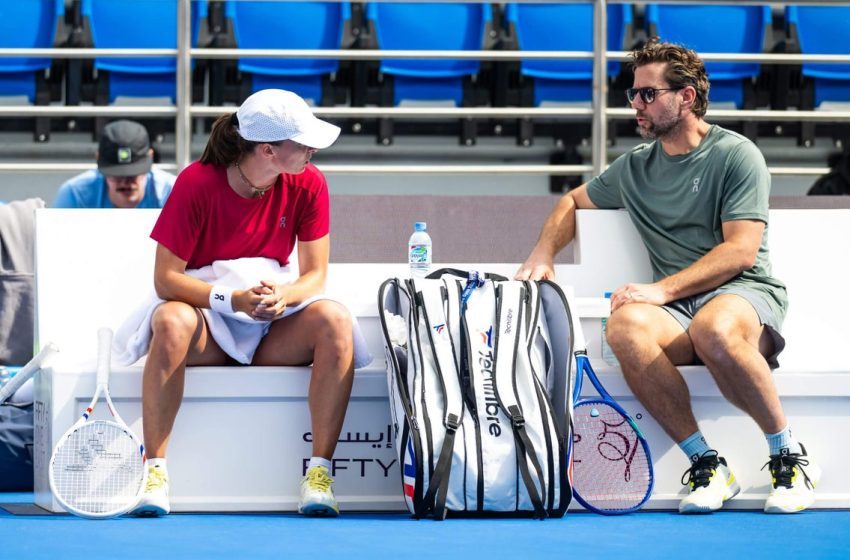
Iga Świątek splits with Wim Fissette after 18 months, 1 Wimbledon title and up-and-down changes
Iga Świątek has parted company with Wim Fissette, her coach of 18 months, after an up-and-down start to 2026.
Świątek won Wimbledon, the Cincinnati Open and the Korea Open during Fissette’s tenure, which started in October 2024, but an ongoing attempt to remodel her game led to inconsistent results and at-times confused losses in which Świątek appeared caught between two different styles of play. Fissette, a 46-year-old from Belgium, had previously coached Kim Clijsters, Angelique Kerber and Naomi Osaka to Grand Slam titles, and Simona Halep and Sabine Lisicki to their first major finals.
Świątek, who has spent over 100 weeks at world No. 1, is currently ranked No. 3. A mixed year so far reached a nadir Thursday night, when she lost in the second round of the Miami Open to world No. 50 Magda Linette. The defeat snapped Świątek’s run of 73 consecutive opening-match wins, which dated back to 2021. After the defeat, Świątek told reporters that she was in “the worst nightmare a tennis player can have.”
When asked if big changes were on the horizon, Świątek said: “You can’t do, like, one huge step and suddenly it’s not going to — there’s no magic solutions. So I guess you need to do it with small changes, but kind of consistently, and keep your discipline,” as reported by Bounces.
“And you know, there’s other stuff — I’ll honestly need time to like figure out and to answer some questions, and I’ll see.”
Announcing the split Monday on Instagram, Świątek wrote: “Miami was challenging for me. I feel disappointment, bitterness and responsibility for my performance on the court of course. I’ve also learned a lot of important lessons and I think that’s very human.
“That being said, after many months of working together with my coach @fissettewim I’ve decided to take a different path. It was an intense time full of challenges and many important experiences. I’m grateful for his support, experience, and everything we achieved together – including one of my biggest dreams in sport.
“Wim, thank you for this time and for the lessons I’ve learned thanks to you. I wish you all the best – both professionally and personally.
“The rest of my team remains unchanged. I know there are many questions, but I’ll let you know what’s next at the right time. I’m taking a moment to take care of myself, process this experience, and prepare for a new chapter.”
Fissette wrote on Instagram: “We both wanted and worked for more but shared important moments and lessons. Iga, I now wish you good luck and success in what’s next. I’m sure you will have it.”
Fissette’s role was also complicated by the other dynamics in Świątek’s coaching box. In recent losses, she has frequently vented her frustration at her team, which includes long-term psychologist Daria Abramowicz. This dynamic was particularly apparent toward the end of the quarterfinal defeat to Elina Svitolina at the BNP Paribas Open in Indian Wells, Calif. earlier this month.
Fissette was also Świątek’s coach during her one-month ban for a positive test for trimetazidine (TMZ), which happened before he joined her team. While serving a provisional suspension in September and October 2024, Świątek missed three events that caused her to lose her world No. 1 ranking. She will drop to No. 4 in the world if Coco Gauff wins or reaches the final of the Miami Open this week.
Świątek is next entered for the Stuttgart Open in Germany in mid-April, where her clay-court season will begin. Clay has tended to be Świątek’s strongest surface, with the French Open accounting for four of her six Grand Slams, even if it has masked just how good — if less remarkable — her hard-court record is.
She still lost that sense of invincibility on clay last year, failing to win a title on the surface, and exiting the French Open at the semifinal stage in her first defeat at the tournament for four years.
Whether or not this is the right decision will take time to understand
Analysis from James Hansen, senior managing editor for tennis
Iga Świątek’s 18 months with Wim Fissette brought the Grand Slam title of which she dreamed and results which, for five years, had seemed impossible for her to suffer. At the start of their project, Świątek expressed a desire to get into a tennis time machine. She wanted to move away from the all-out aggressive, if-you-hit-big-I-hit-bigger game style taught to her by Tomasz Wiktorowski, which won Świątek four majors but became too one-dimensional as opponents figured out how to hurt her on the court, and back toward the more textured, counterpunching style with which she began her domination of women’s tennis.
Those changes paid dividends, but also caused confusion, as changing style in real time on the match court will always do. In defeats through 2025, most notably in the French Open semifinal, when Świątek matched Aryna Sabalenka for two sets and faded in the third, old habits of overhitting and trying to end points too quickly would reappear under stress.
The longer she and Fissette worked together, the less this happened. Her Cincinnati Open and Wimbledon titles were built on baseline clarity, something she was able to achieve largely because her serve — never a great strength — was accurate and fast enough to win free points and take some pressure off her at the back of the court.
But since last summer, Świątek’s improvements to her baseline game have rendered that serve even more of a limiting factor than it once was. Świątek’s motion is not especially fluid, which creates numerous places for hitches to occur and limits its reliability. With fewer first serves earning free points or easy putaways, she has to play more points at neutral or on defense, which loads pressure onto her baseline game.
Returns become more important, and so she plays with more aggressiveness and misses more often. Then she goes back to serving, and there is even more pressure on because she is not winning return games. Carlos Alcaraz’s improvements in the past 12 months have been hugely helped by his serve becoming a reliable release valve for pressure; Świątek’s next coach, whoever it is, will have that area of her game as a priority. Whether or not they can address it will be the only real proof of whether or not parting ways with Fissette now is the right decision.
First Appeared on
Source link






