


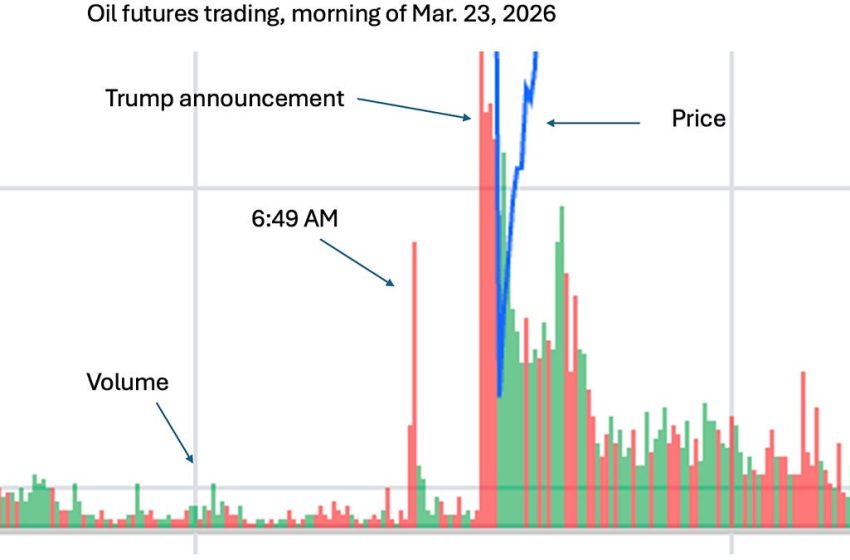
Treason in the Futures Markets
Source: Yahoo Finance
Over the weekend Donald Trump threatened dire vengeance on Iran unless its government opened the Strait of Hormuz within 48 hours, a deadline that would expire Monday evening in Washington. Specifically, he announced that the U.S. would begin bombing power plants — plants that supply electricity to Iran’s civilian population — unless the Strait was cleared.
But at 7:05 AM Monday Trump called the whole thing off — for five days, he said, but many people are assuming that the threatened action, which would have been a massive war crime, is now off the table.
The reason for the about-face, he claimed, was that the U.S. was engaged in productive negotiations with Iranian officials — although this seems to have come as news to the Iranians, who denied that any such negotiations are taking place. Sad to say, in this case, as I tried to explain yesterday, the fanatical, brutal Iranian regime is more credible than the president of the United States. Is he lying or living in a fantasy world? Neither possibility is comforting.
But in any case, Trump’s sudden climb-down was startling. Who could have seen this coming?
The answer is, the person or people who bought large quantities of stock market futures and sold large quantities of oil futures around 15 minutes before Trump’s announcement. As CNBC reports,
At around 6:50 a.m. in New York, S&P 500 e-Mini futures trading on the CME recorded a sharp and isolated jump in volume, breaking from an otherwise subdued premarket backdrop. With thin liquidity typical of early trading hours, the sudden burst stood out as one of the largest volume moments of the session up to that point.
A similar pattern was observed in oil markets. West Texas Intermediate May futures also saw a noticeable pickup in trading activity at roughly the same time, with a distinct volume spike interrupting otherwise quiet conditions.
This “sharp and isolated jump in volume” — which you can see for the oil futures market in the chart at the top of this post — was especially bizarre because there were no major news items — no major publicly available news items — to drive sudden big market transactions. The story would be baffling, except that there’s an obvious explanation: Somebody close to Trump knew what he was about to do, and exploited that inside information to make huge, instant profits.
This wasn’t the first time something like this has happened under Trump. There were large, suspicious moves in the prediction market Polymarket before previous attacks on Iran and Venezuela. But this front-running of U.S. policy was really large: the Financial Times estimates the sales of oil futures in that magic minute Monday morning at about $580 million, and that doesn’t count the purchases of stock futures.
When officers of a company or people close to them exploit confidential information for personal financial gain, that’s insider trading — which is illegal. But we have another word for situations in which people with access to confidential information regarding national security — such as plans to bomb or not to bomb another country — exploit that information for profit. That word is “treason.”
Why is profiting from insider information about national security decisions effectively a form of treason? First, it’s hard to think of a more fundamental principle for officials we entrust with important decisions, especially those that involve national security, that they or people they know should not be allowed to exploit their positions for personal gain.
Second, financial trading based on what should be closely held secrets reveals information to current or potential foreign adversaries. To exaggerate a bit, but only a bit, who needs to bribe agents within the government, or recruit them with honey traps, when you can infer the same information by keeping track of transactions on futures markets?
Finally, there isn’t that big a gap between using knowledge of national secrets to make lucrative financial trades and simply selling those secrets to the highest bidder. Once you’re breached the line that says you shouldn’t profit personally from access to information that is or should be highly classified, the line between trading based on state secrets and selling those secrets directly is a blurry one.
In fact, I’d very much like to know exactly who was making those trades yesterday morning. Were they people directly in the know, or billionaires/traders who paid people in the know for tips?
I’m sure we’ll find out once Kash Patel’s FBI carries out its careful, no-holds-barred investigation.
For the humor-impaired, that was a joke. However, I do believe that the culprits will be easy to determine once Democrats are back in power, and they must apply the full force of law to the people responsible.
One question that may be harder to resolve is the extent to which the possibility of insider trading may actually have influenced policy. Are decisions about war and peace in part serving the cause of market manipulation rather than the national interest? If you dismiss this as unthinkable, you just haven’t been paying attention.
There’s a broader lesson here: You can’t trust a corrupt government to protect national security. And our government is now utterly corrupt: It’s hard to find a single senior official, from the president on down, who treats public office as a grave responsibility rather than an opportunity for personal self-aggrandizement and profit.
Among other things, deeply corrupt governments tend to be very bad at waging war, no matter how much they may exalt “warrior ethos” and “lethality.” When we do a post-mortem on how the Iran debacle happened, arrogant ignorance may still get top billing. But grotesque venality will come a close second.
MUSICAL CODA
First Appeared on
Source link






