


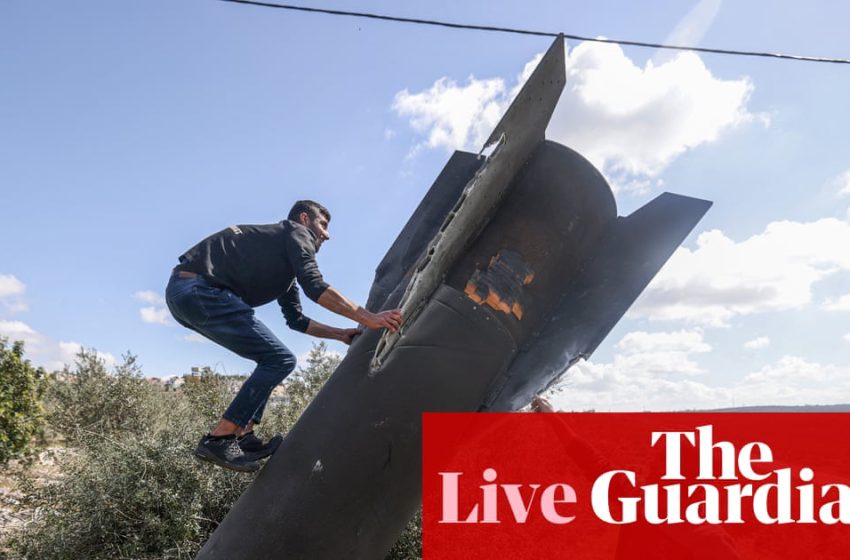
Middle East crisis live: Pakistan reportedly favouring Vance for role in possible US-Iran peace talks | US-Israel war on Iran
JD Vance could lead Iran peace talks for US side in Pakistan if negotiations go ahead – sources
Pakistan’s military leadership has been attempting to broker negotiations between the US and Iran, after the White House confirmed that Pakistan’s army chief, Asim Munir, had a call with Donald Trump on Sunday to discuss the conflict.
Diplomatic sources said the US and Iran could meet for negotiations in Islamabad as early as this week to discuss an end to the war, which began almost a month ago.
It was emphasised that Islamabad had yet to be officially confirmed as the venue for any peace talks, which neither side has formally agreed to so far. Trump’s Middle East envoy, Steve Witkoff, is believed to be preparing to travel to Islamabad but there was no confirmation that anyone from the Iranian side would be in attendance.
Pakistani sources said that the US vice-president, JD Vance, was being put forward as a probable chief negotiator from the US side if talks went ahead, rather than Witkoff or Trump’s son-in-law, Jared Kushner, who led the nuclear negotiations with Iran before the war. You can read more from my colleagues Hannah Ellis-Petersen and Shah Meer Baloch here:
Key events
The UAE’s defence ministry has said that a Moroccan “contractor” in the UAE armed forces was killed in Bahrain in an Iranian attack.
“The Ministry of Defence mourns one of the civilian contractors in the UAE armed forces, a Moroccan national, who was martyred during a routine mission in the sisterly Kingdom of Bahrain following an Iranian missile attack that targeted the sisterly Kingdom of Bahrain,” the ministry wrote in a post on X.
“The brazen Iranian attack resulted in injuries to five members of the UAE Ministry of Defence,’ it added in its statement.
Bahrain’s military had announced earlier that a UAE army personnel was killed in its territory while helping Bahraini forces defend against Iranian attacks.
US-Israeli attacks on Iran have damaged or destroyed more than 82,000 civilian structures across the country, according to the Iranian Red Crescent Society (IRCS).
“Since the beginning of the war up to now, 82,417 civilian units have been damaged and destroyed in airstrikes,” the head of the IRCS, Pirhossein Kolivand, said.
“During this period, 281 medical centres including hospitals, clinics and pharmacies have been targeted,” he added.
In a post on X, Bahrain’s defence force said a UAE serviceman was killed while performing his “national duty” in “confronting… Iranian aggressions”. It is not immediately clear what the incident involved.
Bahrain’s defence force said in a separate post that it had intercepted and destroyed 301 drones and 153 missiles since the war was triggered by the killing of the former Iranian supreme leader, Ali Khamenei, in joint US-Israeli airstrikes on 28 February, which then led to Iran responding with attacks across the Gulf region.

Patrick Wintour
Just as in 1967 when a rank outsider won the Grand National due to a massive pile-up of other horses at one of the final fences, Mohammad Bagher Ghalibaf, the speaker of Iran’s parliament and Donald Trump’s putative interlocutor, appears to have come to the front as the field around him rapidly thinned.
In the pantheon of Iran’s leaders, ruthlessly reduced by targeted assassinations, Ghalibaf stands out as a survivor, but if the US president hopes he has finally located the Delsy Rodríguez of Iran – a pragmatic leader from within the regime willing to do business with America – he may need to think again.
Ghalibaf lacks the sophistication of Ali Larijani, the previous secretary of the Supreme National Security Council, who at times fell out with the previous supreme leader, but had a range of international contacts. Ghalibaf’s image is instead that of a strongman – possibly the one characteristic in any human that most appeals to Trump.
But trying to appoint Ghalibaf from Washington reveals either a misunderstanding of the Islamic Republic’s multi-layered political system, or a determination to upend it: power in Iran historically lies with the supreme leader, and the incumbent, Mojtaba Khamenei, has been selected to that role by the Assembly of Experts.
Iran charges some ships for safe passage through strait of Hormuz – report
Iran has reportedly begun charging some commercial vessels transit fees to pass through the strait of Hormuz, highlighting its growing influence over the key global shipping route.
Sources say payments of up to $2m per voyage are being requested on an ad hoc basis, effectively creating an informal toll, Bloomberg reported.
Some ships are understood to have paid, though the process and currency remain unclear and the system does not appear to be consistent.
However, Iran’s embassy in India denied the claims. In a post on X, it said:
In response to certain claims regarding the alleged receipt of a sum of 2 million dollars by the Islamic Republic of Iran from vessels transiting the Strait of Hormuz, it is emphasized that such claims are unfounded.
The statements made in this regard merely reflect the personal views of individuals and do not, in any way, represent the official position of the Islamic Republic of Iran.
It comes a week after reports that Iran was pursuing a plan in which countries “will be obliged to pay duties and taxes to Iran if they use the strait of Hormuz as a safe route”.
The strait carries about a fifth of the world’s oil and gas, along with large volumes of other goods, with any shift in control closely monitored by global markets.
Pakistan PM Sharif says ready to host talks between US and Iran
Pakistan is ready to host talks between the US and Iran to settle the conflict in the Middle East, prime minister Shehbaz Sharif said in a post on X on Tuesday.
He wrote:
Pakistan welcomes and fully supports ongoing efforts to pursue dialogue to end the WAR in Middle East, in the interest of peace and stability in region and beyond.
Subject to concurrence by the US and Iran, Pakistan stands ready and honoured to be the host to facilitate meaningful and conclusive talks for a comprehensive settlement of the ongoing conflict.
Earlier today, it was reported that Pakistan’s military leadership has been attempting to broker negotiations between the US and Iran, after the White House confirmed that Pakistan’s army chief, Asim Munir, had a call with Donald Trump on Sunday to discuss the conflict.
Diplomatic sources said the US and Iran could meet for negotiations in Islamabad as early as this week to discuss an end to the war, which began almost a month ago.
Summary of the day so far…
It has just gone past 16:35pm in Tehran, and 15:05pm in Tel Aviv and Beirut. Here is a quick recap of events:
-
Pakistani sources told the Guardian that the US vice-president, JD Vance, was being put forward as a probable chief negotiator for the US side if Iran peace talks in Pakistan went ahead.
-
US president, Donald Trump, on Monday claimed there had been “very good and productive” talks with Tehran that aimed to bring the US-Israeli war to an end. But Iran denied any talks were under way.
-
However, Iran’s foreign minister, Abbas Araghchi, has been talking about the war in recent days with his counterparts in Azerbaijan, Egypt, Oman, Pakistan, Russia, South Korea, Turkey and Turkmenistan, his office said.
-
Iranian barrages targeted Israel, Gulf Arab states and northern Iraq on Tuesday, while Israeli and US warplanes continued to carry out airstrikes across Tehran.
-
Israel’s defence minister, Israel Katz, said that the military will take control of south Lebanon all the way to the Litani River, which is about 30km (19 miles) from the Lebanon-Israel border.
-
Katz said that “hundreds of thousands of residents of southern Lebanon” will “not return south of the Litani River until security is guaranteed for residents of the north”, meaning many of these people may never have any homes to go back to.
-
Israel’s displacement of civilians in Lebanon, which has seen more than a million people flee their homes, is a possible war crime, according to Human Rights Watch.
-
The Philippines declared a state of national emergency over the US-Israeli war on Iran, citing the “imminent danger” posed to the country’s energy supply.
-
Iran named a former Iranian Revolutionary Guard commander as the new secretary of the country’s supreme national security council, replacing Ali Larijani, who was killed in an overnight Israeli airstrike earlier this month.
-
German President Frank-Walter Steinmeier said the US-Israeli war on Iran was a “breach of international law” and spoke of a “deep rift” with the US, its traditional ally.
-
Qatar said the regional security system in the Gulf has been broken during the war and said it is working closely with the Trump administration to de-escalate tensions, although it confirmed there had been no direct Qatari mediation between the US and Iran.
Lebanon’s foreign ministry said Iran’s ambassador in Lebanon, Mohammad Reza Sheibani, has to leave by Sunday, declaring him persona non grata.
The Lebanese government cited “Iran’s violation of diplomatic norms and established protocols between the two countries,” without elaborating.
Philippines declare national energy emergency in response to war in Iran
The Philippines has declared a state of national emergency over the US-Israeli war on Iran, citing the “imminent danger” posed to the country’s energy supply.
The Philippines President Ferdinand Marcos Jr said a committee has been formed to ensure the orderly movement, supply, distribution and availability of fuel, food, medicines, agricultural products and other essential goods.
“The declaration of a state of national energy emergency will enable the government … to implement responsive and coordinated measures under existing laws to address the risks posed by disruptions in the global energy supply and the domestic economy,” he said.
Unlike the US or Europe, south-east Asia is hugely reliant on oil that passes through the strait of Hormuz, the vital shipping route which Iran is effectively blocking as leverage against the US (although some ships from “friendly” countries have been allowed through with Tehran’s permission).
Nearly 80% of the region’s crude oil imports come from the Persian Gulf, meaning the war is having a huge impact on economies and resources in south-east Asian countries.
The Philippines, which is among the countries that relies heavily on Middle Eastern oil for fuel needs, is set to import Russian oil this month for the first time in five years.
Iran names new supreme national security council secretary
Iran has named a former Iranian Revolutionary Guard commander as the new secretary of the country’s supreme national security council, replacing Ali Larijani, who was killed in an overnight Israeli airstrike earlier this month.
Iranian state television identified the new secretary as Mohammad Bagher Zolghadr, who had been serving as the secretary of Iran’s expediency council, a powerful arbitration body. Zolghadr has reportedly held other senior positions, including in the judiciary and interior ministry.
Larijani, who had played a key diplomatic role before the war alongside Iran’s foreign minister, Abbas Araghchi, was the most senior Iranian figure to be assassinated in the war since the supreme leader Ali Khamenei was killed in joint US-Israeli airstrikes on its first day.
JD Vance could lead Iran peace talks for US side in Pakistan if negotiations go ahead – sources
Pakistan’s military leadership has been attempting to broker negotiations between the US and Iran, after the White House confirmed that Pakistan’s army chief, Asim Munir, had a call with Donald Trump on Sunday to discuss the conflict.
Diplomatic sources said the US and Iran could meet for negotiations in Islamabad as early as this week to discuss an end to the war, which began almost a month ago.
It was emphasised that Islamabad had yet to be officially confirmed as the venue for any peace talks, which neither side has formally agreed to so far. Trump’s Middle East envoy, Steve Witkoff, is believed to be preparing to travel to Islamabad but there was no confirmation that anyone from the Iranian side would be in attendance.
Pakistani sources said that the US vice-president, JD Vance, was being put forward as a probable chief negotiator from the US side if talks went ahead, rather than Witkoff or Trump’s son-in-law, Jared Kushner, who led the nuclear negotiations with Iran before the war. You can read more from my colleagues Hannah Ellis-Petersen and Shah Meer Baloch here:
Qatar says war caused breakdown in Gulf security system
Qatar’s foreign ministry spokesperson Majid al-Ansari has been speaking to the media about the US-Israeli war on Iran. Here are some of the key takeaways from what he said:
-
The regional security system in the Gulf has been broken during the war, Al Jazeera quoted al-Ansari as saying.
-
The “brotherly relationship” between residents of Qatar and Iran should take precedence “over any other political consideration”, he said.
-
There is no direct Qatari mediation between the US and Iran.
-
The US took the decision to go to war based on their assessment.
-
Qatar is working closely with the Trump administration to de-escalate the war and stop Iranian attacks on Qatar.
-
There have been no incoming missiles or drones from Iran aimed at Qatar since last Thursday. But “we are still in the eye of the storm,” the BBC quoted al-Ansari as saying.
-
“Our posture is defensive. We have had more than 200 drone attacks. We reserve the right to respond. No decision has yet been taken on whether to retaliate. Over 90% of attacks have been intercepted.”
-
Qatar offering to close the US al-Udeid air base – the largest US military base in the Middle East – has not been discussed at all.
US-Israeli war on Iran was a ‘breach of international law’, German president says
In unusually frank comments, German President Frank-Walter Steinmeier said the US-Israeli war on Iran was a “breach of international law”.
“The rift is too deep and the trust in American power politics has been lost, not only among our allies but… worldwide,” he said at an event to mark the 75th anniversary of the German foreign ministry.
Steinmeier, a former foreign minister who now holds a largely ceremonial role, added: “Our foreign policy does not become any more convincing simply because we do not call a breach of international law a breach of international law.”
“There is little doubt that, in any case, the justification of an imminent attack on the US does not hold water,” he said.
At the start of the war, the US administration formally invoked article 51 of the UN charter – the self-defence provision – arguing that Iran’s missile arsenal and nuclear ambitions posed a direct threat to American forces in the region.
Legal experts, however, widely agree that the war on Iran is illegal as there didn’t seem to be any evidence of an imminent threat by Iran when it was launched on 28 February.
Several experts cited Donald Trump’s claim to have obliterated Iran’s nuclear programme last year as evidence that directly countered the suggestion of an imminent threat.
German chancellor Friedrich Merz stuck close to Washington in the early days of the war, but has since shifted his stance, pointing to its destabilising impact on energy costs and “potential to trigger large-scale migration”.
But as the head of the governments, perhaps trying to toe a more diplomatic line, Merz’s comments have been a lot more reserved than Steinmeier’s were today. Merz has repeatedly said Germany shares “the objective that Iran should no longer pose a threat in future”, while also making clear his country would not enter the war.
Israel says it will take ‘control’ of so-called ‘security zone’ up to Lebanon’s Litani river
Israel’s defence minister, Israel Katz, has been quoted by the AFP news agency as saying that the military will take control of south Lebanon all the way to the Litani river, which is about 30km (19 miles) from the Lebanon-Israel border.
“All five bridges over the Litani that were used by Hezbollah for the passage of terrorists and weapons have been blown up, and the IDF (Israeli military) will control the rest of the bridges and the security zone up to the Litani,” Katz said during a visit to a military command centre in Israel. The IDF often refers to “terrorists” even though they regularly kill civilians and destroy civilian infrastructure in their attacks.
Katz said hundreds of thousands of south Lebanon residents who were displaced by the war this month “will not return south of the Litani River until security is guaranteed for the residents of the north” of Israel.
Israeli forces attacked the Qasmiyeh Bridge, a key crossing linking Lebanon’s south to the rest of the country, over the weekend, in what Lebanese President Joseph Aoun described as a “prelude to ground invasion”.
Many Lebanese people fear Israel is attempting to separate southern Lebanon from the rest of the country ahead of a large-scale invasion.
This would mean many people displaced from their homes, following evacuation orders across large areas of southern Lebanon, would have nowhere to return to.
Israel’s displacement of civilians in Lebanon is a possible war crime, according to Human Rights Watch.
Over one million people have been displaced in Lebanon since Israel renewed its war on the country on 2 March, causing a multitude of humanitarian issues given the speed and the scale of the displacement. The Lebanese health ministry said at least 1,039 people, including 79 women and 118 children, have been killed in Israeli attacks since the latest war began.
The International Rescue Committee said:
Thousands remain without adequate shelter – sleeping in the open, on the streets, in tents, or in their cars – while others are packed into overcrowded, under-equipped collective shelters with limited access to clean water, sanitation, and privacy. Local services are struggling to keep pace with rising demand.
Germany’s foreign minister, Johann Wadephul, told broadcaster MDR that he believed Donald Trump’s announcement about talks with Iran could mark a turning point in the US-Israeli war on Iran.
“Something is happening, and that’s a good thing in this time when there have been more risks of escalation than possibilities of bringing this conflict under control,” he said.
As a reminder, Trump yesterday said the threatened US strikes on Iranian power plants had been postponed after “very good and productive” discussions with Iran about a “complete and total resolution of our hostilities” in the Middle East. Iran, however, denied that any such talks took place, although countries, including Pakistan, Turkey and Egypt, are reportedly trying to reduce tension between Washington and Tehran.
Wadephul said he believed Trump did hold serious talks with Iran because “otherwise he wouldn’t have said it that way” and he would not have postponed his threatened attack on Iranian power plants.
“It’s a fragile beginning, but it’s a start nonetheless,” Wadephul said. “We should all strive to ensure that this progress flourishes and that there’s a way to control this conflict.”
Four people have been killed and four others injured by an Israeli airstrike on a house in the Lebanese town of Selaa, according to the country’s National News Agency (NNA).
The injured people were transferred to hospitals in Tyre, a city in southern Lebanon where Israel has intensified its attacks.
The Lebanese border town of Naqoura and the outskirts of the border village Alma al-Shaab were hit by artillery shelling by Israeli forces at dawn, the NNA reported.
The renewed Israeli assault on Lebanon was launched on 2 March after Hezbollah – the Iranian-backed Lebanese militant group – fired rockets into northern Israel in response to the killing of the former Iranian supreme leader, Ali Khamenei, in joint US-Israeli airstrikes.
The IDF has ordered civilians in southern Lebanon to “move immediately to areas north of the Litani River”, in a sweeping order affecting hundreds of thousands of people.
Israel has sent ground troops into southern Lebanon in what many fear could lead to an occupation in the south of the country.
Israel says the aim of its war is to protect communities in northern Israel from Hezbollah attacks. However, many Lebanese civilians have been killed in Israeli airstrikes, which have gripped communities with fear as they have to flee their homes often with nowhere safe to go.
The Lebanese health ministry said in its latest update that at least 1,039 people, including 79 women and 118 children, have been killed in Israeli attacks on Lebanon since 2 March.
You can read how fuel shortages are already affecting people worldwide here:
Countries around the world are assuring their populations that there are sufficient energy supplies to meet domestic demand, despite fears of fuel shortages resulting from the US-Israeli war on Iran, which has driven up the cost of petrol and gas, among other things.
Over in the UK, Michael Shanks, an energy minister, has been speaking to journalists, taking questions ahead of Chancellor Rachel Reeves’s statement on how the government will respond to the soaring global energy prices caused by the war. Shanks stressed there is no need for drivers to worry about a fuel shortage, telling Times Radio:
[Drivers] should do everything as absolutely normal because there is no shortage of fuel anywhere in the country at the moment. We monitor this every single day, I look at the numbers personally. There’s no issue at all with that.
You can read more in our UK politics live blog here:
Lorenzo Tondo
A missile slammed into a street in central Tel Aviv on Tuesday, as Iran sustained its barrage against Israel and, increasingly, Gulf Arab states, even as the US president, Donald Trump, said Washington was engaged in talks with Tehran aimed at ending the war.
Trump’s announcement on Monday that he had extended by five days his deadline to strike Iran’s power plants, describing negotiations with the Islamic Republic as “productive”, had raised hopes among civilians of a possible lull in the fighting.
Although the US president had specified that only energy infrastructure would be spared from joint Israeli-American strikes, many interpreted the shift in tone as a sign of imminent de-escalation – even as Iran denied any such understanding. It did not materialise.
Police said a munition carrying a substantial explosive payload struck central Tel Aviv, causing widespread damage to buildings and vehicles. According to Haaretz, at least six people were lightly injured.
Several buildings were damaged across the city with emergency services reporting casualties at one of the impact sites. One building and the adjacent road were heavily affected, with cars set ablaze.
Fragments from intercepted missiles also fell in Rosh Haayin, causing minor damage but no reported injuries.
The strikes were the latest in a cycle of retaliation following Israeli operations announced on Monday. About 40 minutes after Trump said he would delay action against Iran’s power infrastructure, Israel said on X that it had begun another wave of strikes across Tehran.
The Israel Defense Forces told the Guardian that energy facilities would be spared, suggesting that Israel may be aligning with Washington in suspending attacks on Iranian power plants and related sites. Yet witnesses in Tehran described Monday’s Israeli strikes as “unprecedented” in scale.
In recent weeks, Israel’s military claims to have eliminated more than 70% of Iran’s ballistic missile launchers, and says it has come close to establishing near-total control of Iranian airspace. Even so, Tehran has continued to penetrate Israel’s defences. The escalation has also spilled beyond Israel. On Monday, Iranian strikes extended into Gulf states.
First Appeared on
Source link






