


Scientists Found Unusual Handprints at This Isolated Site, and No One Knows Who Made Them
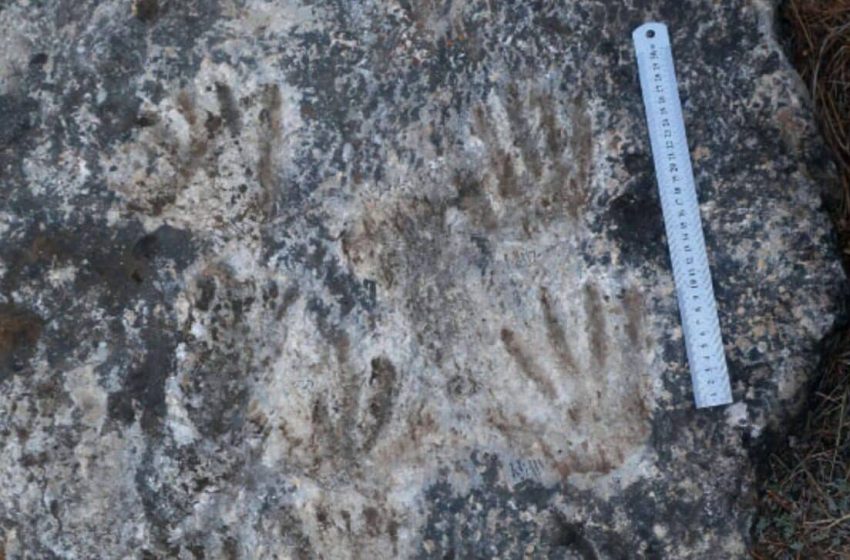
Handprints and footprints pressed into stone on the Tibetan Plateau may represent the oldest known artistic expression, dating back between 169,000 and 226,000 years. Discovered near Quesang village, about 80 kilometers northwest of Lhasa, the impressions were preserved in travertine formed by an ancient hot spring.
Their unusual composition has drawn scientific attention for what appears to be a deliberate act rather than random marks left behind. At the center of the discussion is a simple but unresolved question. Are these traces functional or expressive?
Chance or Intent? The Patterns Say Otherwise
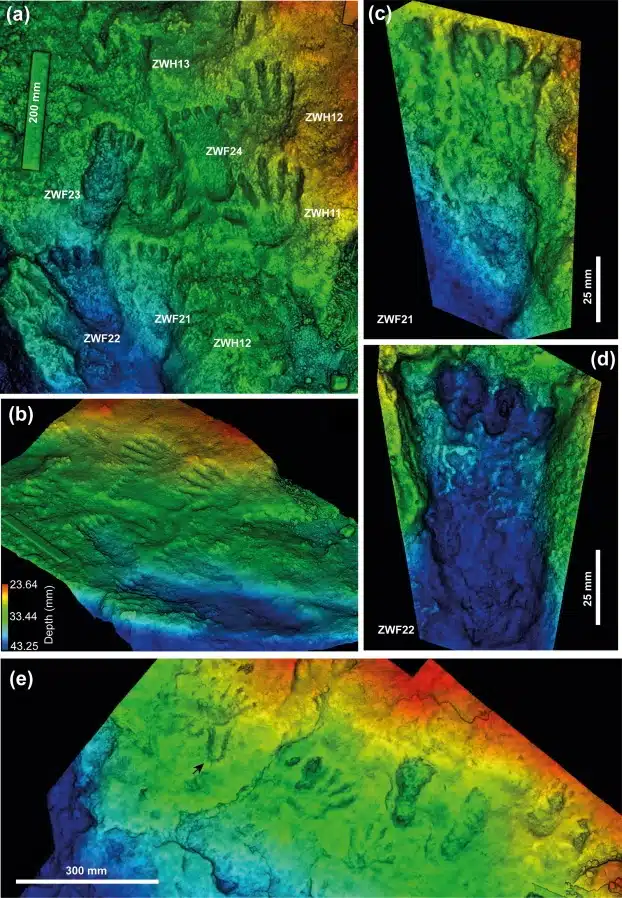
The site includes five handprints and five symmetrical footprints arranged across the surface. The impressions were made when the travertine was still soft, before hardening and preserving the shapes.
According to Dr. Thomas Urban of Cornell University, the prints are “clearly not accidentally placed.” He also added that:
“There’s not a utilitarian explanation for these. So, what are they? My angle was, can we think of these as an artistic behavior, a creative behavior, something distinctly human.”
This interpretation is based largely on the structured layout. The prints do not resemble movement across terrain but rather interaction with a surface, which sets them apart from typical fossilized tracks.
Markings Traced Back to Children
Measurements indicate that two individuals created the impressions, likely children. One, responsible for the footprints, is estimated to have been around 7 years old, while the maker of the handprints was closer to 12.
As explaine in the study reported in Science Bulletin, the presence of handprints is a key detail. Footprints are widely documented in the human fossil record, but handprints occur far less frequently and are often associated with deliberate marking.
“Their presence connects the Tibetan panel to a tradition of parietal art — that is, art that is immobile — typified by hand stenciling on cave walls,” reported a Cornell University statement.
When Did Art Begin, Really?
Until now, the oldest known examples of parietal art, which refers to fixed artistic expressions such as cave markings, came from Sulawesi and were dated between 39,900 and 43,900 years ago. These include early uses of hand motifs.
The study’s authors showed that the Tibetan impressions point to a much earlier origin for this type of expression. The inclusion of handprints connects the site to broader artistic traditions, despite the significant gap in time.
The identity of the individuals who made the prints remains unclear. The period predates confirmedHomo sapiens presence in the region, leading some researchers to consider Denisovans, based on skeletal remains previously found on the Tibetan Plateau.
First Appeared on
Source link






