


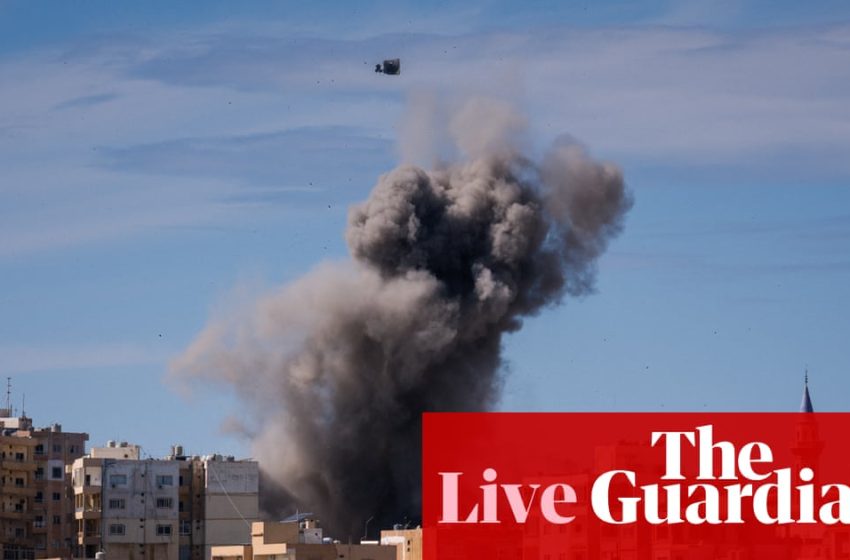
Fire at Kuwait airport after drone attack – as it happened | US-Israel war on Iran
Kuwait air defences are responding to missile and drone attacks, its army said on Wednesday.
In a post to X, the army said “any explosions that may be heard are the result of air defense systems intercepting hostile targets”.
Earlier, a drone attack hit a fuel tank and sparked a fire at Kuwait airport, according to Kuwait’s civil aviation authority.
Emergency procedures were activated immediately, with firefighting teams responding to the blaze, it said, adding that initial reports indicated only material damage.
Key events
This blog is closed now. Thanks for following along. Our live coverage of the war continues here.
WTO fertiliser warning over strait of Hormuz closure: ‘Harvests shrink and prices rise’
Disruptions to international fertiliser supplies caused by the closing of the strait of Hormuz will cause food scarcity and high prices, the World Trade Organisation’s deputy director general, Jean-Marie Paugam, told Agence France-Press.
A third of the world’s fertilisers normally transit the strait, which has been virtually closed by Iran since the start of the war.
Paugam said there would be an impact on both quantity and prices. “The effect compounds the following year: harvests shrink and prices rise,” he said.
The gulf has ample supplies of natural gas, a key ingredient in artificial fertilisers, but production has been severely impeded by the war, with several facilities forced to shut down.
Major food exporters like India, Thailand and Brazil depend on exports of urea, a nitrogen-based fertiliser. There is currently no fertiliser shortage, Paugum said, but as the conflict drags on “we will feel a direct impact on supplies to major producer countries just as planting season begins for the crops that will be harvested next year”.
Countries which import most of their food would be in a very bad position, according to Paugum, including parts of west and north Africa. The effect would be amplified if countries begin stockpiling, as occurred during the Covid pandemic.
Interim summary
If you’re just joining us, here is a recap of the day so far:
-
The US has sent Iran a 15-point plan to end the war, sources told Reuters, with the New York Times saying the plan was delivered by way of Pakistan. It is unclear if Israel is on board with the proposal, nor if Iran is likely to accept it as a basis for negotiations. Crude oil prices dropped more than 5% after news of the plan broke.
-
Donald Trump claimed negotiations to end the Iran war are happening “right now” and that Tehran had agreed to “never” have a nuclear weapon, declaring that “we’ve won this war” to reporters in the Oval Office. He further claimed Tehran gave him a “gift” which was “oil and gas-related” which involved the strait of Hormuz, without giving further details.
-
This comes a day after Iranian officials denied any contact with the US had taken place and called claims of such talks “fake news” designed to “manipulate” oil markets.
-
News that Trump has approved the deployment of more than 1,000 soldiers from the 82nd Airborne Division to the Middle East further undermined the US president’s repeated claims of successful peace talks. The extra troops have not yet left the US but will be sent overseas in the coming days, sources told AP.
-
A projectile has hit the premises of the Bushehr nuclear power plant, according to the International Atomic Energy Agency, who were informed of the strike by Iran. There was no damage to the facility or staff and conditions at the plant remain normal, the IAEA said on X.
-
Approximately 290 US troops have been wounded so far, CNN reports, with 13 soldiers killed in action. More than 1,500 Iranians have been killed in the conflict, Iran’s state broadcaster said on 21 March.
-
Lebanon faces an “existential crisis” after Israel announced plans to seize and occupy large swathes of the country’s south to create a so-called “security zone”, officials say. Many Lebanese fear that IDF plans to create a “buffer” south of the Litani River – 20 miles from the current Israel-Lebanon border – will become a long-term occupation.
-
At least six people in Lebanon have been killed by Israeli strikes, state media reported, as the Israeli military issued evacuation warnings for much of southern Beirut. More than 1,000 people have died in Lebanon since the start of the conflict, according to the health ministry.
-
Iran’s Revolutionary Guards have fired missiles at Israel and US forces in bases in Kuwait, Jordan and Bahrain, state media reported. Kuwait air defences confirmed they were responding to missile and drone attacks, with initial reports indicating only material damage.
Vietnam’s trade ministry has confirmed diesel fuel prices have more than doubled since the start of the war, rising about 105% from 19,270 dong to 39,660 dong (US$1.50) a litre since 26 February.
The price of 95-octane fuel also jumped nearly 68% over the same period, from 20,150 dong to 33,840 dong, Agence France-Presse reports.
Meanwhile, Reuters reports that Vietnam’s prime minister, Pham Mihn Chinh, has asked the Russian resources company Zabrubezhneft during a visit to Moscow to boost investment in Vietnam, including on storage facilities, and to supply crude oil to the country on a long-term basis, potentially in collaboration with the country’s state oil firm Petrovietnam.
Iran fires missiles at Israel, Kuwait, Jordan and Bahrain – reports
Iran’s Revolutionary Guards said they have fired missiles at Israel and military bases hosting US forces in Kuwait, Jordan and Bahrain, according to Iranian state television.
An IRG statement claimed targets were struck by “precision-guided liquid- and solid-fuel missile system and attack drones”, Agence France-Presse reported.
As we reported earlier, Kuwait air defences confirmed they were responding to missile and drone attacks, with initial reports indicating only material damage at this stage.
The airline Jetstar, which operates in New Zealand, has temporarily cut a number of domestic and international flights as the fuel crisis continues, a spokesperson told Radio New Zealand.
About 12% of services have been affected including services between Auckland, Christchurch and Wellington, as well as to Sydney and Brisbane, the company announced, blaming a rise in jet fuel prices.
It comes after Air New Zealand cut four flights to Samoa, also blaming fuel costs.
Jet fuel prices have risen from US$85-90 a barrel to around US$150-200 a barrel recently, according to Reuters, due to the ongoing crisis in the Middle East.
Kuwait air defences are responding to missile and drone attacks, its army said on Wednesday.
In a post to X, the army said “any explosions that may be heard are the result of air defense systems intercepting hostile targets”.
Earlier, a drone attack hit a fuel tank and sparked a fire at Kuwait airport, according to Kuwait’s civil aviation authority.
Emergency procedures were activated immediately, with firefighting teams responding to the blaze, it said, adding that initial reports indicated only material damage.
South Korean shares rose 3% on Wednesday, after reports the US was making progress in its efforts to negotiate with Iran.
The benchmark KOSPI was up 170.27 points, or 3.07%, at 5,724.19 as of 0135 GMT, Reuters reported.
“At this point, it is appropriate to lower the possibility of the war escalating and stock markets going through a correction for a longer time,” said Han Ji-young, an analyst at Kiwoom Securities.
Philippines seeks US waivers to import oil from sanctioned countries after emergency declared
The Philippines is seeking waivers from the US state department so it can obtain oil from US-sanctioned countries — possibly including Iran and Venezuela — to ensure its fuel supply, the country’s ambassador to the US, Jose Manuel Romualdez, told Reuters.
The South-East Asian nation, which relies heavily on imported fuel, declared a state of national energy emergency on Tuesday as the fallout from the Middle East war continues.
As of 20 March, the government said the country has about 45 days of fuel supply remaining and is seeking to procure another 1m barrels of oil to build its buffer.
Manilla has temporarily increased coal-fired power generation in response to the crisis. Washington has previously issued 30-day waivers for Russian crude oil and Iranian oil from tankers already at sea.
Asked if Washington had responded, Romualdez said the matter was a “work in progress”.
Read more background here.
About 1,000 US soldiers to depart for Middle East in coming days – reports
Further to our earlier post, at least 1,000 troops from the 82nd Airborne Division will be sent to the Middle East in the coming days, three people with knowledge of the plans told Associated Press.
Earlier, Sky News and NBC News reported that Trump had approved the deployment.
The 82nd airborne is an elite infantry division that can typically be deployed on short notice and specialises in forcible entry parachute assaults.
It is the latest addition of American troops after US officials last week said thousands of Marines aboard several Navy ships will be heading to the region.
The Marine deployment to the region raises speculation the US may try to seize Kharg Island, which is vital to Iran’s oil network, AP reported.
The US bombed the island more than a week ago, hitting its defences but saying it had left oil infrastructure intact.
Iran has threatened to mine the gulf if the US appears to be on the verge of landing troops.
Colombia is seeking to lead the formation of a global coalition of nations that want to end the use of fossil fuels, at an international meeting in April, Agence France-Presse has reported.
On Tuesday, the country’s environment minister, Irene Vélez Torres, told journalists the meeting comes as the world faces “an extreme energy crisis” due to the the war in the Middle East. Colombia’s goal is to establish a “coalition of those of us who possess the will to eliminate fossil fuels”, she said.
Velez said 45 countries had confirmed their attendance for April’s international conference on the transition away from fossil fuels, organised by Colombia and the Netherlands during last year’s Cop30 meeting in Brazil.
Here are the latest images from the crisis in the Middle East.
Oil prices drop more than 5% after Trump reportedly sends peace plan
Brent crude oil, the global market benchmark, dropped close to six percent on Wednesday after Donald Trump sent a peace plan to Iran, Agence France-Presse reports.
At around 0030 GMT, a barrel of Brent crude was down 5.92% at $98.30.
Benchmark US oil contract, West Texas Intermediate, was down 5.01% at $87.72.
As reported earlier, the US reportedly sent Iran a 15-point plan to end the US-Israel war on Iran, a source familiar with the matter told Reuters.
News of the US plan was reported earlier by the New York Times, which, citing two officials, said the plan was delivered by way of Pakistan.
Per the NYT’s report, it is unclear how widely the plan had been shared among Iranian officials and whether Iran was likely to accept it as a basis for negotiations.
Israeli strikes kill six in Lebanon – state media
Israeli strikes killed at least six people in a town and a Palestinian refugee camp in the southern Sidon area, Lebanese state media reported on Wednesday.
Citing the health ministry, the official National News Agency said four people were killed in an “Israeli enemy raid” on the town of Adloun, and another two in a strike on an apartment in the Mieh Mieh refugee camp.
Drone attack sparks fire at Kuwait airport – reports
A drone attack has hit a fuel tank and sparked a fire at Kuwait airport, Kuwait’s civil aviation authority said on Wednesday.
Emergency procedures were activated immediately, with firefighting teams responding to the blaze, it said, adding that initial reports indicated only material damage.
First Appeared on
Source link






