


Scientists Just Found A Massive Freshwater Reservoir Beneath A Salt Lake, and It Shouldn’t Exist
A massive underground freshwater reservoir beneath the Great Salt Lake is reshaping how scientists understand water systems in arid regions, according to a new study published in Scientific Reports, a discovery that could carry major implications for water management and climate resilience across the American West.
A Hidden Reservoir Beneath A Salty Giant
For decades, the Great Salt Lake in Utah has been seen as a terminal, hypersaline basin with little connection to usable freshwater systems beneath its surface. That assumption is now being challenged. Using advanced geophysical imaging techniques, researchers uncovered a vast body of freshwater lying beneath the lakebed, extending far deeper and wider than previously believed.
The findings suggest that instead of a simple layering of saltwater over denser brine, the subsurface is far more complex. Freshwater appears to penetrate deep into the basin, defying conventional hydrological models. As Zhdanov explained,
“We were able to answer the question of how deep is this potential reservoir, and what is its spatial extent beneath the eastern lake margin. If you know how deep, you know how wide, you know the porous space, you can calculate the potential freshwater volume.”
This revelation fundamentally alters the perceived structure of the lake. It indicates that freshwater inflows from surrounding mountains may be traveling much farther beneath the surface than expected, feeding a concealed and potentially significant aquifer system.
A Scientific Breakthrough
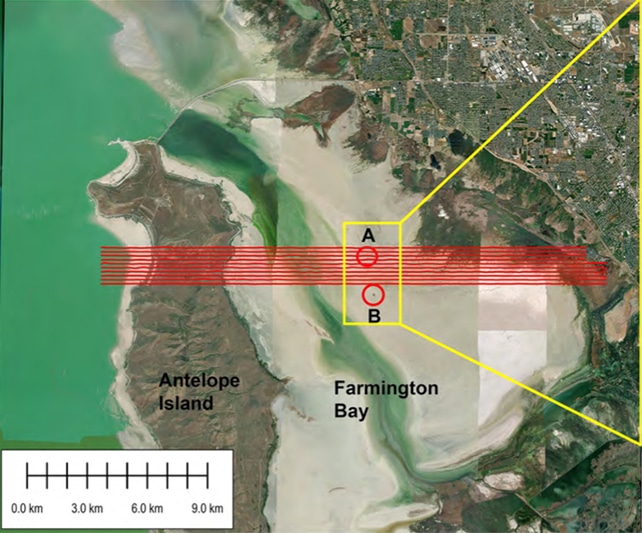
The study, published in Scientific Reports, relied on a combination of airborne electromagnetic surveys and magnetic data analysis to map subsurface structures with unprecedented clarity. These tools allowed scientists to distinguish between saline and freshwater layers and estimate their depth and distribution.
“What we would normally expect as hydrologists is that that brine would occupy the entire volume underneath that lake,” said Johnson. “It’s denser than the freshwater. You’d expect the freshwater from the mountains to come in somewhere at the periphery. But we find it’s coming in towards the interior. And there’s what appears to be deep volume of this freshwater coming in underneath that saline lens.”
This unexpected configuration challenges long-standing assumptions about density-driven stratification in closed-basin lakes. Instead of a stable layering system, the Great Salt Lake may host dynamic interactions between freshwater inflows and saline bodies, creating a far more intricate underground network.
Implications For Water Management And Dust Control
Beyond its scientific significance, the discovery could have immediate real-world applications. As water levels in the Great Salt Lake continue to decline, exposed lakebeds have become major sources of dust pollution, posing risks to air quality and public health.
The newly identified freshwater reserves may offer a tool to mitigate these effects.
“There are beneficial effects of this groundwater that we need to understand before we go extracting more of it,” Johnson noted. “A first-order objective is to understand whether we could use this freshwater to wet dust hotspots and douse them in a meaningful way without perturbing the freshwater system too much.”
Such targeted interventions could help stabilize vulnerable areas of the lakebed without requiring massive water inputs—an increasingly unrealistic option in a drought-stricken region. The idea of using subsurface freshwater strategically opens a new frontier in environmental management.
Mapping The Unknown Beneath The Lake
Despite the breakthrough, researchers emphasize that much remains unknown. Current data covers only parts of the lake, leaving significant gaps in understanding the full extent of the freshwater system.
“This is why we need to survey the entire Great Salt Lake. Then we’ll know the top and the bottom,” said Zhdanov. “To study the top we use airborne electromagnetic methods, which gives us the thickness of the saline layer and where the freshwater starts under the saline layer. To study the bottom, we use magnetic data. We use different techniques to study the vertical extent of this freshwater-saturated sediments, to find the depth to the basement.”
Expanding these surveys could reveal whether the freshwater extends beneath the entire lake, and how it connects to regional groundwater systems. That knowledge would be key to determining whether this hidden resource can be used sustainably.
First Appeared on
Source link






