


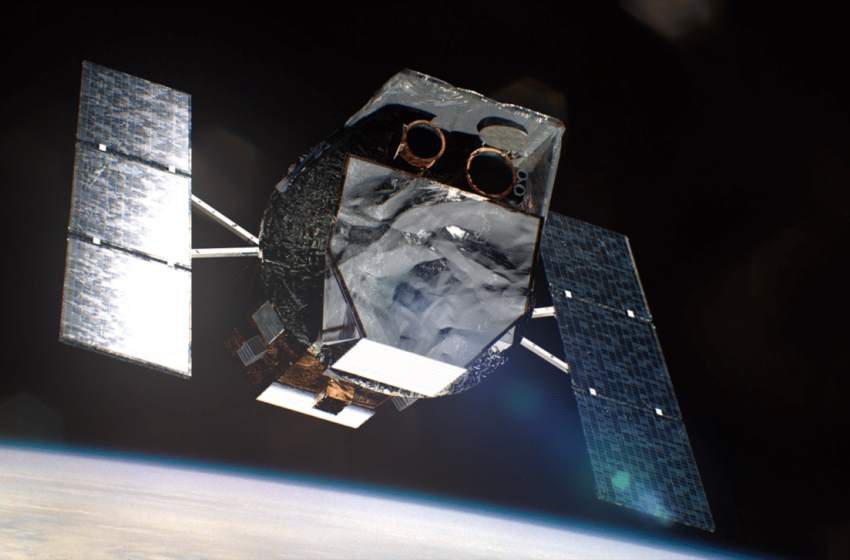
A NASA Spacecraft Is Falling Toward Earth, Now A High-Risk Rescue Effort Is Trying To Catch It In Time
A rare and aging NASA spacecraft is slipping out of orbit, triggering an urgent and unconventional rescue effort led by a private team, an operation first detailed by Ars Technica that could redefine how satellites are saved in space.
A Desperate Bid To Catch A Dying Observatory
The satellite at the center of this mission is Swift, a NASA space observatory designed to detect gamma-ray bursts across the universe. After years of operation, the spacecraft is now losing altitude due to atmospheric drag, placing it on a slow but inevitable path toward reentry. Rather than letting it burn up, engineers are attempting something rarely done: intercepting and docking with the satellite in orbit to extend its life.
According to reporting from Ars Technica, this effort is being led by Katalyst, a private company developing a compact spacecraft capable of physically attaching to Swift. The plan involves launching a servicing vehicle that will rendezvous with the tumbling observatory and stabilize it, an operation filled with technical uncertainty.
“This is really technically ambitious,” said Ghonhee Lee, founder and CEO of Katalyst. “It’s a lot of drag with two big spacecraft docking together,” Lee said. “Originally, we thought we had more time.”
“We realized that you can’t get 100 percent guaranteed success on this,” Lee said.
The stakes are high. Swift remains scientifically valuable, and losing it would mean a gap in critical observations of cosmic explosions that help scientists understand black holes and the evolution of the universe.
Credit: Katalyst Space Technologies
A Mission Built In Record Time Under Pressure
What makes this mission even more unusual is the timeline. Unlike traditional NASA programs that take years to mature, this rescue effort has been assembled in a matter of months.
“This is not quite as mature as you would expect,” one company official said. “Keep in mind that we started this whole thing about five months ago, so we are making great progress by those standards.”
The compressed schedule has forced teams to overlap critical phases of development, design, testing, and validation are happening simultaneously, increasing both speed and risk.
“We’re basically doing it where everything is coming together,” Lee said. “The design, the testing, and the verification are all happening at once.”
NASA appears willing to accept that risk. Shawn Domagal-Goldman, director of NASA’s astrophysics division, described the effort as a bold experiment in a new way of operating in space.
He said the mission reflects a “forward leaning, risk-tolerant approach” and “is both more affordable than replacing Swift’s capabilities with a new mission, and beneficial to the nation—expanding the use of satellite servicing to a new broader class of spacecraft.”
Engineering In The Dark With Missing Data
One of the biggest obstacles facing engineers is surprisingly basic: they don’t fully know what Swift looks like in key areas. Documentation and imagery from its original construction are incomplete, leaving gaps in critical details needed for docking.
“One of the big things in developing this mission is there’s not a lot of great information about Swift looked like prior to launch,” a Katalyst manager said while standing beneath a full-scale model used for testing.
“This view that we have right here, there are no pictures that show this angle. None that we’ve found so far,” the manager said.
Teams have searched through archives from NASA and Northrop Grumman, which originally built the spacecraft, but key perspectives remain missing.
“There are pictures of lots of things around here,” the official said. “There isn’t one at the end of closeout where you’re, like, ‘OK, yeah, this is what we should be expecting.’”
This lack of data forces engineers to rely on assumptions and simulations, increasing the complexity of an already delicate operation involving robotic arms and autonomous navigation.
Why A Smaller Rocket Might Make Or Break The Mission
Launch strategy has also played a central role in shaping the mission. Instead of opting for a heavy-lift rocket like Falcon 9, the team is considering Pegasus, a smaller, air-launched vehicle better suited for this specific orbital profile.
“Out of the Cape, if we’re going on a dedicated Falcon 9, that’s like $65 or $70 million. So there was just no trade space,” a company official explained.
“Pegasus was actually a really good option because it’s built for this type of mission, going to unique inclinations, being able to be responsive, and then the payload capacity of it was perfect. They have up to 400 kilograms (880 pounds) to this orbit. That’s exactly what we need. Falcon 9 would have been way overkill for something like this.”
The entire mission is being developed with a relatively modest budget of around $30 million, remarkably low for a space operation of this complexity.
“Nothing under this program is inventing new technology,” Lee said. “We’re taking technology that’s already been developed, either here or just in the broader industry, and putting it together in the smart way that allows us to move really quickly. And it’s also only $30 million.”
A Turning Point For Satellite Servicing In Orbit
If successful, this mission could mark a major shift in how space agencies and private companies manage aging satellites. Rather than replacing them, future missions could repair, refuel, or reposition spacecraft already in orbit.
“No kidding, if we don’t launch in June, there’s real danger that this mission doesn’t come together,” Lee said.
The implications extend far beyond Swift. Satellite servicing has long been discussed as a way to reduce costs and space debris, but real-world demonstrations have been limited. This mission could push the concept into a more practical and widely adopted phase.
At the same time, the risks remain significant. The operation requires precision docking between two large objects moving at thousands of miles per hour, all while dealing with limited data and tight deadlines.
The outcome is far from certain. Yet if it works, it could open a new era where satellites are no longer disposable—and where space becomes a place not just of exploration, but of maintenance and renewal.
First Appeared on
Source link






