


The Great Salt Lake Is Hiding Something Big, Study Suggests
An airborne survey of one of the saltiest bodies of water on Earth has revealed a deep freshwater reservoir that extends much farther than expected and could help the drying lakebed fight against dust pollution.
As its name suggests, the Great Salt Lake is known for the salinity of its waters, which are up to eight times saltier than the ocean. In the past few years, scientists began to suspect that there may be a hidden reservoir lurking beneath the lake’s hypersaline surface when freshwater began welling up at several spots across the playa.
A team of scientists from the University of Utah tied electromagnetic survey equipment to a helicopter and sent it flying over Farmington Bay to probe beneath the lake. The data revealed a hidden freshwater system deep beneath the Great Salt Lake, reaching depths of 10,000 to 13,000 feet (3 to 4 kilometers).
“We were able to answer the question of how deep this potential reservoir is, and what its spatial extent is beneath the eastern lake margin,” Michael Zhdanov, geology professor at the University of Utah and lead author of a study published in Scientific Reports, said in a statement. “If you know how deep, you know how wide, you know the porous space, you can calculate the potential freshwater volume.”
What lies beneath
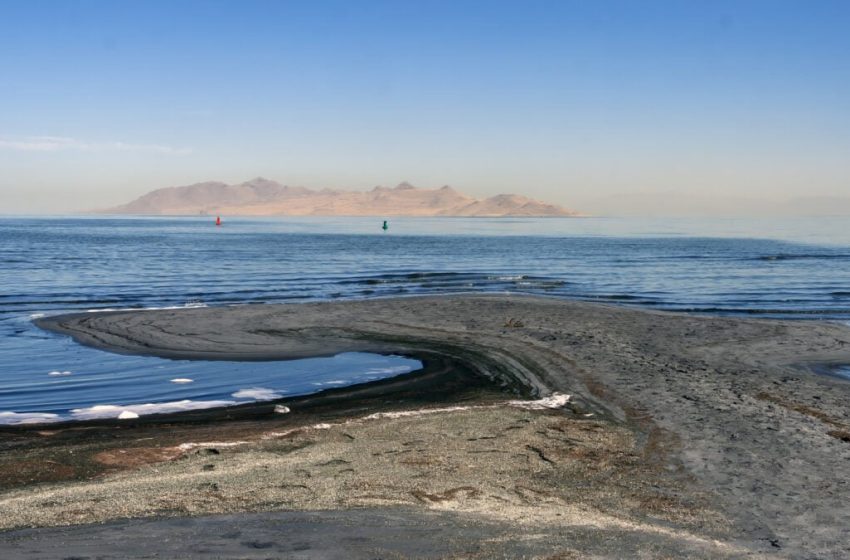
The Great Salt Lake has been rapidly shrinking for decades and is at risk of disappearing entirely due to excessive water consumption and drought. That’s why scientists were surprised to find reed-covered mounds appearing off the lake’s southeast shore in the last several years, suggesting an unknown source of enough freshwater to sustain the vegetated oasis.
To help uncover the mystery, the scientists behind the new study carried out an airborne survey of the southeastern edge of the lake in February. They found that not only is there freshwater beneath the Great Salt Lake, but it also saturates the sediments to surprising depths.
“The unexpected part of this wasn’t the salt lens that we see near the surface across the playa,” Bill Johnson, a hydrologist from the University of Utah and co-author of the new study, said in a statement. “It’s that the freshwater underneath it extends so far in towards the interior of the lake and possibly under the entire lake.”
While scientists expected the freshwater to come in somewhere at the periphery, the study suggests that it may be entering the subsurface toward the lake’s interior. “There’s what appears to be a deep volume of this freshwater coming in underneath that saline lens,” Johnson added.
Nature’s dustbuster
The freshly discovered deep reservoir could help mitigate a longstanding issue at the lake. Due to the Great Salt Lake’s declining water levels, around 800 square miles (2,071 square kilometers) of the exposed lakebed have become a growing source of dust that blows into Utah.

The potential source of freshwater could help reduce the hazardous dust pollution affecting nearby communities. “There are beneficial effects of this groundwater that we need to understand before we go extracting more of it,” Johnson said. “A first-order objective is to understand whether we could use this freshwater to wet dust hotspots and douse them in a meaningful way without perturbing the freshwater system too much.”
After covering Farmington Bay, the team is hoping to be able to survey the lake’s entire 1,500-square-mile (3,885 square-kilometer) footprint to get a full picture of how much freshwater lies beneath the Great Salt Lake.
First Appeared on
Source link






