


Bronze Age Artifact Made from ‘Space Metal’ Unearthed at a Sacrificial Site is Confirmed as the Oldest of Its Kind
A curious Bronze Age artifact unearthed at a ceremonial site in southwestern China has now been identified as the earliest known and the largest of its kind, according to newly published research.
Crafted from meteoritic iron, the rare discovery, described as resembling an “axe-like” instrument, was found at the Sanxingdui site in China’s Sichuan Province, one of the country’s most famous archaeological areas. The confirmation of the artifact’s age offers unique new perspectives on metallurgical practices that occurred early in Bronze Age China.
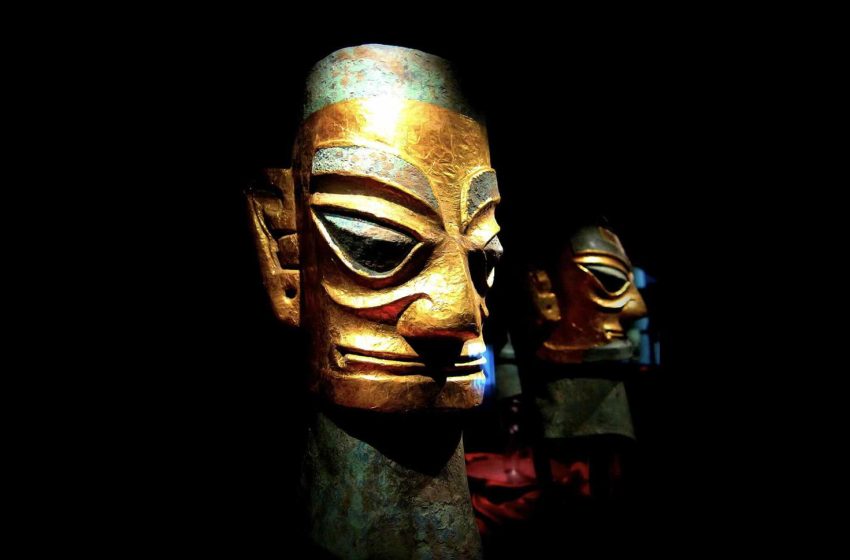
The new discovery adds to the vast existing collection of archaeological discoveries from the region, which include striking Bronze artifacts depicting human faces (pictured above), many of which are covered in gold masks, as well as bronze altars and other artifacts with ritual significance.
Discovery at Sanxingdui
Sanxingdui, which archaeologists believe was active from 2800 to 600 BCE, is renowned for the early evidence of industrial practices they have uncovered there, as well as its ancient sacrificial pits and other ceremonial features.
A range of items crafted from bronze have been recovered as well, and in the case of the meteoritic iron blade, analysis has shown that the object was crafted in a period that predates the use of iron smelting in this part of the world.
A key indication of the extraterrestrial origin of the metal used to craft the artifact is its high concentrations of nickel and iron, which appear to rule out the use of early smelting techniques.
While this strongly supports that the object was crafted from meteoritic iron, Dr. Zishu Yang, the co-author of a recent study detailing the discovery, recently said in a statement that current analysis is “insufficient to definitively classify the specific type of meteorite,” and that the exact variety of meteorite the material was sourced from remains unknown.
Going forward, additional analysis that Yang and his colleagues plan to undertake may help reveal further clues, including possible correlations between the unique artifact, its discovery location, and ancient Chinese historical records that may document meteorite impacts from which the iron could have been sourced.
Meteoritic Iron Mysteries
Meteoritic iron was widely used in the ancient world, though only 13 known examples from China have been found, most of which were discovered further north.
One unique aspect of the recent discovery at Sanxingdui, apart from its age, is that its chemical composition differs from that of the artifacts discovered further to the north, suggesting that different forms of ancient Chinese metallurgy were in use simultaneously during the period.
In addition to differences in the processes that crafted these artifacts, some of them may also have had different intended uses.
“In the broader context of ancient China, we believe cultural and practical considerations likely coexisted,” Yang said, noting that since metals like iron were so rare earlier in history, it was more likely to have been seen as having an important ritual or ceremonial significance. Such might have been the case with the axe-like artifact from Sanxingdui.
However, over time, as greater accessibility to these metals became common, their uses eventually became more practical.
“Due to the extreme rarity of meteoritic iron artifacts, it remains difficult to determine which factor predominated nationwide,” Yang said, though adding that “for the specific specimen examined here, we argue that its ritual significance likely outweighed its utilitarian value.”
Yang and his colleagues say this conclusion is supported by the fact that the Sanxingdui artifact was unearthed from a recognized sacrificial pit, where they say “the vast majority of associated finds are generally interpreted as objects used in ceremonial contexts.”
From ‘Space Metal’ to Ritual Artifact
Along with gaining a better understanding of the metallurgical processes behind its creation and its likely use, Yang and the research team hope to provide a better context for the rare meteoritic iron blade by collecting additional data from future excavations in the area.
“In addition to refining the metallurgical identification of the meteorite, our future work will focus on recontextualizing the artifact within its archaeological context,” Yang said.
“As excavation and research at Sanxingdui Pit No. 7 continue to advance, we expect to obtain a more comprehensive understanding of this meteoritic iron object and its significance within the broader site context,” Yang concluded.
The team’s recent paper, “The earliest meteoritic iron artefact of the Chinese Bronze Age discovered at Sanxingdui, Southwest China,” appeared in Archaeological Research in Asia.
Micah Hanks is the Editor-in-Chief and Co-Founder of The Debrief. A longtime reporter on science, defense, and technology with a focus on space and astronomy, he can be reached at [email protected]. Follow him on X @MicahHanks, and at micahhanks.com.
First Appeared on
Source link






