


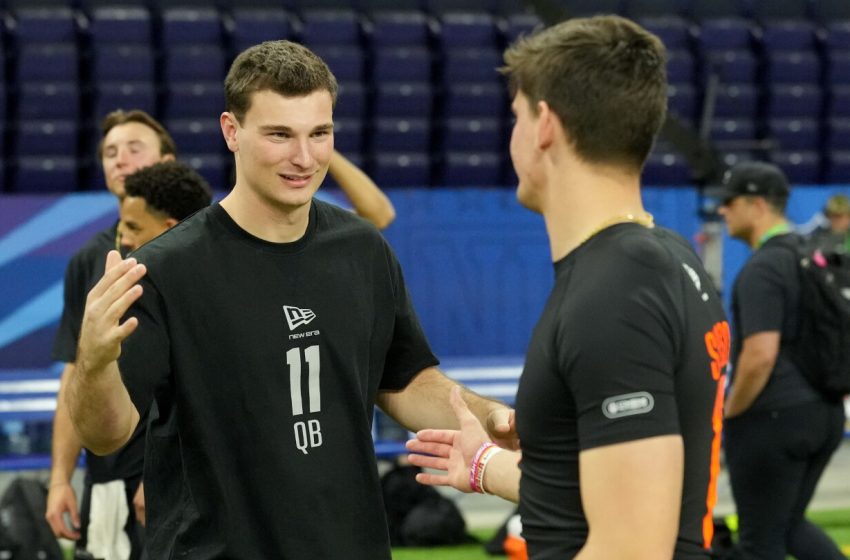
The sudden Fernando Mendoza-Ty Simpson debate helped fuel the take machine
The NFL news cycle has slipped into the lull between free agency and the draft. Which creates an opening — and a need — for someone to fuel the never-ending take machine.
Enter ESPN’s Dan Orlovsky. On Monday, he debuted his opinion that former Alabama quarterback Ty Simpson is the best quarterback in the 2026 draft class. Better than former Indiana quarterback Fernando Mendoza, the presumptive No. 1 overall pick.
And it went from there. As it often does. The take machine abhors a vacuum. The ESPN studio shows, radio shows, and podcasts have many, many hours to fill. And nothing delivers full segments of content than an opinion that cuts against the grain.
In August 2013, ESPN’s Ron Jaworski declared that Colin Kaepernick “could be one of the greatest quarterbacks ever.” It fed the ESPN take machine for days.
Is Orlovsky right on Simpson vs. Mendoza? We don’t know, and we won’t know, until both players have spent multiple years in the NFL. Even then, plenty of factors beyond the quarterback’s skills and abilities will determine it. Teammates, coaching, front office, ownership. The second (or third, or fourth) acts of players like Geno Smith, Sam Darnold, and Baker Mayfield have proven that point in recent years.
For now, however, the take machine is crying, “Feed me.” Even if Orlovsky’s opinion wasn’t fueled by the realization that calling Simpson a better prospect than Mendoza would be very good for business, it was. It is. For ESPN, and beyond.
It’s the perfect time for an organic debate like this to fill the many airwaves. And things got a little spicy on Tuesday, when ESPN’s Pat McAfee and company pressed Orlovsky aggressively on his Simpson take.
Along the way, it was mentioned that Orlovsky is represented by CAA, which also represents Simpson. Orlovsky got defensive: “The agents work for us, not the other way around, just so everybody knows. They’re employed by us. Respectfully, that’s how the business model is.”
Right, but that’s not how it really works. The biggest firms have the most influence, with everyone. If Orlovsky weren’t represented by CAA, he’d have to worry about CAA pushing another CAA client for his gig the next time his contract is up.
And that’s exactly what happens prior to the draft. Among the players who play the same position, the agents play both offense and defense when it comes to ensuring that their clients go as early as possible. They all do. They have to.
Given that Orlovsky is represented by CAA, he’ll naturally be more inclined to listen to the arguments they make for their guy. And something that was said to him possibly stuck, potentially influencing his opinion. Even without anyone making an overt ask.
It’s not a quid pro quo in the classic sense. The agents know how to work the media in the weeks preceding the draft, and they do. The firms that represent the players have clear and direct pipelines to the broadcasters they also represent.
Case in point: Lamar Jackson had no one fighting for him in 2018. No one to push back against Bill Polian’s ridiculous take that Jackson should change positions. No one to plant the seed in the brains of analysts that Jackson is as good, if not better, than the likes of Mayfield (No. 1), Darnold (No. 3), Josh Allen (No. 7), and Josh Freaking Rosen (No. 10). Jackson, amazingly, went 32nd, after the Ravens traded back into the last pick of round one to get the five-year contract that goes with first-round picks.
In the end, this one isn’t about anything other than Orlovsky’s take taking over a slow stretch for NFL news and opinion.
Whether he’s eventually right or wrong doesn’t matter. All that matters is he threw a shovelful of coal into the furnace at a time when the flame was flickering.
And, yes, in time the question of whether he was or wasn’t right will operate as another shovelful of coal, at another lull in the non-stop NFL take machine.
First Appeared on
Source link






