


How Natural Tradeoff And Failure Components?
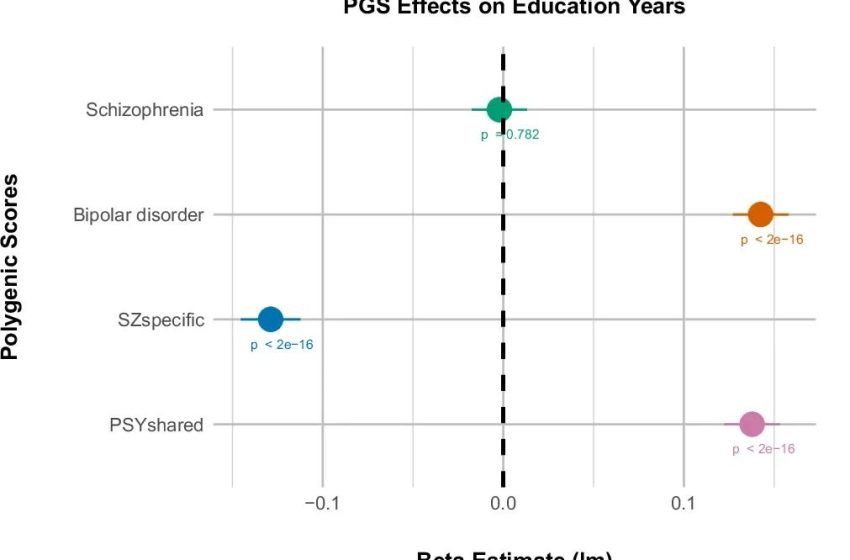
Michael Halassa: Did John Nash Really Have Schizophrenia? is a good article on the genetics of psychosis. Previous research found that schizophrenia genes decreased IQ but increased educational attainment. Usually IQ and education are correlated, so this was surprising. The new research finds two components to schizophrenia genetic risk. The first component, shared with bipolar, increases educational attainment. The second component, not shared with bipolar, decreases IQ. They average out to the observed full-spectrum genetic signal of constant-to-increased educational attainment paired with constant-to-decreased IQ.
In 2021, I discussed tradeoff vs. failure models of psychiatric conditions, and said that most conditions were probably a mix of both. The new research seems to confirm this: the first genetic component of schizophrenia is a tradeoff: bad insofar as it gives you higher schizophrenia risk, good insofar as it gives you higher educational attainment. Most likely this has something to do with creativity or motivation. The second component is a failure: bad in every way, with no compensating advantage. Most likely this is detrimental mutations in genes for neurogenesis and synaptic pruning.
I mostly wasn’t thinking about schizophrenia when I wrote about tradeoffs vs. failures, so I was surprised to see the theory so nicely reflected there. But in retrospect, this is common sense. All multifactorial problems should naturally be combinations of tradeoffs and failures.
Consider something human-level and common-sensical like poverty. People may be poor because of “failures” – negative qualities with no counterbalancing advantages. For example, they may be unintelligent, or chronically ill, or stuck in poor areas with bad education systems. These are cases where something goes wrong – their body, their health care system, their schools.
Other people are poor because of tradeoffs. The starving artist who spends all their time pursuing a creative vision instead of working a 9-5 job. The bohemian who prefers a relaxing lifestyle to the corporate grind. These people start with average capacity for success, but choose to spend their optionality in ways that give them less money and more of other things.
We can trivially extend this to most other negative situations. Single people might be ugly and awkward, or they might have chosen to trade off the good of a relationship for the goods of freedom and casual sex. A bad pizza might be bad because the chef was incompetent, or because it’s traded off taste for some other value like cheapness, convenience, or dietary restrictions (eg vegan, gluten-free). All of this makes sense when we’re talking about normal situations we understand well like romance or pizza. The key insight is that these are such complex multidimensional spaces that there will be lots of reasons they can go well or poorly, and some of those will probably fall into each of the two megacategories of “by choice” and “not by choice”.
Physical illnesses work this way too. Cancer is a failure of normal oncostatic processes, and plenty of risk factors reflect this: radiation, pollution, single-gene mutations. But cancer risk can also be elevated by tradeoffs: for example, with many asterisks and caveats, the higher a person’s risk of cancer, the lower their risk of certain degenerative diseases like Alzheimers, probably because cells can be set to either easy division (maximizing healing and growth) or limited division (minimizing cancer risk).
If you really stretch the model, even something like an amputated leg has both types of risk factor. You might lose your leg through pure bad luck (being clumsy and falling off a cliff), or because you’re prioritizing something other than leg integrity (being a brave soldier who rushes into battle and wins honor but is more likely to step on a mine).
This isn’t to say this pattern is universal. If you take it too seriously, you can confuse yourself by thinking a condition must have advantages, when actually it’s the risk of the condition that has the advantages (to a first approximation, cancer is always bad, you just don’t want to always keep your body in the most cancer-minimizing state possible). But also, things which are too simple to be multifactorial don’t need to have both tradeoff and failure etiologies. As far as I know, muscular dystrophy is simply bad. The reason it keeps happening is that the gene for muscle protein is really big – so if you get a random deleterious mutation, it’s pretty likely to be there!
My previous post presented the combination of tradeoff and failure etiologies as a mysterious (or at least complicated) fact about psychiatric conditions. Now I feel more comfortable that I’ve “dissolved” it – reduced it to something so obvious that I feel silly for ever having made a big deal of it in the first place.
First Appeared on
Source link






