


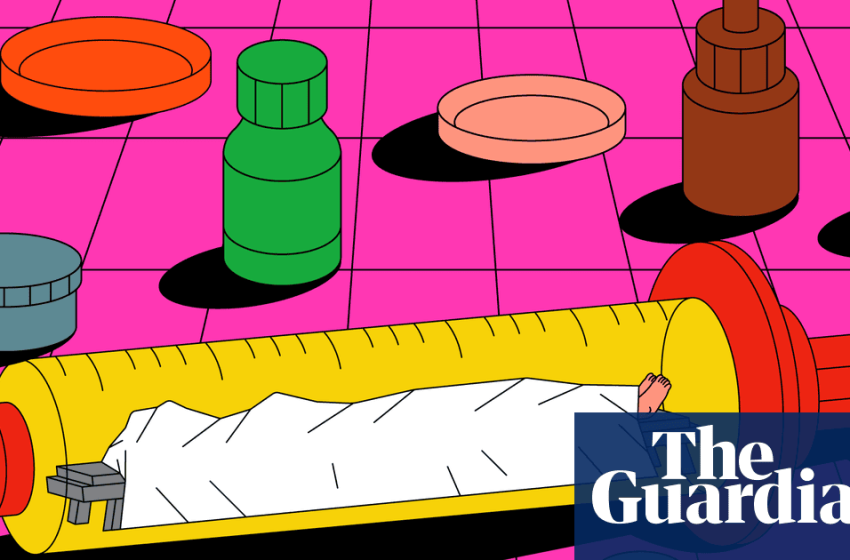
Would you use cadaver fat for a boob job or butt lift? Some people already do | Well actually
Hi Ugly,
I recently became aware of new cosmetic injectables derived from cadaver fat – as in, made of dead people. Apparently the fat is harvested from organ and tissue donors and used for procedures like Brazilian butt lifts and boob jobs.
What is this? How is it legal? Even if it is legal, how is it ethical?
– The Beauty Industry Is Killing Me
A half-dozen dead, devastatingly gorgeous bodies float, naked, in 10ft-tall test tubes. They’re preserved. Perfect. Ready.
“Calling them donors is crass,” a plastic surgeon says. “I call them epidermis angels: beautiful people who left the earth far too soon, and who were so generous as to pass along their good fortune to others.”
Soon, the surgeon will harvest their parts – smooth skin, symmetrical faces, asses with just the right amount of fat – and transplant them on to the living. Beauty, he says, should never be “wasted on the dead”.
When this scene from FX’s sci-fi series The Beauty aired in January, it already felt dated. Real-world cosmetic doctors had been injecting patients with AlloClae, a filler made from donated human cadaver fat, for over a year.
This is probably the macabre material you’ve been hearing about. Recent headlines include “I Got My BBL From A Cadaver” and “Back(side) from the dead!”. But while AlloClae has ignited a fresh cycle of disgust and debate over what I’ll call necrocosmetics, the category isn’t new.
The aesthetics industry has long harvested “cadaveric materials from organ and tissue donors to reconstruct people”, says Dr Melissa Doft, a plastic surgeon based in New York. “We use skin grafts to help repair burns and for breast reconstructions. We use rib grafts to reconstruct noses.”
A little over a decade ago, the tissue bank MTF Biologics developed a method to repurpose donated human adipose tissue – AKA fat – which had previously been discarded after skin tissue collection. The injectable “allograft adipose matrix” treatment known as Renuva was born (or raised from the dead). The product can be used to plump cheeks, nasolabial folds, temples and cellulite dimples, and has the unique ability to merge with the recipient. “The body recognizes Renuva once you inject it,” explains Evi Chnari, the vice-president of R&D at MTF Biologics. “The patient’s own cells then convert it into their own fat.”
Death, quite literally, becomes you.
More from Jessica DeFino:
AlloClae, a Tiger Aesthetics product, functions similarly. Donor fat is purchased, processed and purified of genetic material. Since AlloClae includes lipid molecules and has a thicker consistency, it’s more suitable for use on the body: Brazilian butt lifts (BBLs), breast enhancements, hip dips.
It’s possible to perform these procedures sans dead people, I should note. Hyaluronic acid fillers like Juvéderm and Restylane can add volume to the face. Autologous fat transfer, in which fat is removed from one area of the patient’s body via liposuction and reinjected into other areas, is another popular option.
But beauty enthusiasts are increasingly opting to use human remains instead, mostly due to “filler fatigue” – traditional filler can cause problems such as puffiness and lymphatic issues – and the widespread use of GLP-1s. “People who are on Ozempic or are dieting heavily are really thin, and don’t have enough fat to transfer,” Doft says. “They want their legs and their belly to be skinny, but want their breasts to be fuller.”
Where’s a patient to turn? A corpse, of course.
“I thought everyone was going to get creeped out by it,” says Dr Haideh Hirmand, a plastic surgeon based in New York, but “less people than you’d think even care”. The creep-factor is apparently mitigated by convenience: Renuva and AlloClae don’t require downtime or anesthesia like fat transfers do, making the 30-minute lunch break boob job possible. (Thanks, donors!)
And yup, this is legal.
In the US, the Uniform Anatomical Gift Act (UAGA) authorizes tissue banks to collect voluntary donations from the dead for use in transplants, research, education and more. (Lobbyists for “the multibillion-dollar body parts industry” helped rewrite the UAGA in 2006 to make it “easier for body parts to be harvested quickly”, according to the LA Times.) MTF Biologics and Tiger Aesthetics’ products are FDA-cleared for use in the US.
Is it ethical, though? That’s a little harder to parse.
Earlier this month, I surveyed more than 200 readers about necrocosmetics. Many registered donors expressed concern that their bodies would be used for elective cosmetic surgery rather than life-saving surgery, but this isn’t an either/or situation. A single donor can “save eight lives and enhance 75 others through organ, eye and tissue donation”, according to organ donation non-profit Donate Life. So your abdominal fat might end up in someone’s cheeks – face or butt – but “you’re not just a BBL”, as Doft puts it. “Every part that can be used is being used.”
Consent is another question.
The decision to become an organ and tissue donor can be made by the donor (pre-death) or their family (post-death). A 2012 NPR investigation noted that tissue bank solicitors mentioned the possibility of being used for cosmetic surgery to potential donors only 29% of the time. “In convincing people to become donors, companies rarely mention that a growing part of the [procurement business] is cosmetic surgery,” the LA Times reported in 2019.
Forms vary from state to state, but in some cases it’s possible to designate your tissue donation for “lifesaving and reconstructive purposes”, although due to limitations in industry tracking, it’s not clear if these wishes are always honored. You may also be able to specify your remains go “to non-profit organizations” only, but that doesn’t guarantee non-cosmetic use either. (MTF Biologics is a non-profit.)
Chnari tells me MTF Biologics’ donors do consent to cosmetic use. “That’s the right way of doing it,” she says. A Tiger Aesthetics representative has said the company ensures all its tissue is “consented to for aesthetic use” as well.
Some survey respondents were distressed by the idea of cosmetic companies buying and selling dead people for profit, consensual or not.
“That just falls down to a critique of capitalism,” says Ryan Pferdehirt, the vice-president of ethics services at the Center for Practical Bioethics. The beauty industry has always been built on the commodification of dead bodies, both animal (millions of research animals have died as a result of cosmetic testing; collagen supplements are essentially pulverized cow cartilage) and human (child laborers die harvesting mica for makeup every month; plastic surgeons practice facelifts on cadavers).
In making this trade-off obvious, Renuva and AlloClae feel freshly disturbing.
Personal feelings about this practice may vary depending on cultural beliefs, but the field of bioethics is primarily interested in “minimizing harm to patients”, explains Pferdehirt. Cadavers technically aren’t harmed by becoming injectables, he says, since “there’s no person there any more”, and recipients generally benefit from the infusion of beauty capital. Doft claims her AlloClae patients “feel better in their bodies.”
Then again, one could argue that the proliferation of hyper-perfect zombie bodies perpetuates unrealistic and inaccessible beauty standards – which contribute to appearance-related anxiety, depression, dysmorphia, disordered eating and even suicide in the wider population – and therefore constitutes a sort of collective harm.
“To me, organ donation is such a clear public good,” as one survey respondent said. “This is the opposite.”
Pferdehirt’s biggest concern is the possibility that those who would rather not end up in a rich lady’s ass might remove themselves from the donor registry.
“I will be changing my donor status because of this,” one survey participant shared with me. “I would consider not becoming an organ donor if that’s in the fine print,” said another.
“If people start restricting their participation because of fear about this, the harm may outweigh the good,” Pferdehirt says. “We need skin grafts. We need bone marrow transplants. We need organ donation. That is far more important, I think, than the cosmetic aspects.”
Luckily, plenty of donors don’t care what happens to their remains at all. “I’d be dead,” was a common survey response. “I wouldn’t know.”
“I think a lot of people also like the idea of having a legacy,” Doft adds. I ask if she would be happy as a BBL in the afterlife. The plastic surgeon laughs. “It wouldn’t be my choice operation.”
First Appeared on
Source link






