


AMD doubles up on V-Cache with 9950X3D2 Dual Edition • The Register
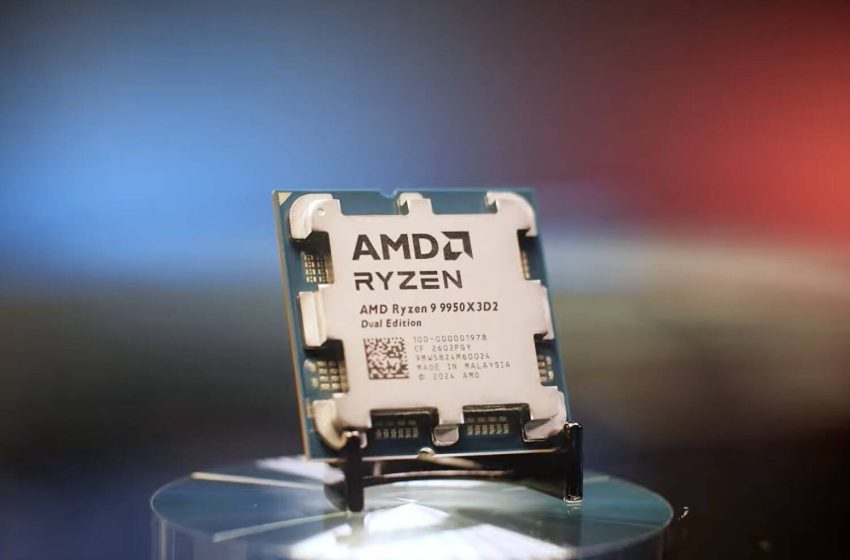
AMD aims to extend its lead in desktop gaming with a new CPU, dubbed the Ryzen 9 9950X3D2 Dual Edition. This top-of-the-line part has 16 cores fed by an absolutely massive 208 MB pool of cache, with memory spread across both CCDs.
The hotly anticipated processor chip is essentially a modified version of the 9950X3D announced in 2025, only both of the chip’s two compute dies are now equipped with a 64 MB SRAM tile, boosting the L3 cache from 128 MB to 192 MB.
Larger caches benefit data heavy workloads, in particular PC games, by keeping more of the working memory closer to the cores. Since the launch of the Ryzen 7 5800X3D in 2022, AMD has used advanced packing to expand its chips’ L3 cache without needing to design a larger die. This technology helped AMD to overtake long-time rival Intel in gaming CPU performance.
| 9950X3D2 | 16/32 | 4.3 GHz | 5.6 GHz | 16 MB | 192 | 200 W | ? |
| 9950X3D | 16/32 | 4.3 GHz | 5.7 GHz | 16 MB | 128 | 170 W | $699 USD |
| 9950X | 16/32 | 4.3 GHz | 5.7 GHz | 16 MB | 64 | 170 W | $649 USD |
While 3D V-Cache’s most obvious benefits accrue to gamers, the additional cache also benefits a lot of high-powered production workloads, like 3D rendering, code compilation, AI, and data science because frequently accessed data can stay resident on the CPU for longer. (This is one of the reasons why caches of server CPUs have increased so dramatically over the past few years.)
According to AMD, customers can expect to see a between 5 and 13 percent boost in production workloads compared to the single V-Cache die equipped 9900X3D.
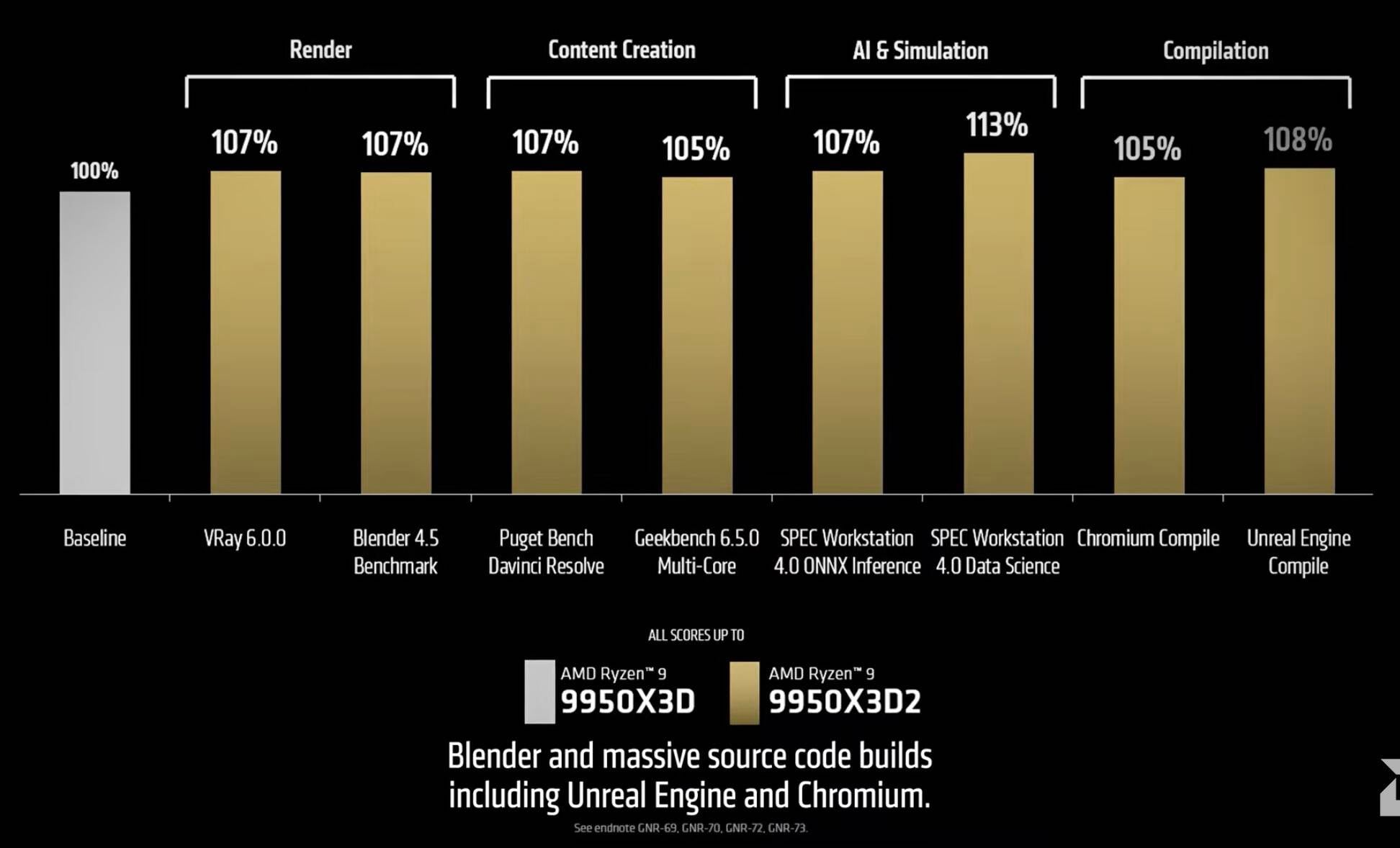
According to AMD customers can expect a roughly 5-13 percent increase in performance from the 9950X3D2 versus the 9950X3D with a single V-Cache die. – Click to enlarge
According to Jack Huynh, SVP of AMD’s computing and graphics group, with the 9950X3D2, customers “no longer have to choose between a gaming or creator CPU.”
However, this technology involves some compromises. Until now, only one of the two core complex dies (CCDs) on AMD’s 12-and-16 core parts were ever equipped with an SRAM tile. Because of this, AMD implemented a core-parking feature where half of the chip’s cores were essentially disabled during certain workloads to prevent them from being scheduled on the V-Cacheless dies.


Even with V-cache on both CCDs, we’re told this core parking functionality is still necessary on the Ryzen 9 9950X3D2 in order to limit cross die communications which would otherwise hurt performance in applications like games.
Historically, one limitation to V-Cache-equipped CCDs is that they usually don’t clock as high. This is for a variety of reasons, including thermal. AMD largely addressed this issue by moving the SRAM tile from the top of the chip to the bottom side in its 9000-series products, but the dies do still tend to clock lower.
In the case of the 9950X3D2, the base clock is 4.3 GHz while the max boost clock tops out at 5.6 GHz, a full 100 MHz lower than the 9950X3D with its single SRAM tile. Having said that, AMD often underestimates the actual cores clocks of its chips, so it wouldn’t be surprising to see it hit 5.65 GHz or even 5.7 GHz depending on what you end up getting in the silicon lottery.
The 9950X3D2 is slated to hit store shelves on April 22. Pricing for the new part hasn’t been released just yet, though with the 9950X3D currently retailing for north of $649, we don’t expect it to be cheap.
This may make it tough to sell to gamers at a time when the memory, storage, and GPU prices are at an all-time high. AMD’s decision to launch a new flagship in the current climate comes in stark contrast to Intel’s newly-launched Core Ultra 200S Plus series processors, which we reviewed earlier this week, which promise 18 to 24 cores at a price ranging from $200-$300.
While AMD’s X3D chips still hold the advantage in gaming, Intel’s latest parts may see wider adoption because they’re cheap and also perform exceptionally well in production workloads. ®
First Appeared on
Source link






