


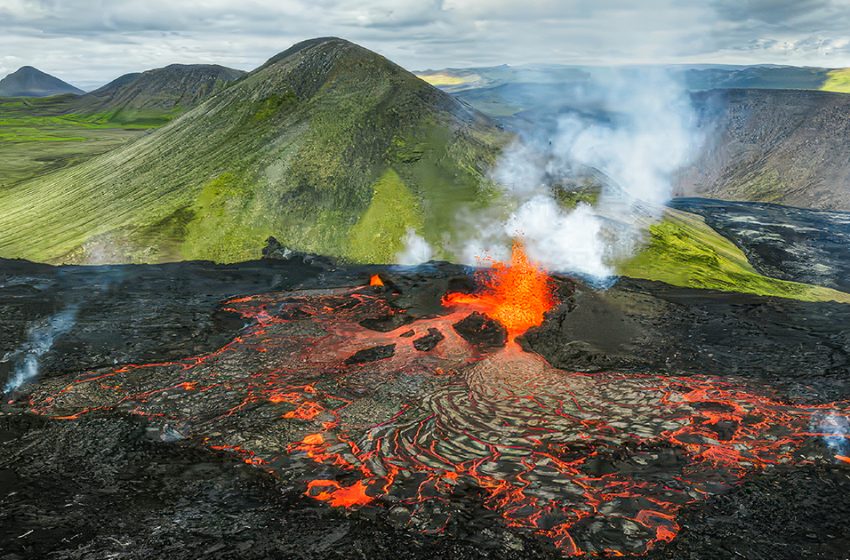
When Coupled Volcanoes Talk, These Researchers Listen
At the heart of this magmatic circulatory system was a series of horizontal reservoirs called the Pāhala sill complex. From those reservoirs branched two arteries, one leading to Kīlauea, the other reaching toward Mauna Loa. “I remember very clearly how we all reacted when we first saw that in my office,” Ross said. “It was pretty shocking.”
The idea that the two shared a deeper magma source but erupted two chemically distinct types of lava made people “really uncomfortable,” Roman said. But the seismic evidence was impossible to ignore; they seem to be coupled.
Their connection seems different — more mercurial, changeable, compared to those of other coupled volcanoes. Sometimes, as with Iceland’s volcanoes, the ones in Hawai‘i take turns erupting. This could be because one taps magma from their shared source so aggressively that the other volcano doesn’t have much left to extract. But on other occasions, both erupt at the same time. This could be because the magmatic heart that connects them fills up with so much magma that both volcanoes “get juiced,” Roman said.
Joining the Conversation
Santorini is a C-shaped Greek island with a violent volcanic past. The most catastrophic outburst of its volcano, in roughly 1600 BCE, contributed to the end of the seafaring Minoan civilization. Today, two small new volcanoes are growing out of its bay, and another one called Kolumbo — capable of producing fearsome tsunamis and clouds of suffocating gases — lurks underwater just offshore.
Unsurprisingly, the region is comprehensively monitored by scientists. In 2024, a new German-Greek venture called Multi-Marex began to install layers of sensors on not just the land but also the seafloor around Santorini. The effort paid off almost immediately, said Jonas Preine, a volcanologist at the Woods Hole Oceanographic Institution; by chance, at the end of January 2025, the region began to shudder.
Large earthquakes rocked Santorini, and many of its residents fled, fearing an eruption. “The residents were so worried,” Preine said. But after several weeks, the quakes dropped off. At the same time, both Santorini and Kolumbo shrank.
What happened? The tectonic architecture of the Aegean Sea is messy, rife with crisscrossing faults and myriad volcanoes that make unraveling what happens at depth extremely difficult. But scientists analyzing Multi-Marex data with the assistance of machine learning quickly produced an explanation: A stream of magma had risen from a great depth to just 3 kilometers or so below the surface. The magma didn’t have enough momentum to punch through to the surface, but it did seem to borrow some of its molten rock from elsewhere.
Another magma reservoir in the crust, one thought to feed Kolumbo, contracted as its reserves drained away. It certainly seemed like another case of volcanic coupling — and the team hopes their improved understanding leads to more accurate forecasting of Santorini and Kolumbo’s future volcanic activity.
In Greece and Hawai‘i, and in other locations like Central Africa and Japan, researchers are looking for the next sets of coupled volcanoes, which they know might exhibit a variety of connected behaviors, including taking turns or erupting simultaneously. They now know that coupled volcanoes won’t necessarily produce the same type of lava or the same type of eruption. And they know not to underestimate how far magma might travel on its journey to the surface, and how deep the connection between coupled volcanoes might be.
First Appeared on
Source link






