


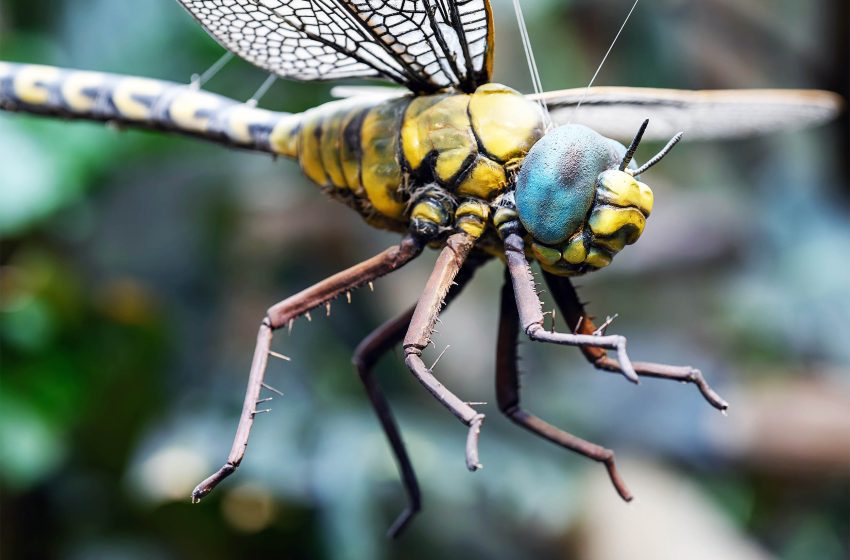
Earth’s first insects were massive with wingspans over two feet long
Picture Earth 300 million years ago. The continents were fused into Pangaea. Thick coal-swamp forests sprawled across the tropics. With high oxygen levels in the air, wildfires flared often.
On land, amphibians and early reptiles shared space with crawling arthropods and outsized cockroaches. Above it all, insects owned the skies – including some that sound almost cartoonish by modern standards.
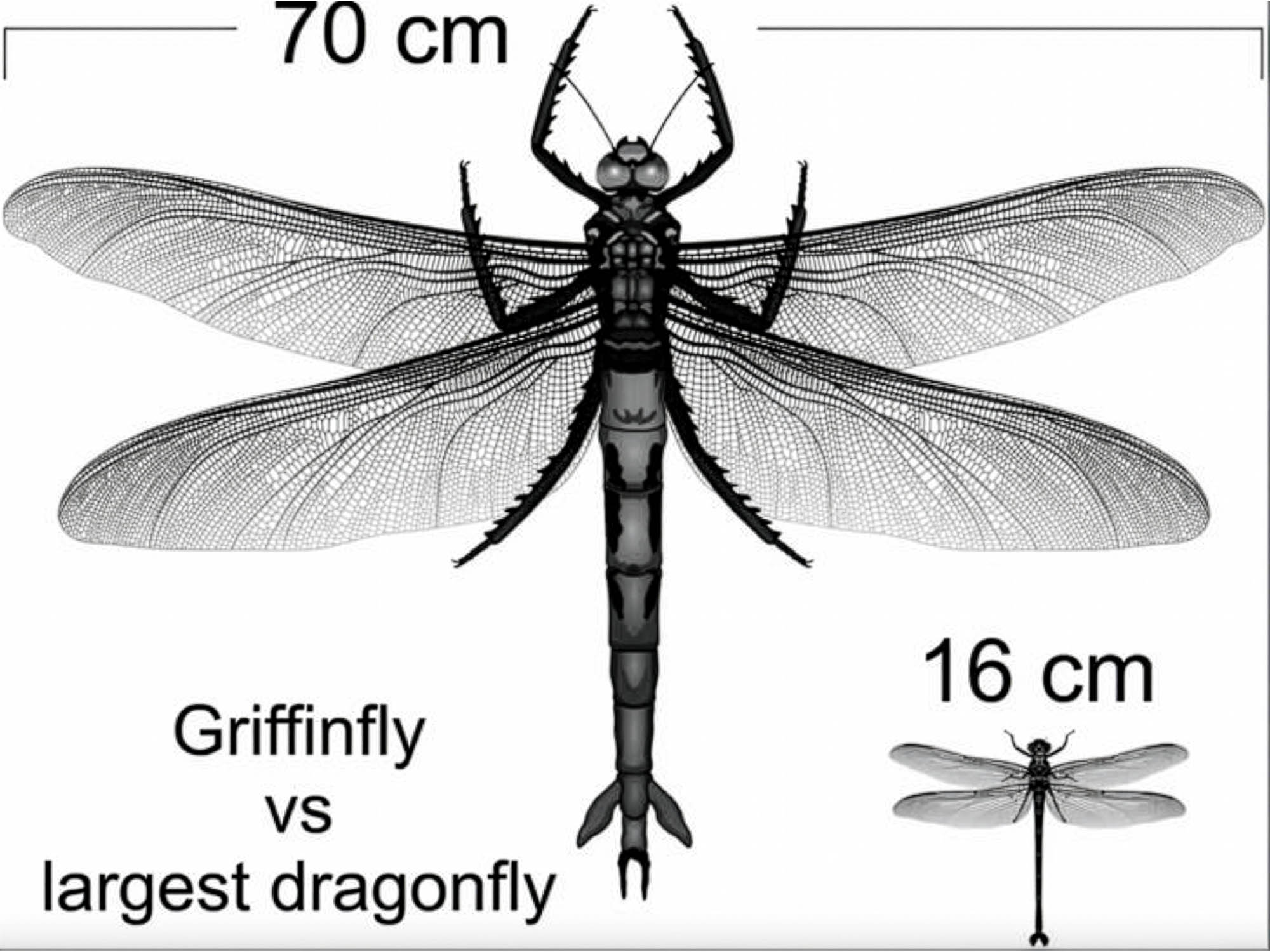
Back then, there were mayfly-like insects with wingspans around 17 inches (45 cm) and predators with wingspans nearing 27 inches (70 cm).
These dragonfly relatives are often called “griffinflies,” and their fossils were first recognized in delicate impressions in fine-grained rocks in Kansas nearly a century ago.
For decades, a tidy explanation dominated: giant insects were possible because atmospheric oxygen levels were far higher than today.
A new paper led by Edward Snelling at the University of Pretoria and co-authored by researchers at Arizona State University argues that this classic story doesn’t hold up – at least not in the way people have assumed.
High oxygen = giant insects?
The “high oxygen = giant insects” idea took off in the late 20th century. In the 1980s, geochemists developed tools to reconstruct ancient atmospheric composition, and those reconstructions suggested a striking oxygen peak around 300 million years ago.
Then a famous 1995 Nature paper pointed out something that seemed too perfect to be a coincidence: the oxygen peak lined up with the era of giant insects.
The logic felt solid because insects breathe in a very different way from mammals and birds. They don’t have lungs. They rely on a tracheal system – a branching network of tubes that delivers oxygen directly to tissues.
At the finest scale are tiny tubes called tracheoles, where oxygen moves into cells largely by diffusion down concentration gradients. Flight muscles, which demand huge amounts of oxygen, seemed like the obvious bottleneck.
So scientists reasoned that a gigantic flying insect would be oxygen-limited in today’s atmosphere. With modern oxygen levels, diffusion through tracheoles shouldn’t be able to keep up with the demands of massive flight muscles.
Higher oxygen in the past could have made the difference – letting the largest insects “get enough air” to power flight.
It was a compelling explanation because it matched both biology and timing. It also had a satisfying simplicity: oxygen goes up, insects get big; oxygen drops, insects get smaller.
Looking inside the flight muscles
Snelling and colleagues took that long-standing idea and asked a practical question. If oxygen truly limits maximum insect size, giant insects should show strong anatomical “compensation” in their oxygen delivery system, especially in the tracheoles inside flight muscles.
In other words, if oxygen transport is the hard ceiling, evolution should have pushed large insects to invest heavily in tracheoles. That would mean packing more of them into flight muscle so enough oxygen can reach energy-hungry cells.
To test this, the team used high-powered electron microscopy to measure how much of the flight muscle is actually taken up by tracheoles across insects of different sizes.
They also extended the analysis to fossil giants, including griffinflies that reached two feet or more in size, by comparing expected scaling patterns.
Data challenges old assumptions
What they found was surprisingly consistent: tracheoles take up about one person or less of flight muscle space in most species, and that pattern still holds when extended to ancient giants.
That’s the key point. If tracheoles occupy such a tiny fraction of flight muscle, insects have plenty of physical “room” to add more if oxygen delivery were truly the limiting factor.
“If atmospheric oxygen really sets a limit on the maximum body size of insects, then there ought to be evidence of compensation at the level of the tracheoles,” Snelling said. “There is some compensation occurring in larger insects, but it is trivial in the grand scheme of things.”
The comparison the team draws is telling. In birds and mammals, capillaries in heart muscle take up much more relative space than insect tracheoles do in flight muscle. This suggests that animals can, and do, invest heavily in oxygen-delivery structures when needed.
In birds and mammals, capillaries take up far more space in heart muscle than tracheoles do in insect flight muscle – about ten times as much. That suggests insects could greatly expand their tracheoles if oxygen were really limiting their size.
Current thoughts on oxygen and insects
The study doesn’t claim oxygen is irrelevant to insect physiology. Oxygen obviously matters. But it challenges a very specific version of the story: that diffusion limits in flight muscle tracheoles set a hard maximum size for flying insects under modern oxygen levels.
The authors argue that their data make that particular constraint unlikely. If tracheoles are occupying only about one percent of muscle, there is a lot of capacity for insects to increase tracheole density if needed.
In that sense, flight muscle doesn’t look like it’s living at the edge of an oxygen cliff. That said, the paper also acknowledges that some scientists still think oxygen could impose limits elsewhere – upstream in the tracheal system, or in other parts of the body.
So the broader “oxygen mattered” hypothesis may not be dead in every form. But the new results do put a major crack in its most popular, most intuitive version.
Rethinking giant insects
If oxygen isn’t the main limit, a more interesting question emerges: why don’t griffinfly-sized insects exist today? The authors point to other possibilities. One is ecology. Vertebrate predators changed dramatically over time.
Birds eventually appeared, bats much later, and aerial ecosystems became far more crowded with animals that could hunt large flying insects efficiently.
Another is biomechanics. Insects wear their skeleton on the outside. Exoskeleton strength, weight, and structural support might become limiting at large sizes, especially for flight.
In other words, giant insects may not have vanished because the air changed. They may have vanished because the world around them changed. That includes shifts in predators, competition in the skies, and the physical limits of building a flying body from an exoskeleton.
Whatever the final answer turns out to be, the new study shifts the hunt. Scientists can’t simply point to oxygen and stop there anymore.
These enormous insects existed, they flew, and their flight muscles don’t look like they were boxed in by tracheole diffusion. So the real reason griffinflies once ruled the air and why they’re gone now is still waiting to be nailed down.
The full study is published in the journal Nature.
—–
Like what you read? Subscribe to our newsletter for engaging articles, exclusive content, and the latest updates.
Check us out on EarthSnap, a free app brought to you by Eric Ralls and Earth.com.
—–
First Appeared on
Source link






