


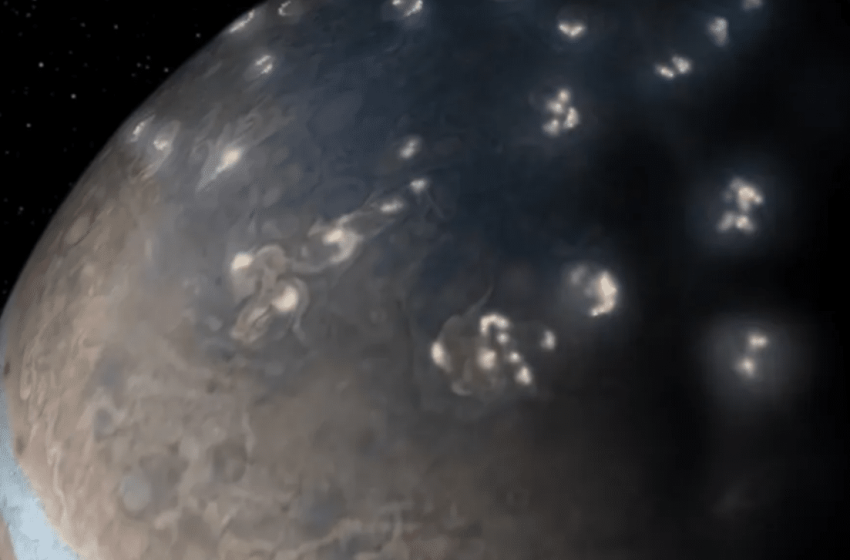
Jupiter’s Lightning Reveals a Force One Million Times Stronger Than Earth’s
Lightning on Jupiter might pack a punch far stronger than anything seen on Earth, up to one million times more powerful. This dramatic discovery, based on NASA’s Juno spacecraft data, sheds light on the extreme forces at play within Jupiter’s vast, stormy atmosphere. By analyzing radio waves emitted by lightning, scientists have unearthed new insights into the mechanics of these bolts, which could have far-reaching implications for understanding the planet’s weather and atmospheric composition.
Uncovering Jupiter’s Furious Lightning
Lightning on Jupiter has always been a source of fascination for astronomers and planetary scientists. But recent findings have elevated this interest to new extremes, suggesting that the lightning on Jupiter could be far more potent than Earth’s most powerful storms. Using data from NASA’s Juno spacecraft, researchers have revealed that the intensity of lightning on the gas giant might be up to one million times stronger than Earth’s bolts. This discovery challenges previous understandings of how lightning is generated and how powerful it can become on different planets.
The Juno spacecraft, which has been orbiting Jupiter since 2016, provided key data by capturing lightning’s radio emissions, a breakthrough that allowed scientists to measure the lightning’s power with unprecedented precision. Previous studies had focused on lightning detected during Juno’s flybys, but those findings were based primarily on flashes visible from the planet’s night side, which are often obscured by thick cloud cover. By focusing on the radio emissions produced by lightning, scientists were able to observe and measure flashes more accurately.
“It was so gratifying to work through the statistics and see that with our Juno data, we were really capturing the majority of lightning pulses at radio wavelengths,” said Michael Wong, the lead author of the study. “Before, there was some question about whether we might be catching only the strongest pulses and missing weaker ones.”
Image credit: NASA/JPL-Caltech/SwRI/MSSS Image processing by Kevin M. Gill © CC BY
The Power of the ‘Stealth Superstorms’
A key aspect of the study involves the discovery of “stealth superstorms” on Jupiter. These storms, unlike the planet’s massive superstorms, last for months and produce significant lightning but at a smaller scale. These storms were particularly valuable for the study because they were more isolated, making it easier for scientists to pinpoint their lightning sources.
Unlike Earth’s storms, which are relatively brief and limited in scope, Jupiter’s storms can span vast areas and endure for centuries. The largest storms on Jupiter can reach altitudes of over 62 miles (100 kilometers), towering far above the typical 6.2 miles (10 kilometers) of Earth’s thunderstorms. This monumental difference in storm height could explain why Jupiter’s lightning is so much more powerful.
The study, published in the journal AGU Advances, suggests that Jupiter’s lightning is not only more frequent but also much more intense because of the planet’s unique atmospheric conditions. The hydrogen-rich atmosphere of Jupiter could play a key role in amplifying the power of lightning. In contrast, Earth’s nitrogen-rich atmosphere behaves very differently, which may contribute to the lower energy levels of Earth’s lightning.
“Could the key difference be hydrogen versus nitrogen atmospheres, or could it be that the storms are taller on Jupiter and so there’s greater distances involved?” Wong speculated. “Or could it be that greater energy is available because with moist convection on Jupiter, you have a bigger buildup of heat needed before you can generate the storm to create lightning?”
First Appeared on
Source link






